 Back
BackChi-Square Analysis and Sex-Linked Inheritance in Genetics
Study Guide - Smart Notes
 Tailored notes based on your materials, expanded with key definitions, examples, and context.
Chi-Square Analysis in Genetics
Introduction to Chi-Square Analysis
The chi-square (χ²) test is a statistical method used in genetics to compare observed experimental results with expected outcomes based on genetic hypotheses. This test helps determine whether deviations from expected ratios are due to random chance or indicate a significant difference.
Purpose: Objectively assess the fit between observed and expected genetic outcomes.
Application: Commonly used to test Mendelian ratios in genetic crosses.
Chi-Square Formula and Calculation
The chi-square value is calculated using the following formula:
Where: O = observed value E = expected value
Each outcome class is considered separately, and the sum is taken over all classes.
Interpreting Chi-Square Results
Interpretation of the chi-square test is based on the probability (P) value:
Low χ² values correspond to high P values, indicating that deviations are likely due to chance.
High χ² values correspond to low P values, suggesting that deviations are unlikely to be due to chance alone.
Degrees of Freedom
The degrees of freedom (df) for a chi-square test is calculated as the number of outcome classes minus one:
df is used to determine the critical value from the chi-square table for a given P value.
Statistical Significance
A result is considered statistically significant if the P value is less than 0.05 (5%).
If P < 0.05, the hypothesis that chance alone explains the deviation is rejected.
If P > 0.05, the deviation is considered nonsignificant, and the hypothesis of chance is not rejected.
Example: Monohybrid Cross and Chi-Square Calculation
Consider Mendel’s monohybrid cross for round vs. wrinkled seeds:
Observed: 5474 round, 1850 wrinkled (total 7324 seeds)
Expected: (7324)(3/4) = 5493 round, (7324)(1/4) = 1831 wrinkled
Calculation:
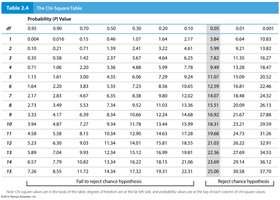
For df = 1, P value is between 0.50 and 0.70 (not significant)
Chi-Square Table
The chi-square table provides critical values for different degrees of freedom and P values, helping to determine statistical significance.
Sex-Linked Inheritance
Introduction to Sex-Linked Inheritance
Sex-linked inheritance refers to the transmission of genes located on sex chromosomes (X and Y). These patterns differ from autosomal inheritance and often result in distinct phenotypic ratios between males and females.
X and Y Chromosomes
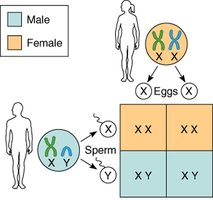
Humans: Females are XX (homogametic), males are XY (heterogametic).
Other systems: Birds (ZW female, ZZ male), XO system in beetles (XO male, XX female).
The Y chromosome determines maleness in humans, primarily due to the presence of the SRY gene.
X-Linked Inheritance
Genes located on the X chromosome exhibit unique inheritance patterns:
Males are hemizygous for X-linked genes (only one X chromosome).
Females have two X chromosomes and can be homozygous or heterozygous for X-linked traits.
Genotypes for X-Linked Traits
Females: X+X+, X+Xm, XmXm (heterozygotes are carriers for recessive traits)
Males: X+Y, XmY (have trait or do not have trait)
Y-Linked Inheritance
Very rare; only males are affected and traits are transmitted from father to son.
Most Y-linked mutations involve male infertility and are not transmitted.
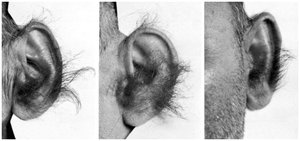
Example: Hairy ears has been proposed as a Y-linked trait.
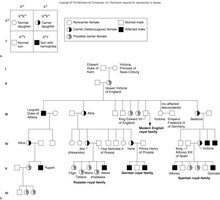
X-Linked Recessive Inheritance
Always expressed in males (hemizygous).
Female homozygotes show the trait; heterozygotes are carriers and usually do not show the trait.
Affected males inherit the allele from their mother.
Affected females inherit the allele from both an affected father and an affected or carrier mother.
X-Linked Dominant Inheritance
Expressed in females with one copy of the allele.
Males are often more severely affected; may be associated with lethality or miscarriage in males.
Example: Congenital generalized hypertrichosis.
Genetic Diseases Related to Cell Division and Sex-Linked Inheritance
Cell Division-Related Diseases
Cancer
Chromosome abnormalities (e.g., Down syndrome)
Susceptibility to diseases such as Alzheimer’s and leukemia
Hemophilia (blood-clotting disorder)
Marfan syndrome (unusually long limbs)
Examples of Sex-Linked Diseases
Hemophilia
Colorblindness
Duchenne muscular dystrophy (muscle degeneration)
Fragile X syndrome (learning, behavioral, and intellectual disabilities)
Male infertility
