 Back
BackChromosome Abnormalities: Structure and Number Variations
Study Guide - Smart Notes
 Tailored notes based on your materials, expanded with key definitions, examples, and context.
Chapter 6: Chromosome Abnormality
Overview of Chromosome Abnormalities
Chromosome abnormalities refer to changes in the structure or number of chromosomes, which can have significant medical and agricultural implications. These abnormalities can arise from genetic variations beyond simple gene mutations, affecting large segments or entire chromosomes.
Structural variations: Include deletions, duplications, inversions, and translocations of chromosome segments.
Numerical variations: Involve changes in the number of individual chromosomes (aneuploidy) or entire sets of chromosomes (polyploidy).
Such changes are important in human disease and plant breeding.
Karyotypes
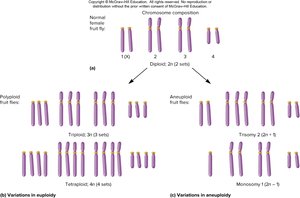
A karyotype is the complete set of chromosomes in a cell, organized by size, shape, and number. Karyotyping is used to detect chromosomal abnormalities and is a standard tool in genetics and medicine.
Chromosome Rearrangement
Chromosome rearrangements involve changes in the structure of chromosomes, such as deletions, duplications, inversions, and translocations. These rearrangements can disrupt gene function and regulation, sometimes leading to disease or developmental abnormalities.
Deletions: Loss of a chromosome segment, which can remove essential genes.
Duplications: Repetition of a chromosome segment, potentially increasing gene dosage.
Inversions: A chromosome segment is reversed end to end.
Translocations: A segment from one chromosome is transferred to another, which can activate oncogenes and cause cancer.
Deletions
Deletions can have severe phenotypic effects, especially if they remove genes critical for development. An example is cri du chat syndrome, where a deletion on chromosome 5 leads to intellectual disability and a distinctive cat-like cry in infants.
Symptoms include severe mental disabilities, abnormal cry, walking and language difficulties, and hyperactivity.
Duplications
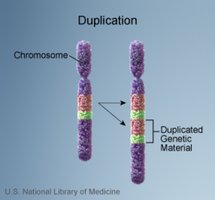
Duplications result in extra copies of a chromosome segment. This can alter gene dosage and lead to developmental abnormalities or evolutionary innovation.
Inversions
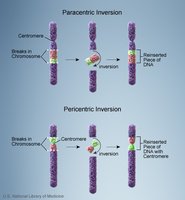
Inversions occur when a chromosome segment breaks off, flips, and reattaches in the reverse orientation. There are two main types:
Paracentric inversion: Does not include the centromere.
Pericentric inversion: Includes the centromere.
Translocations
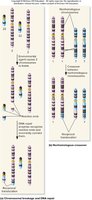
Translocations involve the movement of a chromosome segment to a non-homologous chromosome. This can disrupt gene function and lead to nonviable gametes or diseases such as cancer if regulatory genes are affected.
Translocations can be reciprocal (exchange between two chromosomes) or nonreciprocal (segment moves without exchange).
May result in genetic disorders or contribute to oncogenesis.
Non-disjunction and Aneuploidy
Non-disjunction is the failure of chromosomes to separate properly during meiosis or mitosis, leading to aneuploidy—an abnormal number of chromosomes. Common forms include trisomy (one extra chromosome) and monosomy (one missing chromosome).
Trisomy (2n + 1): Example: Down syndrome (trisomy 21).
Monosomy (2n - 1): Example: Turner syndrome (XO).
Examples of Aneuploid Syndromes
Syndrome | Frequency | Key Features |
|---|---|---|
Edwards syndrome (Trisomy 18) | 1/6000 births | Mental handicap, heart problems, short lifespan |
Patau syndrome (Trisomy 13) | 1/15,000 births | Cleft lip/palate, polydactyly, severe disabilities, high infant mortality |
Down syndrome (Trisomy 21) | 1/800 births | Mental challenges, characteristic facial features, short stature |
Why Aneuploidy Occurs
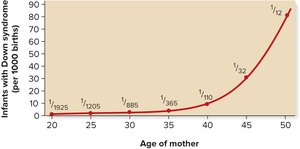
Aneuploidy is often caused by non-disjunction during meiosis, which is more likely as maternal age increases. The risk of Down syndrome, for example, rises sharply with maternal age.
Polyploidy
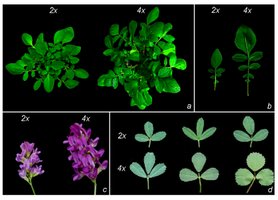
Polyploidy is the presence of more than two complete sets of chromosomes. It is common in plants but rare in animals. Polyploidy can result in larger, more robust plants and is used in agriculture to produce desirable traits.
Triploid (3n): Three sets of chromosomes.
Tetraploid (4n): Four sets of chromosomes.
Polyploidy can arise naturally or be induced using chemicals like colchicine, which disrupts spindle formation during cell division.
Inducing Polyploidy in Plants
Colchicine is a chemical used to induce polyploidy by arresting cells in metaphase, preventing chromosome separation and doubling the chromosome number. This technique is widely used in plant breeding to create new varieties with improved traits.
Genetic Problems: Case Study
Example: A color-blind man marries a normal woman. Their daughter (phenotypically normal) marries a normal man and has three children: a normal boy, a color-blind boy, and a color-blind girl with Turner syndrome. The color-blind girl with Turner syndrome likely results from non-disjunction during meiosis, leading to monosomy X (Turner syndrome) and inheritance of the X chromosome carrying the color-blind allele.
Turner syndrome (XO): Female with only one X chromosome; may exhibit color blindness if the single X carries the mutant allele.
Summary Table: Types of Chromosome Abnormalities
Type | Description | Example/Effect |
|---|---|---|
Deletion | Loss of chromosome segment | Cri du chat syndrome |
Duplication | Repeat of chromosome segment | Gene dosage effects |
Inversion | Reversal of segment orientation | May affect gene regulation |
Translocation | Segment moves to another chromosome | Cancer, nonviable gametes |
Aneuploidy | Abnormal chromosome number | Down, Edwards, Patau syndromes |
Polyploidy | Extra chromosome sets | Common in plants |
