 Back
BackCh6 Chromosome Mutations: Variation in Number and Arrangement
Study Guide - Smart Notes
 Tailored notes based on your materials, expanded with key definitions, examples, and context.
Chromosome Mutations: Variation in Number and Arrangement
Introduction to Chromosomal Mutations
Phenotypic variations in organisms often result from modifications at the chromosome level. Chromosomal aberrations include changes in chromosome number, deletions or duplications of genes or segments, and rearrangements of genetic material within or among chromosomes. These changes can lead to phenotypic variation and may be lethal.
Aneuploidy: Gain or loss of one or more chromosomes, but not a complete set.
Euploidy: Presence of complete haploid sets of chromosomes.
Polyploidy: More than two sets of chromosomes are present.
Terminology for Variation in Chromosome Numbers
The following table summarizes key terms related to chromosome number variation:
Term | Explanation |
|---|---|
Aneuploidy | 2n plus or minus x chromosomes |
Monosomy | 2n − 1 |
Disomy | 2n |
Trisomy | 2n + 1 |
Tetrasomy, Pentasomy, etc. | 2n + 2, 2n + 3, etc. |
Euploidy | Multiples of n |
Diploidy | 2n |
Polyploidy | 3n, 4n, 5n, … |
Triploidy | 3n |
Tetraploidy, Pentaploidy, etc. | 4n, 5n, etc. |
Autopolyploidy | Multiples of the same genome |
Allopolyploid (Amphidiploid) | Multiples of closely related genomes |
Monosomy
Monosomy is the loss of a single chromosome (2n − 1) and can have severe phenotypic effects. In humans, monosomy for the X chromosome is observed (Turner syndrome), but monosomy for autosomes is usually not tolerated. In plants, monosomy is better tolerated. Haploinsufficiency occurs when a single copy of a recessive gene is insufficient for normal function.
Trisomy
Trisomy (2n + 1) involves the addition of an extra chromosome. Organisms with trisomy are generally more viable than those with monosomy, especially if the extra chromosome is small. In plants, trisomics are viable but may show altered phenotypes, such as in Datura (weed) and Oryza sativa (rice).
Down Syndrome: Trisomy 21
Down syndrome is caused by trisomy of chromosome 21 (47, 21+). It is the most common autosomal trisomy that survives to adulthood. Individuals with Down syndrome exhibit a range of phenotypic characteristics, including intellectual disability, characteristic facial features, and increased risk of certain medical conditions.
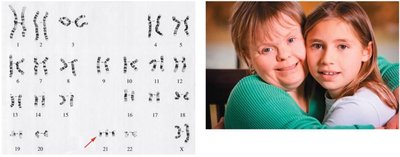
Down Syndrome Critical Region (DSCR): A region on chromosome 21 containing dosage-sensitive genes responsible for many Down syndrome phenotypes. Extra copies of DSCR1 are associated with decreased cancer risk due to suppression of vascular endothelial growth factor (VEGF).
Origin: Most cases result from nondisjunction during meiosis, with the ovum being the source in 95% of cases. The risk increases with maternal age.
Other Human Aneuploidies
Other trisomies that survive to term include Patau syndrome (47, 13+) and Edwards syndrome (47, 18+), both associated with severe malformations and early lethality.
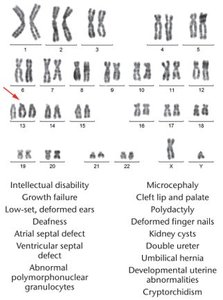
Approximately 20% of all conceptions terminate in spontaneous abortion, with 30% of these showing chromosomal imbalance.
Normal embryonic development requires a precise diploid chromosome complement.
Polyploidy
Polyploidy refers to the presence of more than two sets of chromosomes. It is common in plants but rare in animals. Polyploidy can arise naturally or be induced experimentally (e.g., by colchicine treatment).
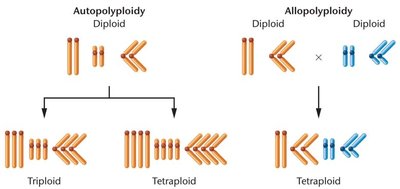
Autopolyploidy: Addition of chromosome sets identical to the same species.
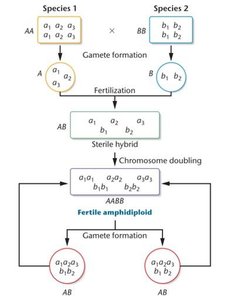
Allopolyploidy: Combination of chromosome sets from different species (hybridization).
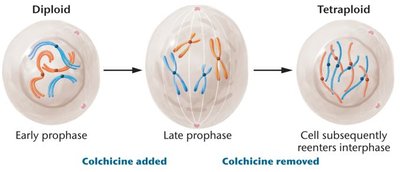
Amphidiploid and Allotetraploid Plants
Amphidiploids are fertile hybrids with two complete diploid genomes from different species. They are important in agriculture (e.g., wheat, cotton, triticale).
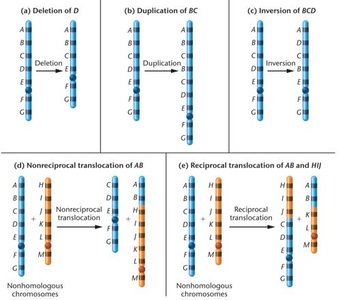
Chromosome Aberrations: Composition and Arrangement
Chromosome aberrations involve deletions, duplications, inversions, and translocations. These changes can alter the amount or arrangement of genetic material and may be heritable if they occur in gametes.
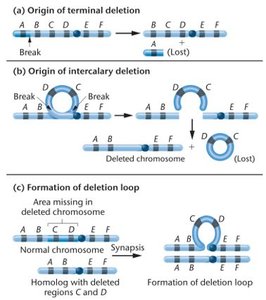
Deletions
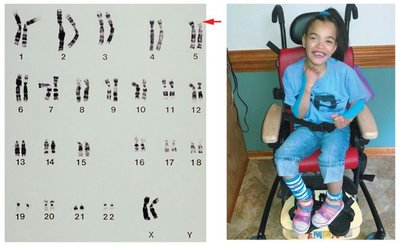
A deletion (deficiency) is the loss of a chromosome segment. Deletions can be terminal (end) or intercalary (interior). During meiosis, a deletion or compensation loop forms to allow synapsis between a normal and a deleted chromosome.
Cri du chat syndrome: Caused by deletion of a small part of the short arm of chromosome 5 (46, 5p-). Severity varies with deletion length.
Duplications
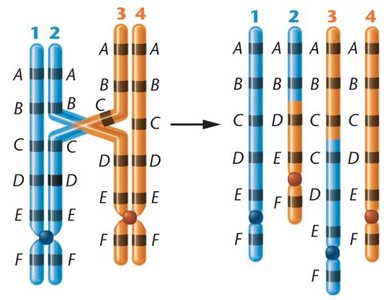
Duplications are repeated segments of chromosomes, often arising from unequal crossing over or replication errors. Duplications can lead to gene redundancy, phenotypic variation, and are a source of genetic variability in evolution.
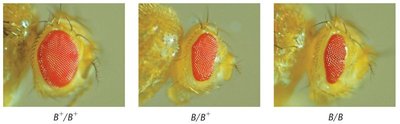
Bar mutation in Drosophila: Duplications in the X chromosome region cause narrow, slit-like eyes (Bar phenotype).
Gene duplication in evolution: Duplicated genes can acquire new functions, contributing to evolutionary adaptation. Multigene families (e.g., hemoglobin, T-cell receptors) arise from gene duplications.
Copy Number Variants (CNVs): Variations in the number of copies of duplicated sequences among individuals, associated with diseases such as autism and diabetes.
Inversions
Inversions are chromosomal aberrations where a segment is reversed within the chromosome. They require two breaks and reinsertion of the inverted segment. Inversions can be paracentric (not including the centromere) or pericentric (including the centromere).
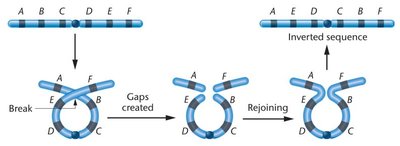
Inversion heterozygotes form inversion loops during meiosis. Crossing over within the loop can produce dicentric (two centromeres) and acentric (no centromere) chromatids, leading to abnormal gametes.
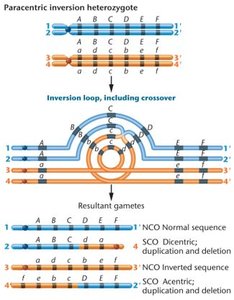
Inversions can preserve allele combinations (balancer chromosomes) and are used in genetic studies.
Translocations
Translocations involve the movement of chromosome segments to new locations. Reciprocal translocations exchange segments between nonhomologous chromosomes without loss or gain of genetic material. However, heterozygotes for translocations can produce genetically unbalanced gametes due to abnormal synapsis and segregation during meiosis.
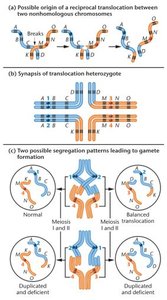
Alternate segregation: Produces normal and balanced gametes.
Adjacent segregation: Produces gametes with duplications and deficiencies, leading to semisterility and reduced reproductive fitness.
Fragile Sites and Associated Syndromes
Fragile sites are regions on chromosomes prone to breakage, often associated with intellectual disability and cancer. Fragile-X syndrome is the most common inherited form of intellectual disability, caused by a folate-sensitive site on the X chromosome and expansion of CGG trinucleotide repeats in the FMR1 gene.
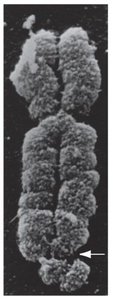
Gene anticipation: The number of CGG repeats increases in future generations, leading to earlier and more severe expression.
Fragile sites are also linked to cancer, such as the FHIT gene at FRA3B on chromosome 3p, which is often altered in lung and other cancers.
