 Back
BackCh 11 Chromosome Structure and DNA Sequence Organization
Study Guide - Smart Notes
 Tailored notes based on your materials, expanded with key definitions, examples, and context.
Ch 11 Chromosome Structure and DNA Sequence Organization
Introduction to DNA Organization
The organization of DNA within cells is fundamental to genetic function. DNA is structured into genes, which are further organized into chromosomes. Advances in microscopy have provided significant insights into chromosome organization, including the study of specialized eukaryotic structures such as polytene and lampbrush chromosomes.
Viral and Bacterial Chromosomes
Structure and Properties
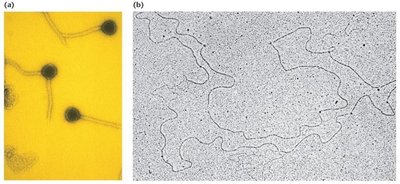
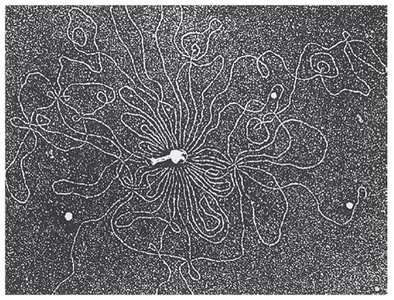
Viral and bacterial chromosomes are typically composed of a single nucleic acid molecule, either DNA or RNA, and are largely devoid of associated proteins.
These chromosomes are much smaller than those found in eukaryotes and contain less genetic information.
Viral genetic material remains inert until it is released into a host cell, where it can be efficiently packaged into a small volume, similar to DNA packaging in bacteria and eukaryotes.
Organism | Nucleic Acid Type | Strandedness | Nucleic Acid Length (μm) | Overall Size (μm) |
|---|---|---|---|---|
Phi × 174 | DNA | SS | 2.0 | 0.025 × 0.025 |
Tobacco mosaic virus | RNA | SS | 3.3 | 0.30 × 0.02 |
Phage Lambda | DNA | DS | 17.0 | 0.07 × 0.07 |
T2 phage | DNA | DS | 52.0 | 0.07 × 0.10 |
Haemophilus influenzae | DNA | DS | 832.0 | 1.00 × 0.30 |
Escherichia coli | DNA | DS | 1200.0 | 2.00 × 0.50 |
SS = single-stranded, DS = double-stranded.
Bacterial Chromosomes
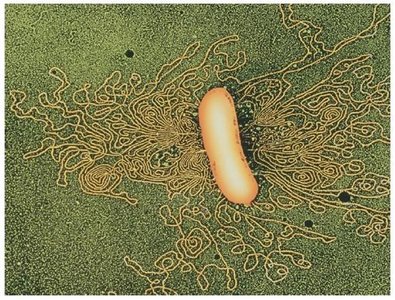
Bacterial chromosomes are typically circular, double-stranded DNA compacted into a region called the nucleoid.
DNA-binding proteins such as HU and H-NS help fold and bend DNA, facilitating its compaction.
Mitochondria and Chloroplasts
Organelle DNA
Both mitochondria and chloroplasts contain their own DNA, which is inherited maternally in most organisms.
Their DNA is structurally similar to that of viruses and bacteria.
Mitochondrial DNA (mtDNA)
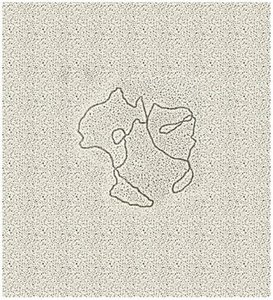
mtDNA is usually a double-stranded closed circle and lacks chromosomal proteins.
Introns are mostly absent, and gene repetition is rare.
Replication of mtDNA depends on enzymes encoded by nuclear DNA.
Chloroplast DNA (cpDNA)
cpDNA is circular, double-stranded, and free of the proteins found in eukaryotic DNA.
It is larger than mtDNA, contains more genes, and includes both introns and duplications.
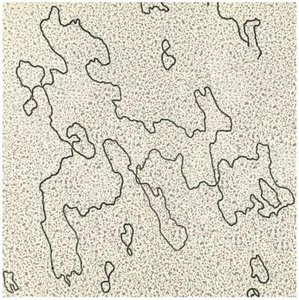
Chromatin Structure
Chromatin and Chromosome Condensation
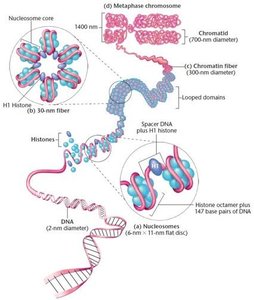
During interphase, eukaryotic chromosomes are uncoiled and decondensed into chromatin, which is dispersed throughout the nucleus and replicated.
During cell division, chromatin condenses into visible chromosomes.
Histones and Nucleosomes
Histones are positively charged proteins that associate with DNA, facilitating its packaging into chromatin.
There are five main types of histones, all rich in lysine and arginine, which enable electrostatic interactions with DNA phosphates.
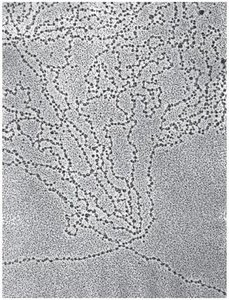
Chromatin fibers are composed of nucleosomes, which are spherical particles formed by DNA wrapped around histone octamers.
Basic model of chromatin structure:
– Digestion of chromatin by endonucleases.
– Chromatin fibers are composed of linear array of
spherical particles called nucleosomes (Figure 11.9).
– Histones H2A, H2B, H3, and H4 occur as tetramers
Chromatin Remodeling and Chemical Modifications
Chromatin Remodeling
Chromatin remodeling is essential for DNA-protein interactions, replication, and gene expression.
Remodeling involves relaxing the compact chromatin structure and reversing inactivity to allow access to DNA.
Histone tails, which protrude from nucleosomes, are key sites for chemical modifications.

Chemical Modifications
Acetylation: Addition of acetyl groups by histone acetyltransferase (HAT) neutralizes positive charges, remodeling chromatin and increasing gene activity.
Methylation: Addition of methyl groups by methyltransferase can increase or decrease transcription.
Phosphorylation: Addition of phosphate groups by kinase affects the cell cycle and DNA replication.
CpG Islands and DNA Methylation
Methylation of cytosine in CpG islands (regions where cytosine is followed by guanine) is negatively correlated with gene activity.
Bisulfite sequencing is used to identify methylated cytosines.
Heterochromatin and Euchromatin
Structural Differences
Euchromatin: Uncoiled, genetically active, and lightly stained during interphase.
Heterochromatin: Condensed, mostly inactive, and darkly stained during interphase. Some chromosomes are entirely heterochromatic.
Chromosome Banding
Mitotic chromosomes exhibit characteristic banding patterns due to differential staining.
G-banding stains regions rich in adenine-thymine, while C-banding stains centromeric heterochromatin.
Banding techniques reveal the complexity and heterogeneity of chromosomes.
Repetitive DNA and Satellite DNA
Categories of Repetitive DNA
Repetitive DNA sequences are repeated many times within eukaryotic chromosomes and are classified into several categories.
Most repetitive sequences do not encode proteins, but some functional genes are present in multiple copies.
Satellite DNA
Satellite DNA is highly repetitive and differs in density from the main genomic DNA.
It is found in heterochromatic centromeric regions and is absent in prokaryotes.
Centromeric DNA Sequences
Centromeres are primary constrictions on chromosomes essential for homolog separation during mitosis and meiosis.
The CEN region is the minimal region required for chromosomal segregation.
Kinetochore proteins bind to spindle fibers during cell division.
Middle Repetitive Sequences
VNTRs and STRs
Variable number tandem repeats (VNTRs, or minisatellites) and short tandem repeats (STRs, or microsatellites) are dispersed throughout the genome and vary among individuals.
These sequences are the basis for DNA fingerprinting in forensic science.
SINEs and LINEs
Short interspersed elements (SINEs) and long interspersed elements (LINEs) are mobile sequences that can relocate within the genome.
Retrotransposons are transposable elements generated via an RNA intermediate (e.g., LINEs).
Multiple-Copy Genes
Some functional genes, such as those encoding ribosomal RNA, are present in multiple copies within the genome.
In humans, these genes are found on the p arm of acrocentric chromosomes 13, 14, 15, 21, and 22.
Pseudogenes
Pseudogenes are noncoding DNA sequences that are evolutionary remnants of once-functional genes.
They have accumulated mutations and are not transcribed.
Specialized Chromosome Structures
Polytene Chromosomes
Polytene chromosomes are found in certain tissues and are visible in interphase nuclei as paired homologs.
They undergo multiple rounds of replication without strand separation or cell division, resulting in large, banded chromosomes.
Puff regions are sites of localized uncoiling and high gene activity (transcription).
Lampbrush Chromosomes
Lampbrush chromosomes are large meiotic chromosomes with extensive DNA looping, found in oocytes of vertebrates and some insects.
The loops are similar to polytene chromosome puffs and represent regions of active transcription.
Summary Table: Types of Chromosomal DNA Structures
Type | Location | Key Features | Function |
|---|---|---|---|
Viral/Bacterial Chromosomes | Viruses, Bacteria | Single molecule, circular or linear, little protein | Genetic information for replication and infection |
Mitochondrial/Chloroplast DNA | Eukaryotic organelles | Circular, double-stranded, maternal inheritance | Organelle function (respiration/photosynthesis) |
Polytene Chromosomes | Insect salivary glands | Paired homologs, banding, puffs | High transcriptional activity |
Lampbrush Chromosomes | Oocytes (vertebrates) | Large, looped, chromomeres | Active transcription during meiosis |
