 Back
BackChromosome Structure and DNA Sequence Organization
Study Guide - Smart Notes
 Tailored notes based on your materials, expanded with key definitions, examples, and context.
Chromosome Structure and DNA Sequence Organization
Chemical Modifications of Chromatin
Chromatin structure is dynamically regulated by chemical modifications of histone proteins, which play a crucial role in gene expression and DNA accessibility. These modifications are reversible and are mediated by specific enzymes.
Acetylation: The enzyme histone acetyltransferase (HAT) adds acetyl groups to lysine residues on histone tails, neutralizing their positive charge. This process remodels chromatin, increases regions of active genes, and decreases regions of inactive genes. Histone deacetylases (HDACs) remove acetyl groups, resulting in tighter chromatin and reduced gene expression.
Methylation: Methyltransferases add methyl groups to arginine and lysine residues in histones, which can either increase or decrease transcription depending on the context. Demethylases remove these methyl groups, reversing the modification.
Phosphorylation: Kinases add phosphate groups to serine and histidine residues, influencing processes such as the cell cycle and DNA replication. Phosphatases remove these phosphate groups.
Example: Acetylation of histone H3 lysine 9 (H3K9ac) is associated with active gene transcription.
Heterochromatin and Euchromatin
Chromosomes are not structurally uniform; they contain regions of euchromatin and heterochromatin, which differ in compaction and genetic activity.
Euchromatin: Less condensed, genetically active, and appears unstained during interphase.
Heterochromatin: Highly condensed, mostly genetically inactive, and appears stained during interphase. Some chromosomes are entirely heterochromatic.
Key Points:
Heterochromatin replicates later in S phase than euchromatin.
Telomeres (chromosome ends) are regions of heterochromatin, maintaining chromosome integrity during replication.
Centromeres are also heterochromatic and facilitate chromosome movement during cell division.
Repetitive DNA and Satellite DNA
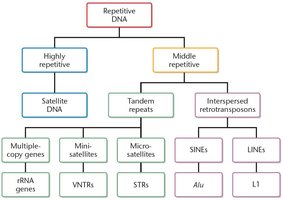
Eukaryotic genomes contain large amounts of repetitive DNA, which can be classified based on sequence repetition and organization.
Highly repetitive DNA: Includes satellite DNA, which is found in heterochromatic regions such as centromeres and is not present in prokaryotes. Satellite DNA can be separated from main-band DNA by density using ultracentrifugation.
Middle repetitive DNA: Includes tandem repeats (minisatellites and microsatellites) and interspersed retrotransposons (SINEs and LINEs).
Example: Satellite DNA is often used as a marker in cytogenetic studies due to its unique density properties.
Centromeric DNA Sequences
Centromeres are essential chromosomal regions that ensure proper segregation of chromosomes during mitosis and meiosis.
Centromeres are primary constrictions on chromosomes and contain a minimal region (CEN region) necessary for chromosomal segregation.
Kinetochore proteins bind to centromeric DNA, attaching chromosomes to spindle fibers during cell division.
Middle Repetitive Sequences: VNTRs and STRs
Middle repetitive DNA includes variable number tandem repeats (VNTRs, also called minisatellites) and short tandem repeats (STRs, also called microsatellites). These sequences are dispersed throughout the genome and vary among individuals.
VNTRs: Found between genes, used in DNA fingerprinting.
STRs: Shorter repeat units, also used in forensic analysis.
Example: STR analysis is a standard method in forensic DNA profiling due to its high variability among individuals.
SINEs and LINEs
Short interspersed elements (SINEs) and long interspersed elements (LINEs) are types of transposable elements that can move within the genome.
SINEs: Short sequences, such as Alu elements, dispersed throughout the genome.
LINEs: Longer sequences, such as L1 elements, which are retrotransposons generated via an RNA intermediate.
Both SINEs and LINEs are examples of interspersed repetitive DNA and contribute to genome evolution and variability.
Middle Repetitive Multiple-Copy Genes
Some functional genes are present in multiple copies within the genome, particularly those encoding ribosomal RNA (rRNA).
Drosophila: Approximately 120 copies of rRNA genes per haploid genome.
Humans: Multiple rRNA gene copies are located on the short arms of acrocentric chromosomes 13, 14, 15, 21, and 22.
Pseudogenes
Pseudogenes are nonfunctional DNA sequences that resemble functional genes but have accumulated mutations (insertions and deletions) that prevent their expression.
They are considered evolutionary vestiges and are not transcribed.
Although a small portion of the genome encodes proteins (2–10%), a large number of single-copy noncoding regions are pseudogenes.
