 Back
Chromosome Variation: Rearrangements, Aneuploidy, and Polyploidy
Study Guide - Smart Notes
 Tailored notes based on your materials, expanded with key definitions, examples, and context.
Chromosome Variation
Overview of Chromosome Mutations
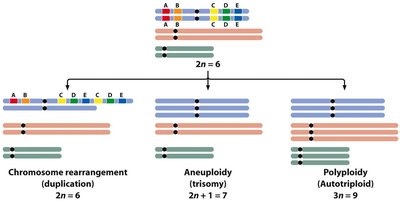
Chromosome mutations are significant alterations in chromosome structure or number, impacting genetic composition and organismal phenotype. The three primary categories are chromosome rearrangements, aneuploidy, and polyploidy. Each type has distinct mechanisms and consequences for meiosis, gamete viability, and fertility.
Chromosome Morphology and Karyotype
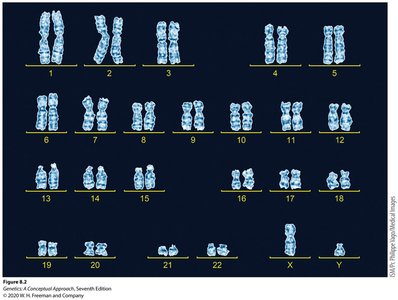
Chromosomes are classified based on centromere position: metacentric, submetacentric, acrocentric, and telocentric. A karyotype is the complete set of chromosomes in an organism, typically visualized during metaphase and arranged by size and morphology.
Chromosome Rearrangements
Types of Chromosome Rearrangements
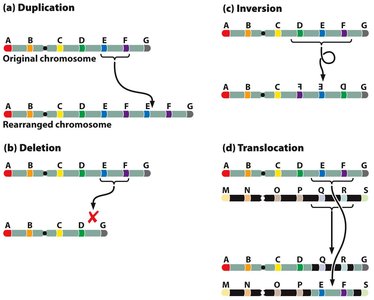
Chromosome rearrangements alter the structure of chromosomes and include duplications, deletions, inversions, and translocations. These changes can disrupt gene function and regulation, leading to phenotypic consequences.
Duplications
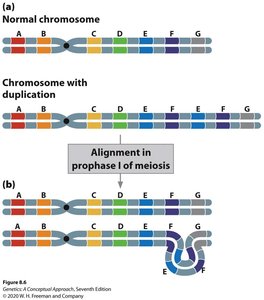
A duplication is a mutation where a segment of the chromosome is repeated. This can be tandem, displaced, or reversed. Duplications often cause gene dosage imbalances, affecting development and phenotype.
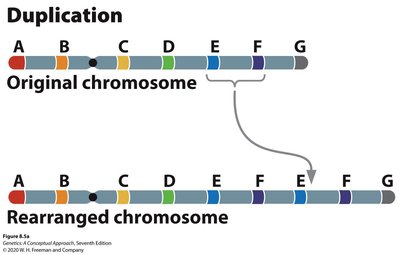
Gene dosage effect: Increased gene product levels can disrupt normal processes.
Phenotypic consequences: May include developmental abnormalities.
Pairing During Meiosis in Duplication Heterozygotes
During prophase I, chromosomes with duplications form loops to align homologous regions, facilitating proper pairing.
Deletions
A deletion is the loss of a chromosome segment. The effects depend on the genes lost; homozygous deletions are often lethal, while heterozygotes may show imbalanced gene expression or pseudodominance.
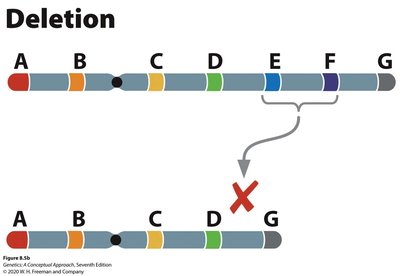
Pseudodominance: Expression of recessive alleles due to deletion of dominant allele.
Imbalanced gene products: Can lead to developmental defects.
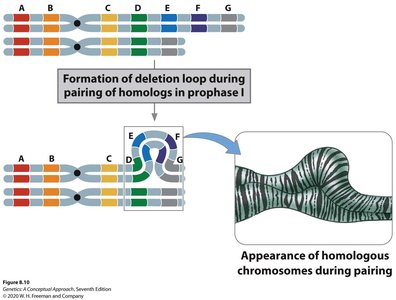
Pairing During Meiosis in Deletion Heterozygotes
Chromosomes with deletions form loops during prophase I to align homologous regions.
Effects of Chromosome Rearrangements in Humans
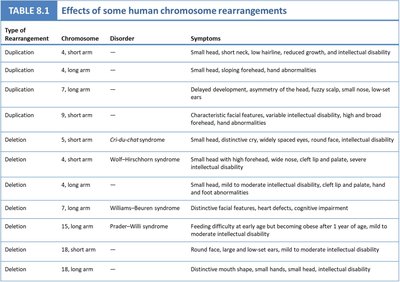
Some human disorders are caused by specific chromosome rearrangements. The table below summarizes several examples:
Type of Rearrangement | Chromosome | Disorder | Symptoms |
|---|---|---|---|
Duplication | 4, short arm | -- | Small head, short neck, low hairline, reduced growth, intellectual disability |
Duplication | 4, long arm | -- | Small head, sloping forehead, hand abnormalities |
Duplication | 7, long arm | -- | Delayed development, abnormality of head, fuzzy scalp, small nose, low-set ears |
Duplication | 9, short arm | -- | Characteristic facial features, variable intellectual disability, high and broad forehead, hand abnormalities |
Deletion | 5, short arm | Cri-du-chat syndrome | Small head, distinctive cry, widely spaced eyes, round face, intellectual disability |
Deletion | 4, short arm | Wolf–Hirschhorn syndrome | Small head, high forehead, wide nose, cleft lip and palate, severe intellectual disability |
Deletion | 7, long arm | Williams–Beuren syndrome | Distinctive facial features, heart defects, cognitive impairment |
Deletion | 15, long arm | Prader–Willi syndrome | Feeding difficulties at early age but becoming obese after 1 year of age, mild to moderate intellectual disability |
Deletion | 18, long arm | -- | Distinctive mouth shape, small hands, small head, mild to moderate intellectual disability |
Inversions
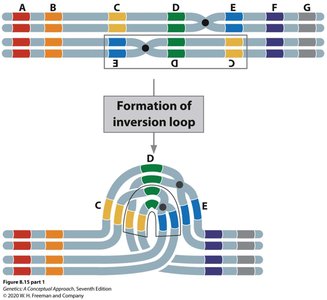
An inversion occurs when a chromosome segment is reversed end to end. Inversions are classified as paracentric (not including the centromere) or pericentric (including the centromere). Inversions can disrupt gene function and alter gene regulation (position effect).
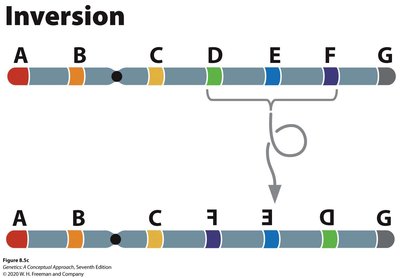
Position effect: Genes may be expressed abnormally due to new location.
Meiotic pairing: Inversion heterozygotes form loops to align homologous regions.
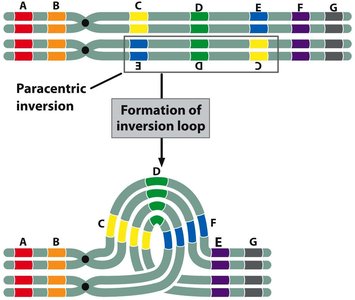
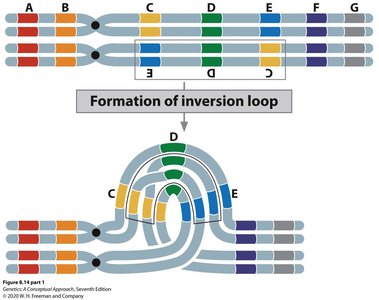
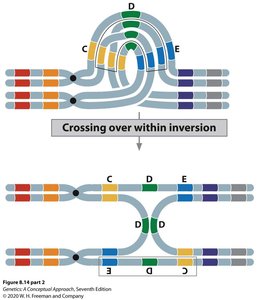
Paracentric Inversions in Meiosis
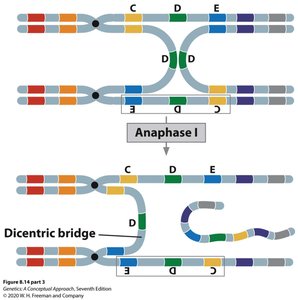
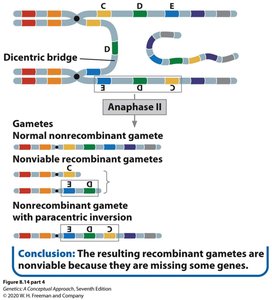
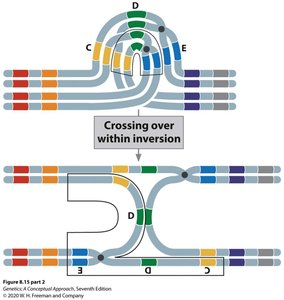
Crossing over within a paracentric inversion loop produces a dicentric bridge and an acentric fragment, leading to nonviable recombinant gametes.
Pericentric Inversions in Meiosis
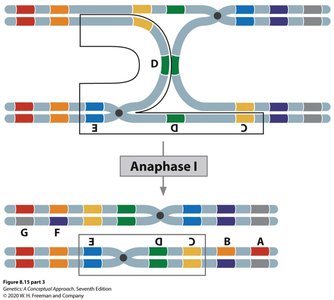
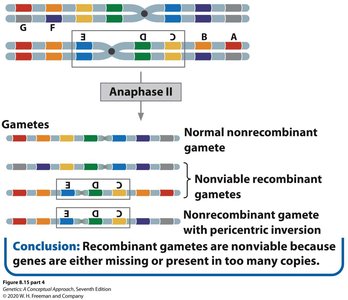
Crossing over within a pericentric inversion loop results in gametes with duplicated and deleted segments, which are nonviable.
Translocations
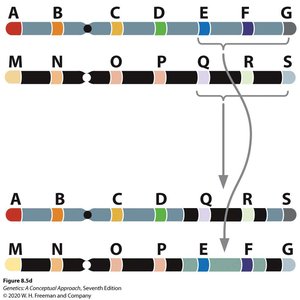
A translocation is the movement of chromosome segments between nonhomologous chromosomes or within the same chromosome. Translocations can be reciprocal (exchange between two chromosomes) or nonreciprocal (segment moves without exchange). Robertsonian translocations involve fusion of two acrocentric chromosomes.
Position effect: Genes may be abnormally regulated.
Accompanied deletions: May result in loss of genetic material.
Meiotic pairing: Translocation heterozygotes form cross-shaped configurations during meiosis.
Aneuploidy
Definition and Causes
Aneuploidy is the presence of an abnormal number of individual chromosomes. It arises from chromosome loss, Robertsonian translocation, or nondisjunction during mitosis or meiosis.
Nondisjunction: Failure of homologous chromosomes or sister chromatids to separate.
Types of Aneuploidy
Nullisomy: (loss of both members of a homologous pair)
Monosomy: (loss of a single chromosome)
Trisomy: (gain of a single chromosome)
Tetrasomy: (gain of two homologous chromosomes)
Double trisomic:
Double monosomic:
Double tetrasomic:
Effects of Aneuploidy
Most aneuploid mutations are lethal in animals and many plants.
Viable aneuploids often show drastic phenotypic changes due to gene dosage imbalance.
Human X-chromosome aneuploidy is tolerated due to X-inactivation.
Aneuploidy in Humans
Turner syndrome (XO): Monosomy of X chromosome.
Klinefelter syndrome (XXY): Trisomy of sex chromosomes.
Down syndrome (trisomy 21): Most common autosomal aneuploidy.
Edward syndrome (trisomy 18): 1/8000 live births.
Patau syndrome (trisomy 13): 1/15,000 live births.
Trisomy 8: 1/25,000–1/50,000 live births.
Familial Down Syndrome
Caused by a Robertsonian translocation between chromosomes 14 and 21, resulting in an extra copy of part of chromosome 21 attached to another chromosome.
Aneuploidy and Maternal Age
Frequency of nondisjunction increases with maternal age, likely due to prolonged meiotic arrest in oocytes.
Uniparental Disomy and Genetic Mosaicism
Uniparental disomy: Both chromosomes of a pair inherited from one parent.
Genetic mosaicism: Individual has regions of tissue with different chromosome constitutions, often from mitotic nondisjunction.
Polyploidy
Definition and Types
Polyploidy is the presence of more than two sets of chromosomes. Most eukaryotes are diploid (2n), but polyploidy can result in triploids (3n), tetraploids (4n), etc. Polyploids are generally larger and have increased commercial value.
Autopolyploidy
Extra chromosome sets are derived from a single species. Autotetraploids (4n) arise from nondisjunction in mitosis; autotriploids (3n) arise from fusion of 2n and n gametes. Autopolyploids often produce unbalanced gametes and are usually sterile.
Allopolyploidy
Arises from hybridization between related species followed by chromosome doubling. Allotetraploids (amphidiploids) are fertile because homologous chromosomes can pair and segregate normally.
Significance: Polyploidy is common in plants, used in breeding, and results in larger organisms.
Polyploidy in animals: Less frequent due to complex development and behavior.
Example: Many crop plants (bananas, potatoes, peanuts, sweet potatoes) are autopolyploids.
Summary
This study unit covers the nature and effects of chromosomal mutations, including rearrangements, aneuploidy, and polyploidy. Understanding these mutations is essential for interpreting genetic variation, gamete viability, and organismal fertility.
