 Back
BackChromosomes and Cellular Reproduction: Study Notes for Genetics Students
Study Guide - Smart Notes
 Tailored notes based on your materials, expanded with key definitions, examples, and context.
Chromosomes and Cellular Reproduction
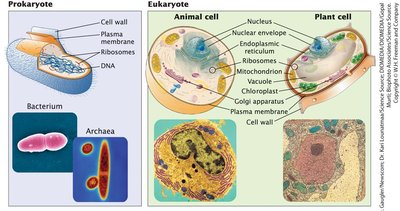
Prokaryote and Eukaryote Cells
Understanding the fundamental differences between prokaryotic and eukaryotic cells is essential for genetics, as these differences influence genetic organization, replication, and inheritance.
Prokaryotes: Unicellular organisms lacking membrane-bound organelles. Their DNA is not highly ordered or packed, and exists as a single circular molecule. Examples include Eubacteria and Archaea.
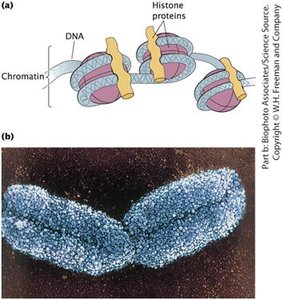
Eukaryotes: Can be unicellular or multicellular, possess membrane-bound organelles, and their genetic material is enclosed within a nuclear envelope. DNA is tightly associated with histone proteins, forming chromosomes.
Viruses: Neither prokaryotic nor eukaryotic; consist of a protein coat surrounding nucleic acid (DNA or RNA).
Feature | Prokaryotic Cells | Eukaryotic Cells |
|---|---|---|
Nucleus | Absent | Present |
Cell Diameter | 1–10 μm | 10–100 μm |
Genome | Usually one circular DNA molecule | Multiple linear DNA molecules |
DNA | Not complexed with histones (bacteria); some histones (archaea) | Complexed with histones |
Amount of DNA | Relatively small | Relatively large |
Membrane-bound Organelles | Absent | Present |
Key Structures in Eukaryotic Cells
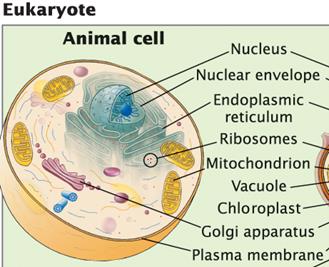
Nucleus: Contains genetic material.
Mitochondria: Site of cellular respiration.
Chloroplasts: Present in plant cells for photosynthesis.
Endoplasmic Reticulum, Golgi Apparatus, Vacuole: Various cellular functions.
Chromosome Structure
Chromosomes are highly organized structures of DNA and protein, essential for genetic inheritance and cell division.
Centromere: Attachment point for spindle microtubules during cell division.
Telomeres: Protective ends of linear chromosomes.
Origins of Replication: Sites where DNA synthesis begins.
Kinetochore: Protein complex at the centromere where spindle fibers attach.
Cell Reproduction
Cell reproduction is the process by which cells divide to produce new cells, ensuring genetic continuity and variation.
Prokaryotic Cell Division: Simple binary fission, rapid replication.
Eukaryotic Cell Division: Involves mitosis and meiosis, with complex chromosome behavior.
Diploid vs. Haploid Cells
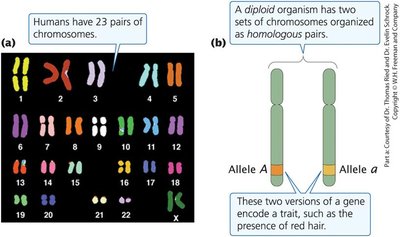
Diploid (2n): Two sets of genetic information, typical of somatic cells.
Haploid (n): One set of genetic information, typical of gametes.
The Cell Cycle
The cell cycle describes the sequence of events in cell growth and division, including interphase and mitotic phase.
Interphase: Consists of G1 (growth), S (DNA synthesis), and G2 (preparation for division).
M Phase: Includes mitosis (nuclear division) and cytokinesis (cytoplasmic division).
Checkpoints: G1/S and G2/M checkpoints regulate progression and ensure DNA integrity.
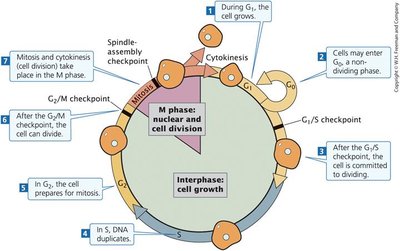
Stage | Major Features |
|---|---|
G0 phase | Stable, nondividing period |
G1 phase | Growth and development; G1/S checkpoint |
S phase | DNA synthesis |
G2 phase | Preparation for division; G2/M checkpoint |
M phase | Mitosis and cytokinesis |
Mitosis
Mitosis is the process by which somatic cells divide, producing two genetically identical daughter cells.
Phases: Interphase, Prophase, Prometaphase, Metaphase, Anaphase, Telophase, Cytokinesis.
Genetic Consequence: Each new cell contains a full complement of chromosomes and is genetically identical to the parent cell.
Key Points of Mitosis
Separation of Sister Chromatids: Ensures equal distribution of genetic material.
Cohesin Protein: Holds chromatids together; its removal is essential for chromatid separation.
Sexual Reproduction and Genetic Variation
Sexual reproduction involves meiosis and fertilization, leading to genetic variation among offspring.
Meiosis: Reduces chromosome number by half, produces haploid gametes.
Fertilization: Fusion of haploid gametes restores diploid chromosome number.
Genetic Variation: Results from crossing over and random assortment of chromosomes.
Meiosis
Meiosis is a specialized cell division process that produces four haploid cells from one diploid cell, essential for sexual reproduction.
Meiosis I: Separation of homologous chromosomes, reductional division.
Meiosis II: Separation of sister chromatids, equational division.
Crossing Over: Exchange of genetic material between non-sister chromatids during Prophase I.
Random Distribution: Homologous chromosomes align and segregate randomly during Metaphase I.
Major Events in Meiosis
Stage | Major Features |
|---|---|
Prophase I | Chromosomes condense, homologous chromosomes synapse, crossing over occurs |
Metaphase I | Homologous pairs align on metaphase plate |
Anaphase I | Homologous chromosomes separate |
Telophase I | Chromosomes arrive at spindle poles |
Cytokinesis | Cytoplasm divides |
Interkinesis | Spindle breaks down, chromosomes relax |
Prophase II | Chromosomes recondense |
Metaphase II | Individual chromosomes align |
Anaphase II | Sister chromatids separate |
Telophase II | Chromosomes arrive at spindle poles |
Cytokinesis | Cytoplasm divides |
Comparison of Mitosis, Meiosis I, and Meiosis II
Event | Mitosis | Meiosis I | Meiosis II |
|---|---|---|---|
Cell division | Yes | Yes | Yes |
Reduction in chromosome number | No | Yes | No |
Genetic variation produced | No | Yes | No |
Crossing over | No | Yes | No |
Random distribution | No | Yes | No |
Metaphase | Individual chromosomes line up | Homologous pairs line up | Individual chromosomes line up |
Anaphase | Chromatids separate | Homologous chromosomes separate | Chromatids separate |
Genetic Consequences of the Cell Cycle
The cell cycle and its associated processes ensure genetic stability and variation. Mitosis produces genetically identical cells, while meiosis introduces genetic diversity through crossing over and independent assortment.
Errors in Mitosis/Meiosis: Can lead to genetic diseases such as Down Syndrome (trisomy 21), Turner Syndrome (XO karyotype), and certain cancers.
Meiosis in Animals and Plants
Meiosis is fundamental to gamete production in animals (spermatogenesis and oogenesis) and alternation of generations in plants.
Animals: Spermatogenesis produces sperm; oogenesis produces eggs.
Plants: Alternate between diploid (sporophyte) and haploid (gametophyte) stages.
Key Terms and Concepts
Oogonium: Diploid cell that undergoes meiosis to produce an ovum.
Polar Body: Small cell produced during oogenesis, typically not fertilized.
Microsporocyte: Diploid cell in plants that undergoes meiosis to produce microspores.
Endosperm: Triploid tissue formed after pollination in plants.
Formulas and Equations
Chromosome Number After Division:
DNA Molecule Count:
Example:
If an oogonium produces an ovum with 18 chromosomes, the oogonium originally had 36 chromosomes (diploid).
If a secondary spermatocyte has 12 chromosomes, the primary spermatocyte had 24 chromosomes.
Additional info: These notes expand on brief points to provide a comprehensive overview suitable for genetics students, including definitions, comparisons, and relevant examples.
