 Back
BackComprehensive Study Notes: Foundations of Genetics, Mitosis & Meiosis, Mendelian Genetics, and Modification of Mendelian Ratios
Study Guide - Smart Notes
 Tailored notes based on your materials, expanded with key definitions, examples, and context.
Introduction to Genetics
Overview of the Human Genome
The human genome consists of billions of nucleotide bases and thousands of genes, forming the basis for heredity and variation.
Nucleotides: Four types—Adenine (A), Cytosine (C), Thymine (T), Guanine (G).
Genome Size: Haploid genome contains approximately 3 billion bases; diploid genome contains about 6 billion bases.
Gene Count: Approximately 20,000 genes in the human genome.
Early History of Genetics
Genetics has roots in ancient domestication and cultivation, with early theories from Hippocrates and Aristotle. The modern era began with the cell theory and Darwin's theory of evolution by natural selection.
Cell Theory: All organisms are composed of cells derived from pre-existing cells.
Evolution: Darwin and Wallace proposed evolution by natural selection, but lacked understanding of inheritance mechanisms.
Mendel: Gregor Mendel explained inheritance using pea plants, establishing the foundation for genetics.
Chromosomal Theory of Inheritance
The chromosomal theory states that genes reside on chromosomes and are transmitted across generations.
Genes and Chromosomes: Exist in pairs and separate during gamete formation.
DNA as Genetic Material: Avery, MacLeod, McCarty, and Hershey-Chase experiments established DNA as the carrier of genetic information.
Structure of DNA and Central Dogma
Watson and Crick proposed the double helix structure of DNA, which is central to genetic information flow.
DNA Structure: Antiparallel, double-stranded helix; monomer is the nucleotide.
Central Dogma: DNA → RNA (transcription) → Protein (translation).
Proteins: Enzymes, hemoglobin, insulin, actin, myosin, and others contribute to phenotype.
Recombinant DNA Technology and 'Omics'
Restriction enzymes and vectors enabled recombinant DNA technology, leading to genomics, proteomics, and bioinformatics.
Genomics: Study of genome structure, function, and evolution.
Proteomics: Analysis of protein sets and their functions.
Bioinformatics: Computational processing of genetic and protein data.
Model Organisms
Model organisms are essential for genetic studies due to their ease of growth, short life cycles, and straightforward genetic analysis.
Criteria: Easy to grow, short life cycle, many offspring, simple genetic analysis.
Mitosis and Meiosis
Cell Structure and Chromosomes
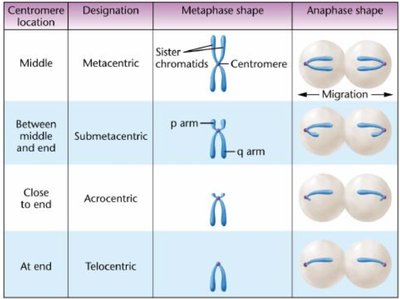
Cells are highly organized, and chromosomes are classified based on centromere location.
Homologous Chromosomes: Chromosomes with the same genes but possibly different alleles.
Sister Chromatids: Identical copies joined at the centromere.
Centromere Location: Determines chromosome type: metacentric, submetacentric, acrocentric, telocentric.
Centromere Location | Designation | Metaphase Shape | Anaphase Shape |
|---|---|---|---|
Middle | Metacentric | Sister chromatids, centromere in middle | Migration to poles |
Between middle and end | Submetacentric | p arm, q arm | Migration to poles |
Close to end | Acrocentric | Short p arm, long q arm | Migration to poles |
At end | Telocentric | Centromere at end | Migration to poles |
Cell Cycle and Mitosis
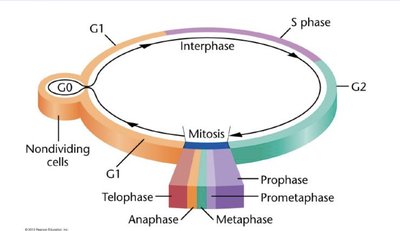
The cell cycle consists of interphase and mitosis, with most time spent in interphase. Mitosis produces two genetically identical daughter cells.
Interphase: G1 (growth), S (DNA replication), G2 (growth), G0 (non-dividing).
Mitosis Phases: Prophase, Prometaphase, Metaphase, Anaphase, Telophase, Cytokinesis.
Mitosis vs. Meiosis
Mitosis produces identical cells, while meiosis produces four haploid gametes, generating genetic variation through segregation and crossing over.
Mitosis: Two identical daughter cells.
Meiosis: Four genetically unique gametes; involves two divisions.
Genetic Variation: Segregation, independent assortment, crossing over.
Meiosis: Process and Significance
Meiosis is essential for sexual reproduction, reducing chromosome number by half and restoring diploidy upon fertilization.
Meiosis I: Homologous chromosomes pair (synapsis), form tetrads, undergo recombination.
Meiosis II: Sister chromatids separate, resulting in four haploid cells.
Spermatogenesis: Formation of sperm in testes.
Oogenesis: Formation of ova in ovaries; only one functional ovum produced.
Mendelian Genetics
Mendel's Experiments and Principles
Mendel used peas to demonstrate predictable inheritance patterns, establishing the foundation for transmission genetics.
Unit Factors: Traits controlled by pairs of factors (genes).
Dominance/Recessiveness: One allele may mask the other.
Segregation: Alleles separate during gamete formation.
Independent Assortment: Alleles of different genes assort independently.
Monohybrid and Dihybrid Crosses
Monohybrid crosses involve one trait; dihybrid crosses involve two traits and yield a 9:3:3:1 ratio in F2 generation.
Testcross: Used to determine genotype of dominant phenotype.
Forked-Line Method: Probability-based approach for multiple traits.
Probability Laws in Genetics
Genetic outcomes can be predicted using product and sum laws.
Product Law: Probability of independent events occurring together is the product of their individual probabilities.
Sum Law: Probability of an outcome achieved in multiple ways is the sum of individual probabilities.
Chi-Square Analysis
Chi-square analysis tests the fit of observed genetic data to expected ratios, accounting for chance deviations.
Formula:
Degrees of Freedom:
Interpretation: p-values indicate likelihood of deviation due to chance.
Pedigree Analysis
Pedigrees trace inheritance patterns in families, using standardized symbols for sex, phenotype, and carriers.
Symbols: Circles (female), squares (male), diamonds (unknown), shading (expression), dots (carriers), diagonal line (deceased).
Modification of Mendelian Ratios
Incomplete Dominance and Codominance
Not all traits follow simple dominance; some show intermediate or joint expression.
Incomplete Dominance: Heterozygotes have intermediate phenotype.
Codominance: Both alleles are fully expressed (e.g., MN blood group).
Multiple Alleles
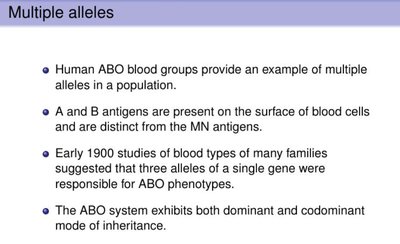
Some genes have more than two alleles, leading to complex inheritance patterns.
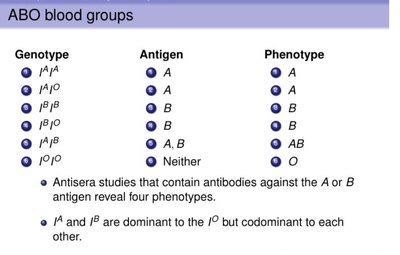
ABO Blood Groups: Three alleles (IA, IB, IO) produce four phenotypes.
Dominance and Codominance: IA and IB are dominant to IO, but codominant to each other.
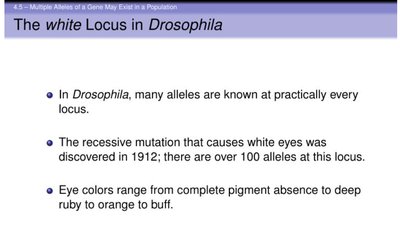
Multiple Alleles in Drosophila
The white locus in Drosophila demonstrates the existence of many alleles at a single locus, affecting eye color.
Over 100 alleles: Range from complete pigment absence to various colors.
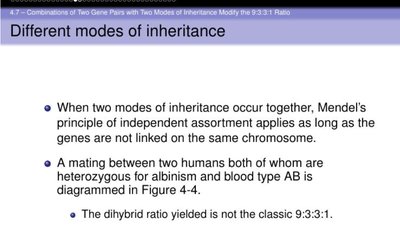
Different Modes of Inheritance
When two modes of inheritance occur together, Mendel’s principle of independent assortment applies if genes are not linked.
Example: Albinism and blood type AB in humans.
Dihybrid Ratio: May deviate from classic 9:3:3:1 ratio.
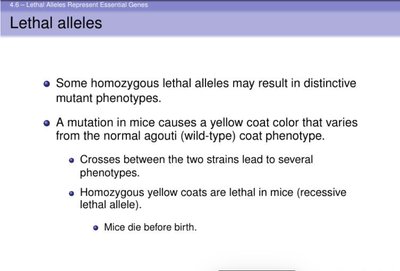
Lethal Alleles
Lethal alleles can result in distinctive mutant phenotypes or death.
Homozygous Lethal: Example in mice—yellow coat color is lethal when homozygous.
Mutant Phenotypes: Crosses between strains lead to several phenotypes; homozygous yellow coats are lethal.
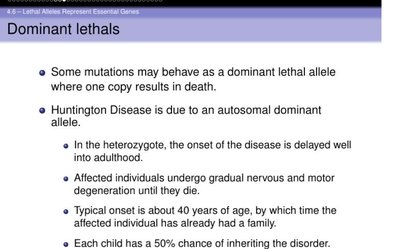
Dominant Lethal Alleles
Some mutations behave as dominant lethal alleles, where one copy results in death. Huntington Disease is a classic example.
Autosomal Dominant: Onset delayed into adulthood; gradual nervous and motor degeneration.
Inheritance: Each child has a 50% chance of inheriting the disorder.
Additional info:
These notes cover foundational concepts from Chapters 1-5, including the structure and function of DNA, cell division, Mendelian genetics, and modifications to Mendelian ratios.
Images included are directly relevant to chromosome structure, cell cycle, multiple alleles, modes of inheritance, and lethal alleles.
