 Back
BackConcepts of Genetics: Foundations, Chromosomes, and Mendelian Principles
Study Guide - Smart Notes
 Tailored notes based on your materials, expanded with key definitions, examples, and context.
Introduction to Genetics
Overview of Genetics and Its Historical Foundations
Genetics is the scientific study of heredity and variation in living organisms. The field has evolved from early observations of trait inheritance to the molecular understanding of genes and chromosomes. The discipline is built on a rich tradition of discovery, from ancient domestication of plants and animals to the experiments of Mendel and the elucidation of DNA structure.
Transmission genetics: The process by which genes are passed from parents to offspring through gametes.
Model organisms: Species such as Drosophila melanogaster (fruit fly), Mus musculus (mouse), and Arabidopsis thaliana (mustard plant) are used to study genetic principles applicable to other organisms, including humans.
Modern genetics integrates classical approaches with molecular, genomic, and bioinformatic techniques.
Genes, Chromosomes, and Heredity
Chromosome Theory and Genetic Continuity
Genetic information is organized into genes, which are located on chromosomes. Chromosomes are the vehicles for transmitting genetic information from one generation to the next. The chromosome theory of inheritance unites Mendel's principles with cytological observations of chromosome behavior during meiosis.
Diploid organisms have pairs of homologous chromosomes (2n), one from each parent.
Haploid gametes (n) are produced by meiosis, ensuring genetic continuity and variation.
Mutations are heritable changes in DNA sequence, providing the raw material for genetic diversity.
Example: The white-eyed mutation in Drosophila is an allele of a gene controlling eye color, demonstrating the relationship between genotype and phenotype.
DNA as the Genetic Material
Experiments by Avery, MacLeod, McCarty, and Hershey-Chase established DNA as the genetic material. The structure of DNA, elucidated by Watson and Crick, revealed a double helix composed of nucleotide pairs (A=T, G≡C), providing a mechanism for replication and gene expression.
Central Dogma: DNA → RNA → Protein
Gene expression involves transcription (DNA to mRNA) and translation (mRNA to protein).
Proteins are polymers of 20 amino acids, with diverse functions including enzymes, structural components, and signaling molecules.
Example: Sickle-cell anemia is caused by a single nucleotide mutation in the β-globin gene, leading to an amino acid substitution and altered hemoglobin function.
Mitosis and Meiosis
Cell Division and Chromosome Segregation
Mitosis and meiosis are processes that ensure the accurate transmission of genetic material during cell division.
Mitosis: Produces two genetically identical diploid daughter cells for growth and repair.
Meiosis: Produces four genetically unique haploid gametes, introducing genetic variation through independent assortment and crossing over.
Homologous chromosomes: Pairs with the same genes but possibly different alleles; segregate during meiosis I.
Key stages: Prophase, metaphase, anaphase, telophase (in both mitosis and meiosis, with unique events in meiosis such as synapsis and chiasma formation).
Mendelian Genetics
Mendel's Experimental Approach and Postulates
Gregor Mendel's experiments with pea plants established the foundational principles of inheritance. He analyzed traits with clear dominant and recessive forms, using controlled crosses and quantitative analysis.
Monohybrid cross: Involves one pair of contrasting traits; F1 generation shows only the dominant trait, F2 shows a 3:1 phenotypic ratio.
Dihybrid cross: Involves two pairs of traits; F2 generation shows a 9:3:3:1 phenotypic ratio, demonstrating independent assortment.
Mendel's Postulates:
Unit factors in pairs: Genes exist in pairs in diploid organisms.
Dominance/recessiveness: One allele may mask the expression of another.
Segregation: Paired alleles separate during gamete formation.
Independent assortment: Alleles of different genes assort independently during gamete formation.
Genetic Terminology and Analysis
Genotype: The genetic constitution of an organism (e.g., DD, Dd, dd).
Phenotype: The observable trait (e.g., tall or dwarf).
Homozygous: Two identical alleles (DD or dd).
Heterozygous: Two different alleles (Dd).
Punnett square: A diagrammatic tool to predict genotypic and phenotypic ratios.
Testcross: Crossing an individual of unknown genotype with a homozygous recessive to determine genotype.
Probability and Genetic Ratios
Genetic outcomes are subject to the laws of probability. The product law and sum law are used to calculate the likelihood of specific genotypes and phenotypes in offspring. Larger sample sizes reduce the impact of chance deviation from expected ratios.
Relevant Images
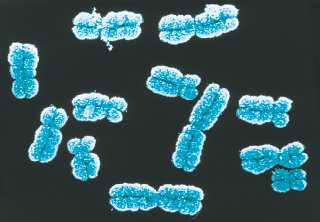 Colorized image of human chromosomes, illustrating the physical structure of chromosomes as seen under a microscope. This image is directly relevant to the discussion of chromosome structure and visualization during cell division.
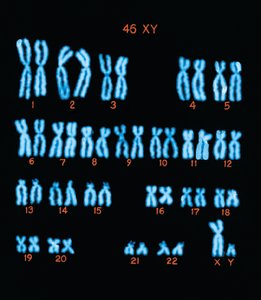 Human male karyotype, showing the diploid set of chromosomes arranged in homologous pairs. This image supports the explanation of homologous chromosomes and karyotype analysis in genetics.
