 Back
BackConjugation, Resonance, and Dienes: Structure and Stability
Study Guide - Smart Notes
 Tailored notes based on your materials, expanded with key definitions, examples, and context.
Conjugation in Organic Molecules
Definition and Structural Features
Conjugation occurs when p orbitals can overlap across three or more adjacent atoms, allowing for electron delocalization. This phenomenon is commonly observed in systems with alternating single and double bonds, such as 1,3-dienes and allylic carbocations.
Conjugated system: A molecule with alternating single and double bonds, enabling p orbital overlap and electron delocalization.
1,3-diene: A compound with two double bonds separated by a single bond, where each carbon is sp2-hybridized and possesses an unhybridized p orbital.
Allylic carbocation: A positively charged carbon atom adjacent to a double bond, also featuring conjugation.
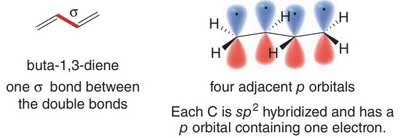
Bonding in 1,3-Dienes
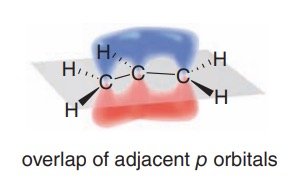
In 1,3-dienes, the overlap of adjacent p orbitals leads to the formation of delocalized π bonds. This delocalization results in unique bond lengths and increased stability compared to isolated double bonds.
Bonding: Each carbon forms σ-bonds via sp2 orbitals and π-bonds via p orbitals.
Bond lengths: The central C–C bond in a conjugated diene is shorter than a typical single bond due to partial double bond character from delocalization.
Electron delocalization: The π electrons are spread over multiple atoms, not localized between two carbons.
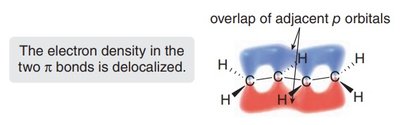
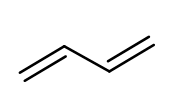
Comparison: Isolated vs. Conjugated Dienes
Isolated dienes have double bonds separated by more than one single bond, resulting in localized π electrons. In contrast, conjugated dienes have alternating single and double bonds, leading to delocalized π electrons and increased stability.
Isolated diene: π electrons are localized; no significant interaction between double bonds.
Conjugated diene: π electrons are delocalized; increased stability due to resonance.
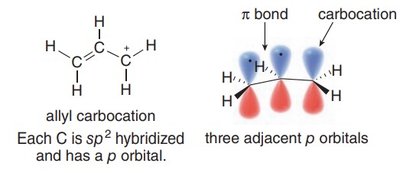
Allylic Carbocations and Resonance
Structure and Stability of Allylic Carbocations
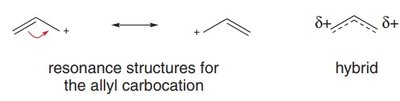
An allylic carbocation is a carbocation where the positive charge is adjacent to a double bond. The structure allows for resonance stabilization, making allylic carbocations unusually stable for primary carbocations.
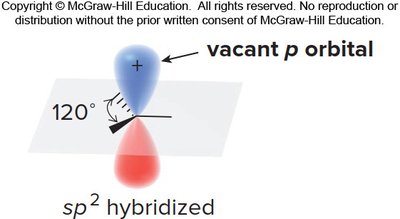
Hybridization: All carbons are sp2-hybridized, each with a p orbital.
Resonance: The positive charge is delocalized over multiple atoms, increasing stability.
Bonding: The empty p orbital on the carbocation overlaps with adjacent p orbitals, allowing charge delocalization.
Carbocation Stability Trends
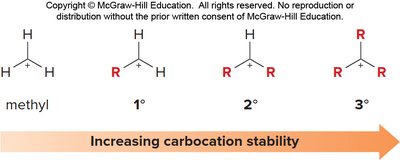
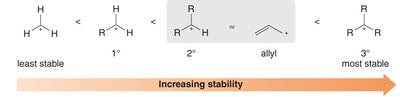
Carbocation stability increases with the number of alkyl substituents due to hyperconjugation and inductive effects. Allylic carbocations are stabilized by resonance, making them as stable as secondary carbocations.
Order of stability: methyl < primary < secondary ≈ allylic < tertiary
Resonance stabilization: Allylic carbocations are stabilized by delocalization of the positive charge.
Resonance Structures and Resonance Hybrid
Resonance structures are different Lewis structures that represent the same molecule, showing the delocalization of electrons. The actual molecule is a resonance hybrid, which is a weighted average of all valid resonance structures.
Drawing resonance structures: Only move lone pairs and/or π bonds; maintain overall charge balance.
Major contributors: Structures with full octets, minimal charges, and negative charges on more electronegative atoms are favored.
Resonance hybrid: The true structure is a blend of all resonance forms, with delocalized electrons.
Recognizing Resonance in Organic Molecules
Common Resonance Scenarios
Resonance is a key concept in organic chemistry, appearing in various functional groups and molecular motifs. Recognizing when resonance applies is essential for understanding molecular stability and reactivity.
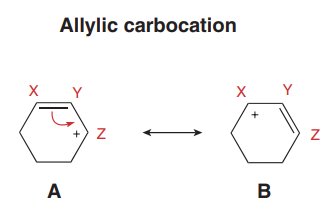
Three-atom allyl system (X=Y–Z*): Positive charge or lone pair adjacent to a double bond.
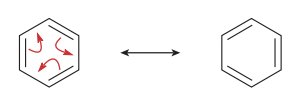
Conjugated double bonds: 1,3-dienes, aromatic rings (e.g., benzene).
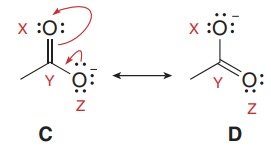
Positive charge next to lone pair: e.g., acetate or amidate ions.
Double bonds with electronegative atoms: Delocalization occurs when one atom is much more electronegative than the other.
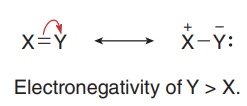
Criteria for Major and Minor Resonance Contributors
Not all resonance structures contribute equally to the resonance hybrid. The most significant contributors are those that maximize stability.
Every atom has an octet (when possible).
Structures with fewer formal charges are preferred.
Negative charges should reside on more electronegative atoms.
Structures with more covalent bonds are favored.
Hybridization and Resonance
Hybridization and Electron Delocalization
Electron delocalization through resonance requires overlapping p orbitals, which is only possible when atoms are sp2 or sp hybridized. The hybridization of atoms may differ from simple models when resonance is present.
sp2 hybridization: Allows for one unhybridized p orbital, essential for resonance.
sp hybridization: Allows for two unhybridized p orbitals, as seen in alkynes.
sp3 hybridization: No unhybridized p orbitals; not involved in resonance.
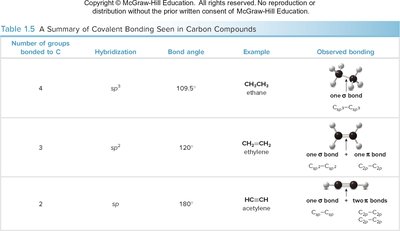
Summary Table: Covalent Bonding in Carbon Compounds
The following table summarizes the relationship between the number of groups bonded to carbon, hybridization, bond angles, and observed bonding patterns:
Number of groups bonded to C | Hybridization | Bond angle | Example | Observed bonding |
|---|---|---|---|---|
4 | sp3 | 109.5° | CH3CH3 (ethane) | One σ bond |
3 | sp2 | 120° | CH2=CH2 (ethylene) | One σ bond, one π bond |
2 | sp | 180° | HC≡CH (acetylene) | One σ bond, two π bonds |
Additional info: Understanding conjugation and resonance is essential for predicting the stability and reactivity of organic molecules, which is foundational for advanced studies in organic and biological chemistry.
