 Back
BackDNA as the Genetic Material: Discovery, Structure, and Organization
Study Guide - Smart Notes
 Tailored notes based on your materials, expanded with key definitions, examples, and context.
DNA as the Genetic Material
Historical Perspective and the Definition of a Gene
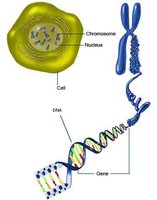
The concept of the gene has evolved from a unit controlling phenotype to a molecular segment of DNA encoding functional products. Early geneticists defined genes by their role in inheritance and phenotype, while molecular biology later clarified that a gene is a DNA segment encoding a protein or functional RNA.
Genetic Definition: A gene controls an organism’s form, function, or behavior and is inherited according to Mendelian principles.
Molecular Definition: A gene is a segment of DNA containing the information to produce a protein or functional RNA.
Chromosomal Location: Genes reside on chromosomes and segregate during cell division.
The Central Dogma of Molecular Biology
The central dogma describes the flow of genetic information: DNA is transcribed into RNA, which is translated into protein. This process links genotype (genetic makeup) to phenotype (observable traits).
DNA: Stores genetic information.
RNA: Acts as an intermediary, carrying instructions from DNA.
Protein: Executes cellular functions and determines phenotype.
Discovery of DNA as the Genetic Material
Early Experiments and the Chromosome Theory
By the early 20th century, scientists knew that genes controlled heritable traits and were located on chromosomes. However, the chemical nature of the genetic material was unclear, with proteins initially favored due to their complexity.
Griffith’s Transformation Experiment (1928)
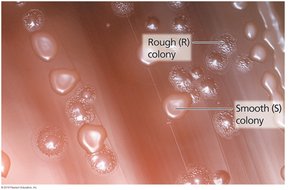
Frederick Griffith demonstrated that a "transforming principle" from dead pathogenic bacteria could permanently change non-pathogenic bacteria, suggesting the transfer of genetic information.
S (Smooth) Strain: Virulent, causes disease in mice.
R (Rough) Strain: Non-virulent, lacks protective capsule.
Key Finding: Mixing heat-killed S strain with live R strain transformed R into S, killing mice.
Avery, MacLeod, and McCarty Experiment (1944)
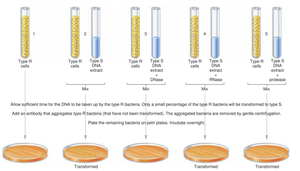
These researchers identified DNA as the "transforming principle" by systematically destroying different macromolecules in bacterial extracts and showing that only destruction of DNA prevented transformation.
Protease, RNase, and other treatments: Did not prevent transformation.
DNase treatment: Prevented transformation, implicating DNA as the genetic material.
The Hershey-Chase Experiment (1952)
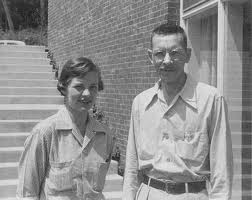
Alfred Hershey and Martha Chase used bacteriophages labeled with radioactive isotopes to show that DNA, not protein, is the genetic material transmitted to bacteria during infection.
32P-labeled DNA: Entered bacterial cells and was inherited by progeny phages.
35S-labeled protein: Remained outside the cells and was not inherited.
Structure of DNA
Components of Nucleic Acids
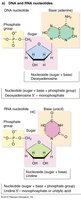
DNA and RNA are polymers of nucleotides, each consisting of a pentose sugar, a nitrogenous base, and a phosphate group.
Pentose Sugar: Deoxyribose in DNA, ribose in RNA.
Nitrogenous Bases: Purines (adenine, guanine) and pyrimidines (cytosine, thymine in DNA; uracil in RNA).
Phosphate Group: Links nucleotides via phosphodiester bonds.
Chargaff’s Rules
Erwin Chargaff found that in any species, the amount of adenine equals thymine (A=T) and the amount of guanine equals cytosine (G=C), suggesting base pairing.
Rosalind Franklin’s X-ray Crystallography
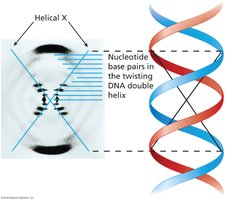
Franklin’s X-ray diffraction images revealed the helical structure of DNA, with regular repeating distances corresponding to the spacing of base pairs and the helical turn.
Watson and Crick Model (1953)
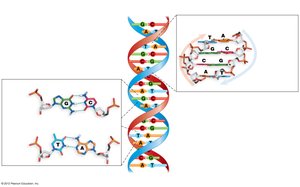
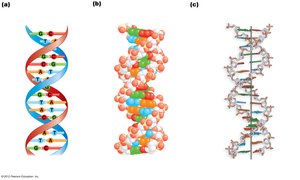
Watson and Crick proposed the double helix model of DNA, with two antiparallel strands held together by complementary base pairing (A-T and G-C) and a sugar-phosphate backbone on the outside.
Double Helix: Right-handed, with about 10 base pairs per turn.
Antiparallel Strands: One runs 5’ to 3’, the other 3’ to 5’.
Hydrogen Bonds: Two between A and T, three between G and C.
Organization of Genomes
Prokaryotic Genomes
Prokaryotes typically have a single, circular chromosome composed of double-stranded DNA. DNA is compacted by supercoiling and may include small circular plasmids.
Genome Size: Measured in base pairs (bp), kilobases (kb), or megabases (Mb).
Supercoiling: DNA is twisted to fit inside the cell, regulated by topoisomerases.
Eukaryotic Genomes
Eukaryotes have multiple linear chromosomes, each a long double-stranded DNA molecule. DNA is packaged with histone proteins into chromatin, with the nucleosome as the basic unit of organization.
Nucleosome: 146-147 bp of DNA wrapped around eight histone proteins.
Higher-Order Structure: Chromatin is further compacted into fibers and loops to fit within the nucleus.
Telomeres: Specialized structures at chromosome ends.
DNA vs. RNA
Key Differences
DNA and RNA differ in their sugar, bases, and structure.
Sugar: DNA contains deoxyribose; RNA contains ribose.
Bases: DNA uses thymine (T); RNA uses uracil (U) instead.
Strandedness: DNA is usually double-stranded; RNA is usually single-stranded but can form secondary structures.
Summary Table: DNA vs. RNA
Feature | DNA | RNA |
|---|---|---|
Sugar | Deoxyribose | Ribose |
Bases | A, T, G, C | A, U, G, C |
Strandedness | Double-stranded | Single-stranded (usually) |
Function | Genetic information storage | Information transfer, catalysis |
Conclusion
DNA is the universal genetic material in prokaryotes and eukaryotes, with its structure and organization underpinning the storage, transmission, and expression of genetic information. The discovery and elucidation of DNA’s structure were pivotal in the development of modern genetics and molecular biology.
