 Back
BackDNA as the Genetic Material: Historical Experiments and Molecular Structure
Study Guide - Smart Notes
 Tailored notes based on your materials, expanded with key definitions, examples, and context.
DNA as the Genetic Material
Introduction to Genes and Genetic Material
Genetics is the study of heredity and variation in living organisms. The concept of the gene has evolved from a unit controlling phenotype to a molecular segment of DNA encoding functional products. Understanding the molecular basis of heredity is foundational to modern genetics.
Gene (Genetic Definition): A unit controlling an organism’s form, function, or behavior, residing on chromosomes and segregating during inheritance.
Gene (Molecular Definition): A segment of DNA containing the information to express a protein or functional RNA.
Central Dogma: Genetic information flows from DNA to RNA to protein, linking genotype to phenotype.
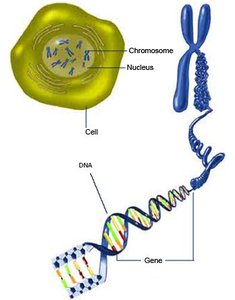
Historical Foundations of Molecular Genetics
Key Milestones in Genetics
The field of genetics has progressed through several key discoveries, from Mendel’s laws to the identification of DNA as the genetic material and the elucidation of its structure.
1850–1900: Mendel’s work on heredity; discovery of chromosomes.
1900–1953: Rediscovery of Mendel, chromosome theory, and identification of DNA as genetic material.
1953–2003: Central Dogma established; molecular biology revolution.
2003–present: Genomics era, including gene therapy and personal genetics.
Discovery of DNA as the Genetic Material
Griffith’s Transformation Experiment
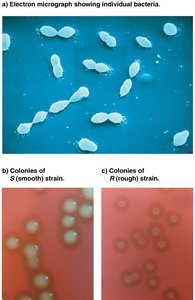
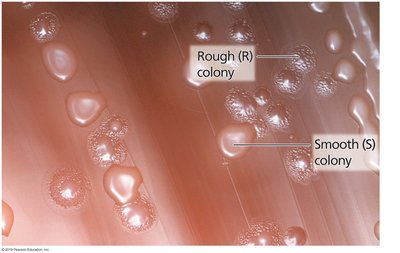
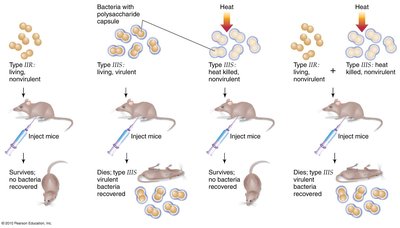
Frederick Griffith’s experiments with Streptococcus pneumoniae in 1928 demonstrated the phenomenon of transformation, suggesting the existence of a ‘transforming principle’ capable of transferring genetic information.
S (Smooth) Strain: Virulent, causes pneumonia in mice due to protective capsule.
R (Rough) Strain: Non-virulent, lacks capsule, does not cause disease.
Key Finding: Mixing heat-killed S strain with live R strain transformed R into virulent S, indicating transfer of genetic information.
Avery, MacLeod, and McCarty’s Identification of DNA
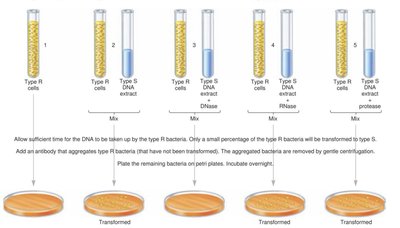
In the 1940s, Avery, MacLeod, and McCarty demonstrated that DNA is the ‘transforming principle’ by showing that only DNA, not protein or RNA, could transform R cells into S cells.
Experimental Approach: Treated cell extracts with enzymes degrading proteins, RNA, or DNA.
Result: Only destruction of DNA prevented transformation, confirming DNA as the genetic material.
The Hershey-Chase Experiment
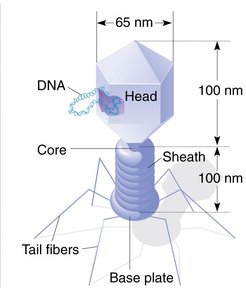
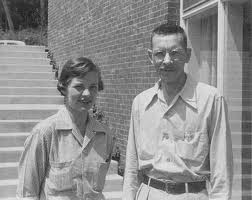
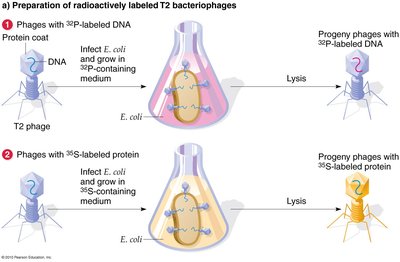
Alfred Hershey and Martha Chase used bacteriophage T2 to confirm that DNA, not protein, is the genetic material. They labeled phage DNA with radioactive phosphorus (32P) and protein with radioactive sulfur (35S), showing that only DNA entered bacterial cells and directed viral replication.
Bacteriophage: Virus that infects bacteria, composed of DNA and protein.
Key Finding: DNA, not protein, is inherited by progeny phages.
Molecular Structure of DNA
Nucleic Acids and Nucleotides
DNA and RNA are nucleic acids composed of nucleotide monomers. Each nucleotide consists of a pentose sugar, a nitrogenous base, and a phosphate group.
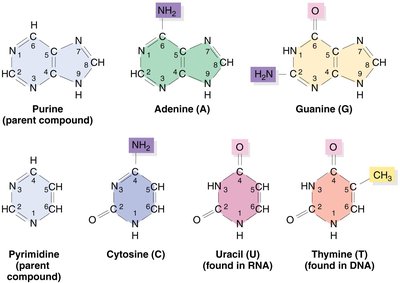
DNA: Deoxyribonucleic acid; sugar is deoxyribose; bases are adenine (A), guanine (G), cytosine (C), and thymine (T).
RNA: Ribonucleic acid; sugar is ribose; bases are adenine (A), guanine (G), cytosine (C), and uracil (U).
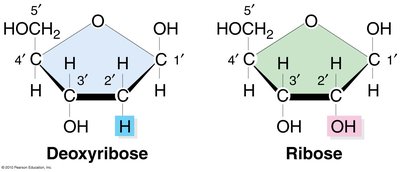
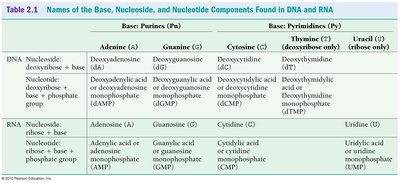
Table: Names of Bases, Nucleosides, and Nucleotides in DNA and RNA
Base | DNA Nucleoside | DNA Nucleotide | RNA Nucleoside | RNA Nucleotide |
|---|---|---|---|---|
Adenine (A) | Deoxyadenosine | dAMP | Adenosine | AMP |
Guanine (G) | Deoxyguanosine | dGMP | Guanosine | GMP |
Cytosine (C) | Deoxycytidine | dCMP | Cytidine | CMP |
Thymine (T) | Deoxythymidine | dTMP | - | - |
Uracil (U) | - | - | Uridine | UMP |
Chargaff’s Rules
Erwin Chargaff discovered that in DNA, the amount of adenine equals thymine (A=T) and the amount of guanine equals cytosine (G=C), providing key evidence for base pairing in the double helix.
Watson and Crick Model of DNA Structure
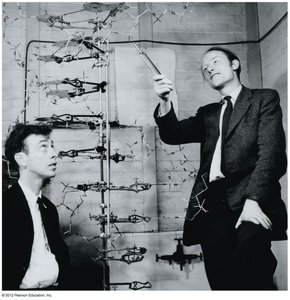
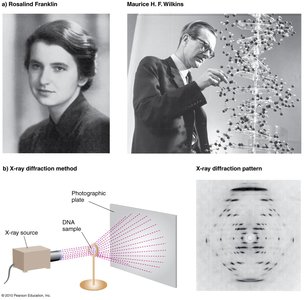
In 1953, Watson and Crick proposed the double helix model of DNA, integrating data from Chargaff and Rosalind Franklin’s X-ray crystallography.
Double Helix: Two antiparallel polynucleotide strands wound in a right-handed helix.
Sugar-Phosphate Backbone: On the outside, bases on the inside.
Base Pairing: A pairs with T (2 hydrogen bonds), G pairs with C (3 hydrogen bonds).
One Turn: 3.4 nm, 10 base pairs per turn.
DNA Polarity and Antiparallel Strands
DNA strands have directionality, with a 5’ phosphate end and a 3’ hydroxyl end. The two strands run in opposite directions (antiparallel).
DNA Compaction and Chromatin Structure
In prokaryotes, DNA is typically a single circular chromosome, often supercoiled. In eukaryotes, DNA is organized into linear chromosomes and further compacted by wrapping around histone proteins to form nucleosomes, the basic unit of chromatin.
Nucleosome: 146 base pairs of DNA wrapped around eight histone proteins.
Higher-Order Structure: Chromatin fibers are further compacted to fit within the nucleus.
Comparison of DNA and RNA
Key Differences
Sugar: DNA contains deoxyribose; RNA contains ribose.
Bases: DNA uses thymine (T); RNA uses uracil (U) instead.
Strandedness: DNA is usually double-stranded; RNA is usually single-stranded but can form secondary structures.
Summary Table: Base Composition of DNA from Various Organisms
DNA Origin | A (%) | T (%) | G (%) | C (%) | A/T | G/C |
|---|---|---|---|---|---|---|
Human (sperm) | 31.0 | 31.5 | 19.1 | 18.4 | 0.98 | 1.03 |
Corn (Zea mays) | 25.6 | 25.3 | 24.5 | 24.6 | 1.01 | 1.00 |
Drosophila | 27.3 | 27.6 | 22.5 | 22.6 | 0.99 | 1.00 |
Euglena nucleus | 22.6 | 24.4 | 27.7 | 25.3 | 0.93 | 1.07 |
Escherichia coli | 26.1 | 23.9 | 24.9 | 25.1 | 1.09 | 0.99 |
Conclusion
The identification of DNA as the genetic material and the elucidation of its structure were pivotal in the development of modern genetics. These discoveries underpin our understanding of heredity, gene expression, and the molecular mechanisms of life.
