 Back
BackDNA as the Genetic Material: Structure, Evidence, and Organization
Study Guide - Smart Notes
 Tailored notes based on your materials, expanded with key definitions, examples, and context.
DNA as the Genetic Material
Historical Perspective and Evidence
The identification of DNA as the genetic material was a pivotal moment in genetics, supported by a series of experiments and discoveries from the late 19th to mid-20th century.
Early Discoveries: Friedrich Miescher isolated 'nuclein' (now known as nucleic acid) from cell nuclei, identifying it as a distinct cellular component containing phosphorus.
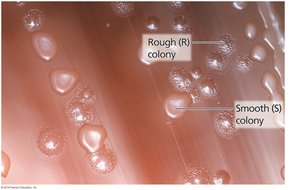
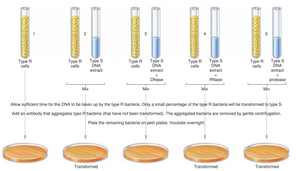
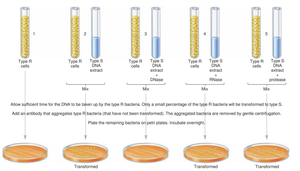
Griffith's Experiment (1928): Demonstrated the 'transforming principle' in Streptococcus pneumoniae, showing that genetic traits could be transferred between bacteria.
Avery, MacLeod, and McCarty (1944): Identified DNA as the transforming principle by selectively destroying cellular components and observing transformation only when DNA was intact.
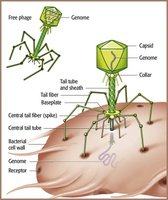
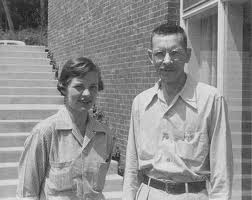
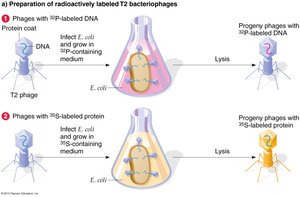
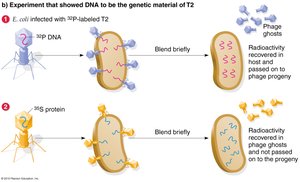
Hershey-Chase Experiment (1952): Used bacteriophages labeled with radioactive isotopes to confirm that DNA, not protein, is the genetic material transferred during viral infection.
Example: The transformation of non-virulent R strain bacteria into virulent S strain by DNA from heat-killed S strain.
Definition and Function of Genes
Genes are fundamental units of heredity, defined both genetically and molecularly:
Genetic Definition: Genes control aspects of an organism’s phenotype and reside on chromosomes, segregating during reproduction.
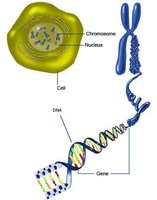
Molecular Definition: A gene is a segment of DNA containing the information to express a protein or functional RNA.
Structure of DNA
DNA Composition and Nucleotides
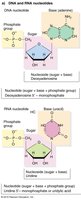
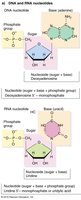
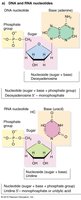
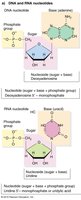
DNA and RNA are nucleic acids, polymers of nucleotides. Each nucleotide consists of:
A pentose (5-carbon) sugar
A base (purine or pyrimidine)
A phosphate group (PO4)
DNA: Deoxyribonucleic acid (deoxyribose sugar, bases A, G, C, T)
RNA: Ribonucleic acid (ribose sugar, bases A, G, C, U)
Chargaff's Rules
Erwin Chargaff showed that in DNA:
The amount of adenine (A) equals thymine (T)
The amount of guanine (G) equals cytosine (C)
This provided clues to the base pairing mechanism in DNA.
Double Helix Structure
Watson and Crick, using data from Chargaff and Rosalind Franklin, proposed the double helix model of DNA in 1953:
Two antiparallel polynucleotide strands form a right-handed double helix
Sugar-phosphate backbone on the outside, paired bases on the inside
A pairs with T (two hydrogen bonds), G pairs with C (three hydrogen bonds)
One turn of the helix is 3.4 nm and contains ten base pairs
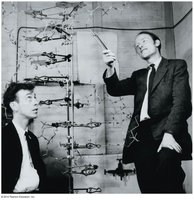
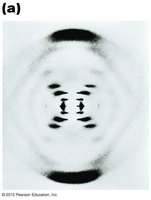
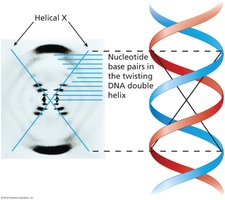
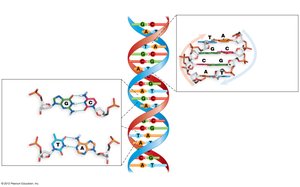
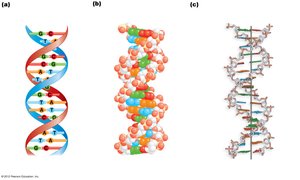
Example: The antiparallel orientation of DNA strands: 5' to 3' and 3' to 5'.
Phosphodiester Bonds and DNA Polarity
Nucleotide monomers are joined by covalent phosphodiester bonds between the 5' phosphate and 3' hydroxyl groups, giving DNA strands polarity (5' end and 3' end).
Phosphodiester bond: $\text{O-P-O}$
Organization of Genomes
Prokaryotic Genomes
Prokaryotes (bacteria and archaea) typically have:
Double-stranded DNA
Single, circular chromosome
Smaller circles of DNA called plasmids
DNA is supercoiled for compaction
Example: The E. coli genome is 4.6 Mb, much longer than the cell itself.
Eukaryotic Genomes
Eukaryotes have:
Double-stranded DNA
Multiple linear chromosomes
DNA wrapped around histone proteins forming chromatin
Basic unit: nucleosome (146-147 bp DNA around eight histones)
Higher-order chromatin structure for further compaction
Special structures at chromosome ends called telomeres
Virus Genomes
Variability in Genetic Material
Viruses can have genomes composed of DNA or RNA, which may be single- or double-stranded, circular or linear, and distributed across one or several pieces. Some viruses, such as retroviruses, have RNA genomes.
Summary Table: DNA vs. RNA
Feature | DNA | RNA |
|---|---|---|
Sugar | Deoxyribose | Ribose |
Bases | A, G, C, T | A, G, C, U |
Strandedness | Usually double-stranded | Usually single-stranded |
Function | Genetic information storage | Information transfer, regulation, catalysis |
Key Equations
Chargaff's Rule: $\text{[A]} = \text{[T]}, \text{[G]} = \text{[C]}$
Phosphodiester bond formation: $\text{5'}\text{-phosphate} + \text{3'}\text{-OH} \rightarrow \text{phosphodiester bond}$
Conclusion
DNA is the primary genetic material in prokaryotes and eukaryotes, with its structure and function elucidated through key experiments and molecular models. Its organization varies across domains of life and is fundamental to heredity, variation, and evolution.
