 Back
BackDNA Mutation and Repair: Types, Mechanisms, and Genetic Implications
Study Guide - Smart Notes
 Tailored notes based on your materials, expanded with key definitions, examples, and context.
DNA Mutation & Repair
Introduction to DNA Mutation
Mutations are permanent alterations in the DNA sequence that can affect genetic information and phenotype. They are a fundamental source of genetic variation, which drives evolution, but can also cause diseases and disorders. Mutations can occur in both somatic and germ cells, and in coding or noncoding regions of the genome.
Mutation: Any change in the DNA sequence, including base substitutions, insertions, deletions, or larger chromosomal alterations.
Genetic Variation: Mutations provide the raw material for evolution and are essential for probing biological processes.
Human Disease: Many inherited diseases are caused by mutations in specific genes.
Classification of Mutations by Molecular Change
Mutations can be classified based on the type of molecular change they introduce into the DNA sequence.
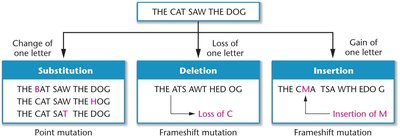
Point Mutation: A change affecting a single nucleotide pair.
Base Substitution: Replacement of one nucleotide and its partner with another pair.
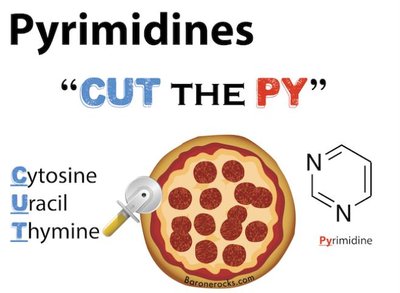
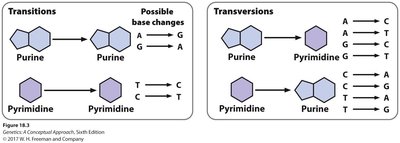
Transition: Purine replaces purine (A ↔ G) or pyrimidine replaces pyrimidine (C ↔ T).
Transversion: Purine interchanges with pyrimidine (A or G ↔ C or T).
Insertion/Deletion: Addition or loss of one or more nucleotides, which may cause frameshift mutations if not in multiples of three.
Types of Point Mutations
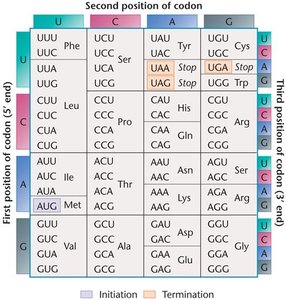
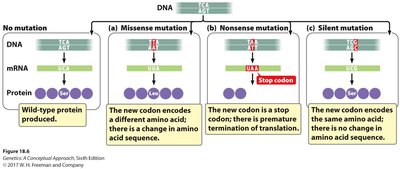
Missense Mutation: Alters a codon so that a different amino acid is inserted into the protein.
Nonsense Mutation: Converts a codon encoding an amino acid into a stop codon, leading to premature termination of translation.
Silent Mutation: Changes a codon to a synonymous codon, so the amino acid sequence remains unchanged.
Frameshift Mutations
Frameshift mutations result from insertions or deletions that are not multiples of three nucleotides, altering the reading frame of the gene and typically resulting in a nonfunctional protein.
Frameshift mutations are among the most deleterious changes to the coding sequence of a protein.
Examples of Mutation: Sickle-Cell Disease
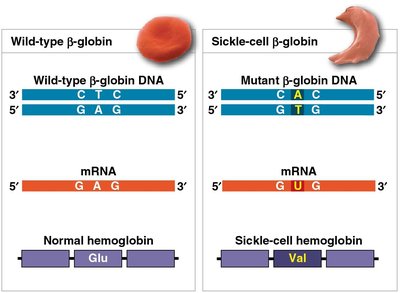
Sickle-cell disease is caused by a missense mutation in the β-globin gene, resulting in the substitution of valine for glutamic acid. This mutation reduces the oxygen-carrying capacity of red blood cells and is lethal in homozygotes, but heterozygotes have increased resistance to malaria (heterozygote advantage).

Classification of Mutations by Phenotype
Mutations can also be classified based on their effects on phenotype:
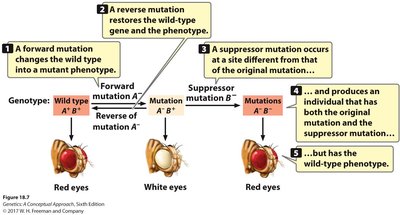
Forward Mutation: Changes wild-type to mutant phenotype.
Reverse Mutation: Changes mutant phenotype back to wild-type.
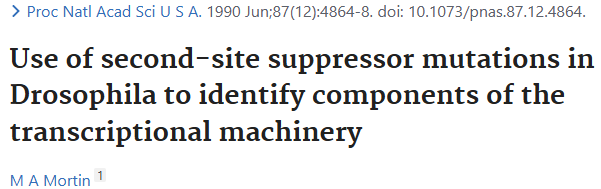
Suppressor Mutation: A second mutation that hides or suppresses the effect of a primary mutation. Can be intragenic (within the same gene) or intergenic (in a different gene).
Neutral Mutation: No effect on organism's fitness or protein function.
Lethal Mutation: Interrupts essential processes, resulting in death.
Conditional Mutation: Expressed only under certain environmental conditions (e.g., temperature-sensitive mutations).
Loss-of-Function Mutation: Reduces or eliminates gene function.
Gain-of-Function Mutation: Produces a new or enhanced activity.
Dominant-Negative Mutation: Mutant protein interferes with the function of the wild-type protein.
Classification of Mutations by Location
Mutations are also categorized by their location in the genome:
Somatic Mutation: Occurs in non-germ cells; not heritable.
Germ-Line Mutation: Occurs in gametes; heritable and passed to offspring.
Autosomal Mutation: Occurs in genes on autosomes.
Sex-Linked Mutation: Occurs in genes on sex chromosomes (X or Y).
Summary Table: Types of Mutations
Type of Mutation | Definition |
|---|---|
Base substitution | Change of a single DNA nucleotide |
Transition | Purine ↔ purine or pyrimidine ↔ pyrimidine |
Transversion | Purine ↔ pyrimidine |
Insertion | Addition of one or more nucleotides |
Deletion | Loss of one or more nucleotides |
Frameshift mutation | Insertion/deletion altering reading frame |
Missense mutation | Codon change results in different amino acid |
Nonsense mutation | Codon change results in stop codon |
Silent mutation | Codon change does not alter amino acid |
Neutral mutation | Change does not affect protein function |
Loss-of-function | Reduces or eliminates gene function |
Gain-of-function | New or enhanced gene function |
Lethal mutation | Causes premature death |
Suppressor mutation | Suppresses effect of another mutation |
Causes of Mutation: Spontaneous vs. Induced
Mutations can arise spontaneously or be induced by external factors.
Spontaneous Mutation: Occurs naturally due to errors in DNA replication or spontaneous chemical changes.
Induced Mutation: Caused by environmental agents (mutagens) such as chemicals or radiation.
Spontaneous Replication Errors
DNA Polymerase Errors: Occasional misincorporation of nucleotides during replication, sometimes escaping proofreading and repair mechanisms.
Tautomeric Shifts: Temporary changes in base structure (tautomers) can lead to abnormal base pairing and transition mutations.
Spontaneous Chemical Changes
Depurination: Loss of a purine base (A or G), creating an apurinic site. If unrepaired, can result in the insertion of an incorrect base during replication.
Deamination: Loss of an amino group from a base, such as cytosine to uracil, leading to C→T transitions after replication.
Genetic Code and Translation
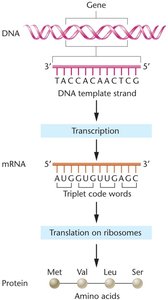
The genetic code is read in triplets (codons) during translation. Mutations can alter the reading frame or codon identity, affecting protein synthesis and function.
Summary
Mutations are essential for genetic diversity but can also cause disease.
They are classified by molecular change, phenotype, and location.
Spontaneous mutations arise from replication errors and chemical changes; induced mutations are caused by environmental factors.
Understanding mutation types and mechanisms is crucial for genetics, evolution, and medical research.
