 Back
BackDNA Mutation, Repair, and Genetic Mapping in Eukaryotes
Study Guide - Smart Notes
 Tailored notes based on your materials, expanded with key definitions, examples, and context.
Ch 15: DNA Mutation & Repair
Introduction to DNA Repair
DNA repair systems are essential for maintaining the integrity of genetic material. These systems counteract both spontaneous and induced DNA damage, preventing genetic diseases and cancer. Multiple repair pathways exist to address different types of DNA lesions.
Single-strand repair mechanisms: Mismatch Repair (MMR), Base Excision Repair (BER), Nucleotide Excision Repair (NER)
Double-strand repair mechanisms: Homologous Recombination (HR), Nonhomologous End Joining (NHEJ)
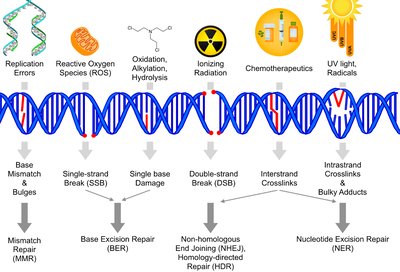
Mismatch Repair (MMR)
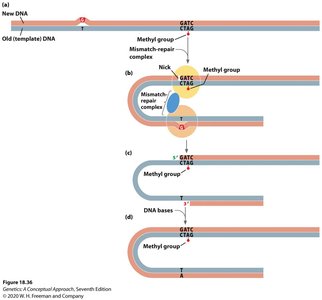
Mismatch repair corrects errors that escape proofreading during DNA replication. It distinguishes the newly synthesized strand from the template to ensure accurate repair.
Strand discrimination in bacteria: Based on DNA methylation. Adenine methylase adds methyl groups to adenine residues; newly synthesized DNA is temporarily unmethylated, allowing the repair machinery to target the correct strand.
Strand discrimination in eukaryotes: The new strand is identified by nicks at the ends of Okazaki fragments.
Key proteins: MutS (recognizes mismatch), MutL (mediator), MutH (endonuclease, nicks unmethylated strand), exonucleases (remove mismatched region), DNA polymerase (fills gap), DNA ligase (seals nick).
Base Excision Repair (BER)
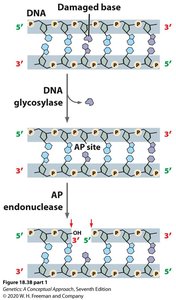
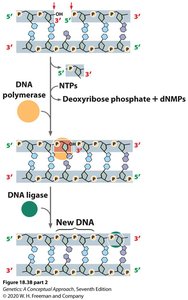
BER corrects DNA containing small, non-helix-distorting base lesions, such as deaminated, oxidized, or alkylated bases. The process involves excision of the damaged base followed by replacement of the nucleotide.
DNA glycosylase: Recognizes and removes the damaged base, creating an apurinic/apyrimidinic (AP) site.
AP endonuclease: Cleaves the DNA backbone at the AP site.
DNA polymerase: Fills in the correct nucleotide.
DNA ligase: Seals the nick to restore the DNA strand.
Nucleotide Excision Repair (NER)
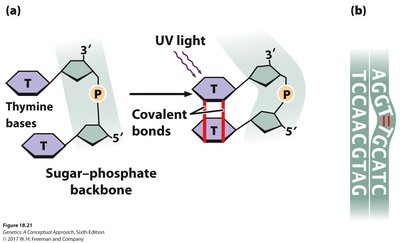
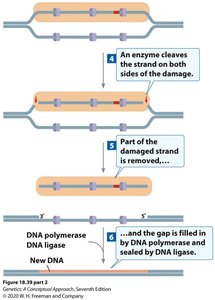
NER repairs bulky, helix-distorting lesions such as pyrimidine dimers caused by UV light or chemical adducts. It removes and replaces a short single-stranded DNA segment containing the lesion.
Damage recognition: Enzyme complex detects distortion in DNA structure.
Excision: Endonucleases cleave the DNA on both sides of the lesion.
Repair synthesis: DNA polymerase fills in the gap; DNA ligase seals the nick.
Key proteins in bacteria: UvrA, UvrB, UvrC, UvrD.
Direct Repair
Direct repair mechanisms restore altered bases to their original structures without removing the nucleotide. An example is photoreactivation repair, where the enzyme photolyase uses blue light to cleave thymine dimers caused by UV radiation. Humans lack this pathway.
Photoreactivation repair: Photolyase absorbs blue light and breaks the covalent bonds of thymine dimers, restoring normal base pairing.
SOS Repair (Bacterial Emergency Response)
The SOS response in bacteria is an emergency repair system activated by extensive DNA damage. It allows DNA replication to continue past lesions but is error-prone, introducing mutations that may contribute to genetic diversity and antibiotic resistance.
Key features: Last-resort mechanism, error-prone DNA synthesis, survival advantage under severe DNA damage.
Double-Strand Break Repair (DSB Repair)
Double-strand breaks are among the most lethal forms of DNA damage. Two main pathways repair DSBs:
Nonhomologous End Joining (NHEJ): Directly joins broken DNA ends, often resulting in loss of nucleotides and possible mutations. Ku proteins stabilize DNA ends and recruit repair enzymes.
Homologous Recombination (HR): Uses a homologous sequence (usually a sister chromatid) as a template for accurate repair. Involves strand invasion, DNA synthesis, and ligation. Requires BRCA proteins and occurs mainly in S and G2 phases.
Repair Pathway | Template Required? | Fidelity | Cell Cycle Phase |
|---|---|---|---|
NHEJ | No | Low (error-prone) | Any |
HR | Yes (sister chromatid) | High (accurate) | S/G2 |
Ch 6: Genetic Mapping in Eukaryotes
Basic Genetic Terms
Gene: An inherited factor (encoded in DNA) that determines a characteristic.
Allele: Alternative forms of a gene.
Locus: Specific location of a gene on a chromosome.
Genotype: Set of alleles possessed by an individual.
Phenotype: Observable manifestation of a characteristic.
Mendelian Principles
Law of Segregation: Two alleles for each gene separate during gamete formation.
Law of Independent Assortment: Alleles of different genes assort independently if on different chromosomes.
Genetic Variation
Sources: Mutation (creates new alleles), independent assortment, crossing over, random fertilization.
Result: Each zygote has a unique genetic identity; sexual reproduction increases genetic diversity.
Genetic Recombination and Linkage
Genetic recombination refers to the production of offspring with combinations of traits differing from either parent. Genes located close together on the same chromosome (linked genes) tend to be inherited together, but crossing over during meiosis can separate them, producing recombinants.
Independent assortment: Genes on different chromosomes show 50% recombination frequency.
Linkage: Genes on the same chromosome may show less than 50% recombination, depending on their distance apart.
Genetic Mapping
Genetic mapping determines the relative positions of genes on chromosomes by analyzing recombination frequencies. The farther apart two genes are, the higher the probability of crossover and recombination frequency.
Map unit (mu) or centiMorgan (cM): 1% recombination frequency = 1 mu or 1 cM.
Additivity: Recombination frequencies between linked genes are additive, but not always equal to physical distance due to crossover hotspots and coldspots.
Gene Pair | Recombination Frequency | Interpretation |
|---|---|---|
yellow, white | 0.5% | Very close together |
white, miniature | 34.5% | Farther apart |
yellow, miniature | 35.4% | Farther apart |
Key Concepts in Linkage and Mapping
Complete linkage: 0% recombination; genes always inherited together.
Maximum recombination frequency: 50%, as seen with unlinked genes or genes far apart on the same chromosome.
Double crossovers: Can complicate mapping; must be considered in three-point testcrosses.
Applications
Human Genome Project: Used genetic and physical mapping to sequence the human genome.
Gene mapping in model organisms: Drosophila (fruit fly) is a classic model for linkage and mapping studies.
