 Back
BackDNA Mutation: Types, Causes, and Repair Mechanisms
Study Guide - Smart Notes
 Tailored notes based on your materials, expanded with key definitions, examples, and context.
DNA Mutation and Repair
Introduction to DNA Mutation
Mutations are permanent changes in the DNA sequence that can affect genetic information and lead to various biological consequences. They can occur spontaneously or be induced by external factors. Understanding the mechanisms and repair of mutations is essential for genetics, as mutations are the source of genetic variation and can also cause genetic diseases and cancer.
Types and Causes of DNA Mutation
Spontaneous Mutations
Spontaneous Replication Errors: Mistakes made by DNA polymerase during replication, sometimes escaping proofreading mechanisms.
Spontaneous Chemical Changes: Chemical alterations in DNA bases that occur naturally, such as depurination and deamination.
Depurination
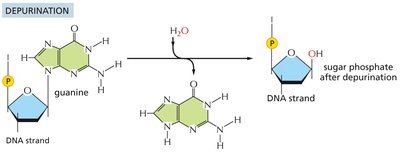
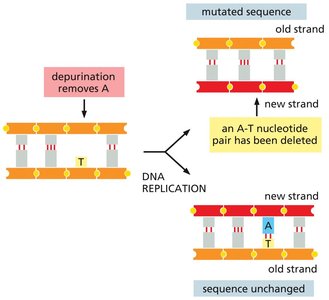
Depurination is the loss of a purine base (adenine or guanine) from the DNA molecule, creating an apurinic site. If not repaired, this can lead to the loss of a nucleotide pair during replication or the insertion of an incorrect base.
Mechanism: Hydrolysis of the glycosidic bond between the base and deoxyribose sugar.
Consequence: Can result in frameshift mutations or base substitutions.
Deamination
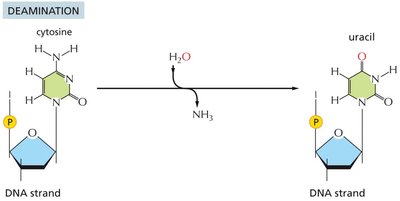
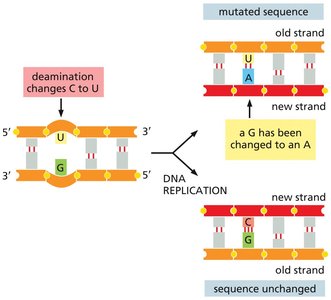
Deamination is the removal of an amino group from a DNA base, most commonly cytosine, converting it to uracil. This alters base-pairing properties and can result in transition mutations if not repaired before replication.
Cytosine to Uracil: Uracil pairs with adenine, leading to a C→T transition after two rounds of replication.
5-Methylcytosine to Thymine: Deamination of 5-methylcytosine produces thymine, which is more difficult for repair systems to recognize as abnormal.

Induced Mutations
Induced mutations result from exposure to external physical or chemical agents known as mutagens.
Chemical Mutagens: Include base analogs, alkylating agents, deaminating agents, hydroxylamine, intercalating agents, and oxidative agents.
Physical Mutagens: Include various forms of radiation such as ultraviolet (UV) light and ionizing radiation (X-rays, gamma rays, cosmic rays).
Intercalating Agents
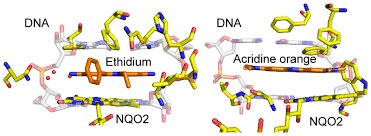
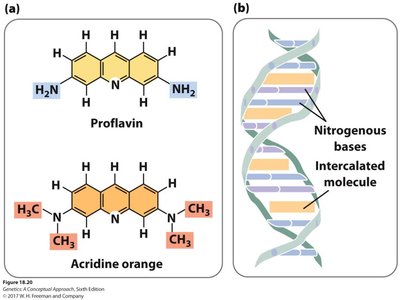
Intercalating agents are planar molecules that insert between DNA base pairs, distorting the double helix and causing insertions or deletions during replication. Examples include ethidium bromide, proflavin, and acridine orange.
Oxidative Damage
Oxidative damage is caused by reactive oxygen species (free radicals) generated during normal cellular metabolism or by exposure to ionizing radiation. These species can alter bases, break DNA strands, and cause deletions or translocations.
Radiation-Induced Mutations
Ultraviolet (UV) Light: Causes the formation of pyrimidine dimers, especially thymine dimers, which distort DNA structure and block replication.
Ionizing Radiation: X-rays, gamma rays, and cosmic rays can cause single- and double-strand breaks, base modifications, and chromosomal rearrangements.

The Ames Test for Mutagenicity
Principle and Procedure
The Ames test is a widely used assay to assess the mutagenic potential of chemical compounds. It uses auxotrophic strains of Salmonella or E. coli that cannot synthesize histidine (his⁻). The test measures the rate at which these bacteria revert to histidine prototrophy (his⁺) in the presence of a suspected mutagen.
Auxotroph: A mutant organism that requires a specific additional nutrient for growth.
Minimal Medium: Contains only essential nutrients; only prototrophs can grow.
Complete Medium: Contains all nutrients required for growth, allowing both auxotrophs and prototrophs to grow.
Rat Liver Extract: Added to simulate mammalian metabolism, as some chemicals become mutagenic only after metabolic activation.
Interpretation of Results
Increased number of revertant colonies indicates mutagenicity of the tested compound.
A positive Ames test suggests that the compound may also be carcinogenic, as many carcinogens are mutagens.
Plate Condition | Expected Result | Interpretation |
|---|---|---|
Control (no mutagen) | Few colonies | Spontaneous mutation rate |
Test compound | Many colonies | Compound is mutagenic |
Test compound + liver extract | More/fewer colonies | Compound is mutagenic only after metabolism, or detoxified by metabolism |
Transposable Elements (TEs)
Definition and Impact
Transposable elements, or "jumping genes," are DNA sequences that can move within the genome. They can cause mutations by inserting into or excising from genes, altering gene function or regulation. In humans, about 45% of the genome is derived from TEs, mostly retrotransposons.
DNA Repair Mechanisms
Overview
DNA repair systems are essential for maintaining genetic integrity by correcting damage caused by spontaneous or induced mutations. Failure in these systems can lead to genetic diseases and cancer.
Types of DNA Repair
Proofreading: DNA polymerase corrects errors during replication by removing and replacing mispaired nucleotides.
Mismatch Repair (MMR): Corrects errors missed by proofreading, such as base mismatches and small insertions/deletions.
Base Excision Repair (BER): Removes and replaces damaged bases resulting from deamination, oxidation, or alkylation.
Nucleotide Excision Repair (NER): Removes bulky DNA lesions, such as thymine dimers caused by UV light.
Homologous Recombination (HR) Repair: Repairs double-strand breaks using a homologous template.
Nonhomologous End Joining (NHEJ): Repairs double-strand breaks without a homologous template, often resulting in small insertions or deletions.
Strand Discrimination in Mismatch Repair
Bacteria: Newly synthesized DNA is unmethylated for a short time. Mismatch repair enzymes recognize the unmethylated strand as the one to be corrected.
Eukaryotes: The newly synthesized strand is identified by nicks at the ends of Okazaki fragments on the lagging strand.
Summary Table: Types of DNA Damage and Repair Mechanisms
Type of Damage | Cause | Repair Mechanism |
|---|---|---|
Base mismatch | Replication error | Proofreading, MMR |
Depurination | Spontaneous hydrolysis | BER |
Deamination | Spontaneous/chemical | BER |
Pyrimidine dimer | UV light | NER |
Double-strand break | Ionizing radiation | HR, NHEJ |
