 Back
BackDNA Repair Mechanisms in Genetics
Study Guide - Smart Notes
 Tailored notes based on your materials, expanded with key definitions, examples, and context.
DNA Repair Mechanisms
Introduction to DNA Repair
DNA repair is essential for maintaining genetic stability and preventing mutations that can lead to diseases such as cancer. Cells possess multiple repair pathways to correct different types of DNA damage, ensuring the integrity of genetic information across generations.
DNA damage can arise from replication errors, environmental factors (e.g., UV light, chemicals), or spontaneous chemical changes.
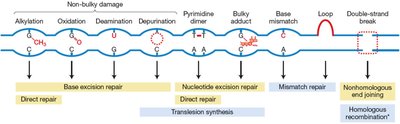
Cells distinguish between types of damage, such as small base changes, bulky distortions, mismatches, and strand breaks, to select the appropriate repair mechanism.
Proofreading by DNA Polymerase
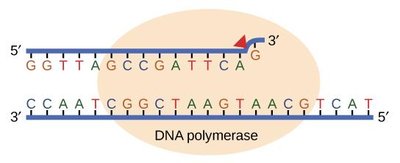
During DNA replication, DNA polymerase possesses a proofreading function that corrects most errors immediately as they occur.
DNA polymerase checks each newly added nucleotide for correct base pairing.
If an incorrect base is detected, the enzyme removes it using its 3'→5' exonuclease activity and replaces it with the correct nucleotide.
Major DNA Repair Mechanisms
Direct Repair
Direct repair mechanisms restore damaged DNA bases to their original form without removing nucleotides or cleaving the DNA backbone. These processes are highly specific and enzyme-mediated.
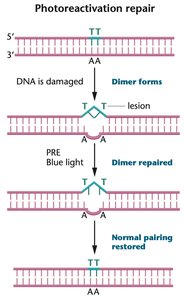
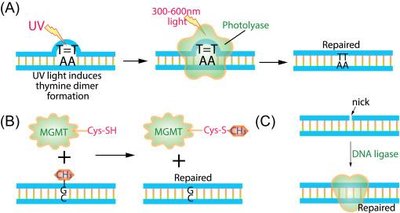
Photoreactivation: Repairs UV-induced thymine dimers using the enzyme photolyase, which is activated by visible light (300–600 nm).
Alkylation repair: The enzyme O6-methylguanine methyltransferase (MGMT) removes methyl groups from alkylated guanine bases.
Base Excision Repair (BER)
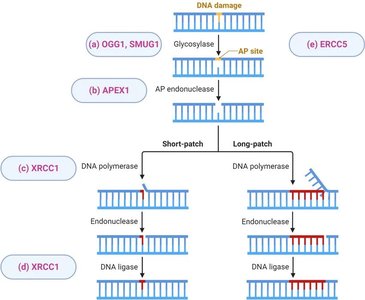
Base excision repair corrects non-bulky, small base lesions that do not distort the DNA helix, such as deaminated, oxidized, or alkylated bases.
DNA glycosylase recognizes and removes the damaged base, creating an abasic (AP) site.
AP endonuclease cleaves the DNA backbone at the AP site.
DNA polymerase fills in the gap with the correct nucleotide.
DNA ligase seals the nick in the backbone.
Nucleotide Excision Repair (NER)
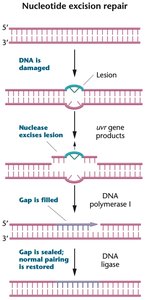
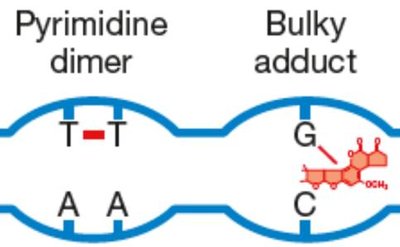
Nucleotide excision repair removes bulky DNA lesions that distort the double helix, such as thymine dimers and bulky adducts (e.g., benzo[a]pyrene-guanine adducts from smoke).
A nuclease excises a short single-stranded DNA segment containing the lesion.
DNA polymerase synthesizes new DNA using the undamaged strand as a template.
DNA ligase seals the final phosphodiester bond.
Mismatch Repair (MMR)
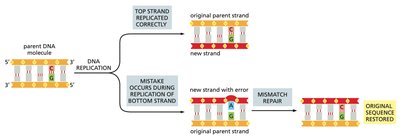
Mismatch repair corrects base-pair mismatches that escape proofreading during DNA replication. This system distinguishes the newly synthesized strand from the parental strand to ensure only the incorrect base is removed.
In bacteria, the parental strand is methylated, while the new strand is not immediately methylated.
MMR proteins (e.g., MutS, MutL, MutH in E. coli) recognize the mismatch, excise a segment of the new strand, and DNA polymerase fills the gap.
In eukaryotes, strand discrimination is based on nicks and interaction with replication machinery.
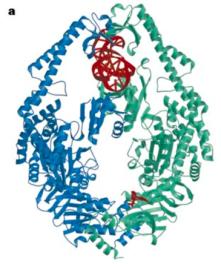
Double-Strand Break Repair
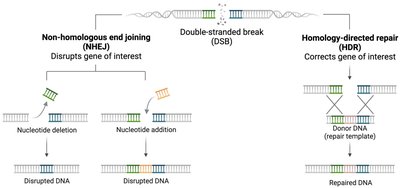
Double-strand breaks (DSBs) are severe DNA lesions that can be repaired by two main mechanisms: Non-Homologous End Joining (NHEJ) and Homologous Recombination Repair (HRR).
Non-Homologous End Joining (NHEJ)
NHEJ directly ligates the broken DNA ends without the need for a homologous template.
This process can result in the loss or addition of nucleotides at the break site, potentially causing mutations.
NHEJ operates throughout the cell cycle.
Homologous Recombination Repair (HRR)
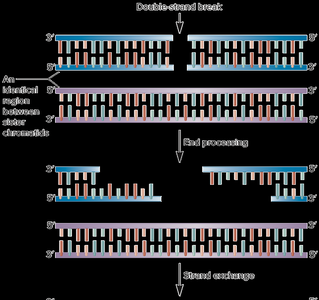
HRR uses a homologous DNA sequence (usually a sister chromatid) as a template for accurate repair.
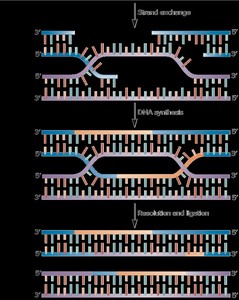
Key steps include end resection, strand invasion, DNA synthesis, and resolution of Holliday junctions.
HRR is most active during the S and G2 phases of the cell cycle when a sister chromatid is available.
Resolution of Holliday Junctions
Holliday junctions are cross-shaped DNA structures formed during homologous recombination. Their resolution determines whether a crossover (exchange of chromosome arms) or non-crossover (patch repair) occurs.
Enzymatic cleavage of the junction can result in either outcome, influencing genetic diversity and genome stability.
Summary Table: DNA Repair Mechanisms
Type of Damage | Repair Mechanism | Key Enzymes/Proteins | Notes |
|---|---|---|---|
Non-bulky base changes | Base Excision Repair (BER) | DNA glycosylase, AP endonuclease, DNA polymerase, DNA ligase | Removes single abnormal bases |
Bulky adducts, thymine dimers | Nucleotide Excision Repair (NER) | Nuclease, DNA polymerase, DNA ligase | Removes short DNA segment |
Base mismatches | Mismatch Repair (MMR) | MutS, MutL, MutH (bacteria); MSH2, MSH6 (eukaryotes) | Corrects replication errors |
Double-strand breaks | NHEJ, HRR | Ku proteins, Ligase IV (NHEJ); Rad51, BRCA1/2 (HRR) | NHEJ is error-prone; HRR is accurate |
UV-induced dimers | Direct Repair (Photoreactivation) | Photolyase | Requires light energy |
