 Back
DNA Replication and Recombination: Structure, Mechanism, and Experimental Evidence
Study Guide - Smart Notes
 Tailored notes based on your materials, expanded with key definitions, examples, and context.
DNA Organization in Chromosomes
Chromatin Structure and DNA Compaction
The organization of DNA within chromosomes is essential for efficient packaging and regulation of gene expression. Eukaryotic cells contain approximately 2 meters of DNA, which must fit inside a nucleus with a diameter of about 5 µm. This is achieved through multiple levels of DNA compaction, involving structural proteins and nucleosomes.
Chromatin: The substance of chromosomes, consisting of DNA and associated proteins.
Nucleosome: The basic unit of chromatin, formed by DNA wrapped around a core of eight histone proteins.
Scaffold Proteins: Provide structural frameworks for higher-order DNA folding.
Compaction Levels: DNA is compacted into chromatin, then further into scaffold-associated chromatin, condensed heterochromatin, and finally into compacted chromosomes.
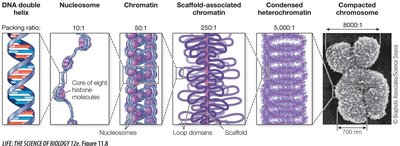
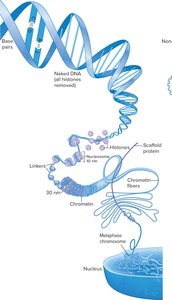
Example: The nucleosome structure allows for a packing ratio of 10:1, while fully compacted chromosomes achieve a packing ratio of 8000:1.
DNA Replication: Mechanism and Models
Overview of DNA Replication
DNA replication is the process by which a cell duplicates its genetic material prior to cell division. The mechanism ensures high fidelity and rapid synthesis, despite the vast size of the genome.
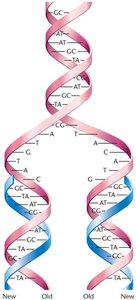
Semi-conservative Replication: Each new DNA molecule consists of one old (parental) strand and one newly synthesized strand.
Replication Fork: The site where DNA is locally opened for replication.
Fidelity: DNA polymerases have proofreading abilities, reducing the error rate to approximately 1 in 109 nucleotides.
Models of DNA Replication
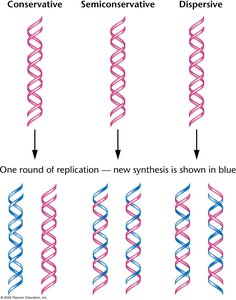
Three main models were proposed for DNA replication: conservative, semi-conservative, and dispersive. Experimental evidence supports the semi-conservative model.
Conservative Model: Both strands of the parent DNA remain together; new DNA consists of entirely new strands.
Semi-conservative Model: Each daughter DNA contains one parental and one new strand.
Dispersive Model: DNA strands are a patchwork of old and new segments.
Experimental Evidence: Meselson-Stahl Experiment
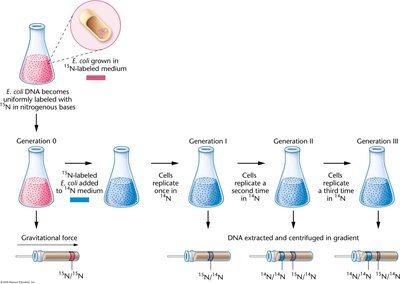
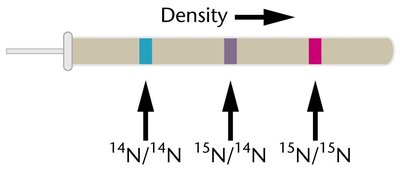
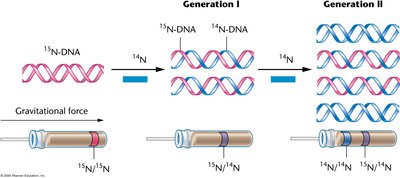
The Meselson-Stahl experiment (1958) provided definitive evidence for the semi-conservative replication of DNA using isotopes of nitrogen (15N and 14N) in E. coli.
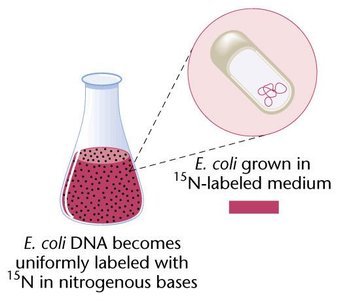
Heavy Isotope Labeling: Bacteria were grown in 15N medium, resulting in heavy DNA.
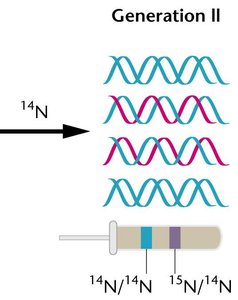
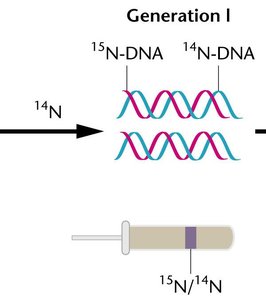
Centrifugation: DNA was separated by density after replication in 14N medium.
Results: After one generation, DNA was intermediate in density (15N/14N); after two generations, both intermediate and light DNA (14N/14N) were observed, supporting the semi-conservative model.

Replication Model | Generation I | Generation II |
|---|---|---|
Conservative | 15N/15N & 14N/14N | 15N/15N & 14N/14N |
Semi-conservative | 15N/14N | 15N/14N & 14N/14N |
Dispersive | 15N/14N | 15N/14N |
Experimental Evidence: Taylor-Woods-Hughes Experiment
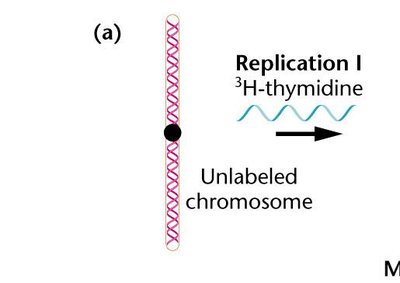
The Taylor-Woods-Hughes experiment (1957) demonstrated semi-conservative replication in eukaryotes using 3H-thymidine labeling in Vicia faba (broad bean).
Autoradiography: Allowed visualization of labeled chromatids after replication.
Results: Both sister chromatids labeled after first replication; after second replication, only one chromatid labeled, confirming semi-conservative replication.
Mechanism of DNA Replication
Steps of DNA Replication
DNA replication involves three main steps: initiation, elongation, and termination. Each step is facilitated by specific enzymes and proteins.
Initiation: DNA double helix is unwound, and primers are synthesized.
Elongation: DNA polymerase adds nucleotides to the growing strand in the 5' to 3' direction.
Termination: Replication ends when all DNA regions are copied.
Key Enzymes:
Helicase: Unwinds the DNA helix.
Gyrase (Topoisomerase): Relieves supercoiling.
Single-Stranded Binding Proteins (SSBPs): Stabilize separated strands.
Primase: Synthesizes RNA primers.
DNA Polymerase III: Main enzyme for DNA synthesis.
DNA Polymerase I: Removes RNA primers and fills gaps.
Ligase: Joins Okazaki fragments.
Leading and Lagging Strands
DNA synthesis occurs in the 5' to 3' direction. The leading strand is synthesized continuously, while the lagging strand is synthesized discontinuously in short segments called Okazaki fragments.
Okazaki Fragments: Short DNA segments on the lagging strand, joined by DNA ligase.
Polymerase Directionality: DNA polymerase can only add nucleotides to the 3' end.
Equation:
Proofreading and DNA Repair
DNA polymerases possess proofreading abilities to correct errors during replication. Additional repair mechanisms include mismatch repair and excision repair.
Proofreading: DNA polymerase removes incorrectly paired bases.
Mismatch Repair: Proteins scan newly replicated DNA for mistakes.
Excision Repair: Enzymes excise damaged bases and DNA polymerase fills in the correct bases.
DNA Replication in Bacteria vs. Eukaryotes
Bacterial DNA Replication
Bacterial chromosomes are circular and contain a single origin of replication (oriC). Replication is bidirectional, proceeding from the origin to the termination region (ter).
Replicon: The region of DNA replicated from a single origin.
DNA Polymerases: Five types (I, II, III, IV, V) with distinct roles in replication and repair.
DNA Polymerase III: Main enzyme for elongation.
DNA Polymerase I: Removes RNA primers and fills gaps.
Eukaryotic DNA Replication
Eukaryotic chromosomes are linear and contain multiple origins of replication, allowing rapid and simultaneous replication of large genomes. DNA is complexed with nucleosomes, requiring additional steps for replication through chromatin.
Multiple Origins: Yeast has 250-400; mammals have ~25,000.
Polymerase Switching: Different polymerases synthesize leading and lagging strands.
Chromatin Remodeling: Nucleosomes must be removed and reassembled during replication.
Telomeres and Telomerase
Telomeres are repetitive DNA sequences at the ends of eukaryotic chromosomes, protecting them from degradation and solving the end-replication problem. Telomerase is a ribonucleoprotein enzyme that extends telomeres in cells that express it (e.g., stem cells, cancer cells).
Hayflick Limit: Most cells can divide only 40-60 times before senescence.
Telomerase Components: TERC (RNA template) and TERT (reverse transcriptase protein).
Clinical Relevance: Abnormal telomere maintenance is associated with aging, genetic disorders, and cancer.
Genetic Recombination
Homologous Recombination
Genetic recombination involves the exchange of genetic material between homologous chromosomes, contributing to genetic diversity. The process is directed by specific enzymes and involves several steps:
Endonuclease Nicking: Introduction of single-strand nicks at identical positions.
Strand Displacement and Pairing: Cut strands pair with complementary strands on the opposite duplex.
Ligation: Loose ends are sealed by ligase.
Branch Migration: The cross bridge moves along the chromosome.
Duplex Separation: Chromosomes bend and rotate, forming the Holliday structure (chi form).
Example: Homologous recombination is essential for proper segregation of chromosomes during meiosis and for DNA repair.
Summary Table: Key Enzymes in DNA Replication
Enzyme | Function |
|---|---|
Helicase | Unwinds DNA helix |
Gyrase (Topoisomerase) | Relieves supercoiling |
SSBPs | Stabilize single-stranded DNA |
Primase | Synthesizes RNA primer |
DNA Polymerase III | Main DNA synthesis |
DNA Polymerase I | Removes RNA primer, fills gaps |
Ligase | Joins Okazaki fragments |
