 Back
DNA Replication and Recombination: Structured Study Notes
Study Guide - Smart Notes
 Tailored notes based on your materials, expanded with key definitions, examples, and context.
DNA Replication and Recombination
Overview of DNA Replication
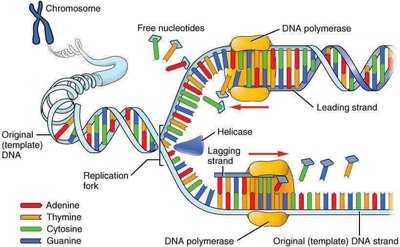
DNA replication is a fundamental process in genetics, ensuring the accurate transmission of genetic information from one generation to the next. The process is highly regulated and involves multiple enzymes and proteins.
Replication Fork: The site where the DNA double helix unwinds to allow replication.
Leading and Lagging Strands: DNA synthesis occurs continuously on the leading strand and discontinuously on the lagging strand.
Key Enzymes: DNA polymerases, helicase, primase, topoisomerase, and single-strand DNA-binding proteins (SSBPs).
Models of DNA Replication
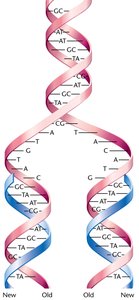
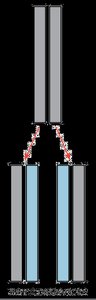
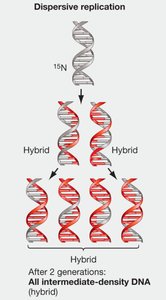
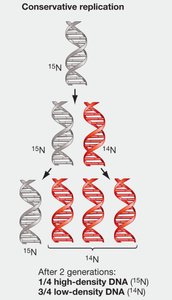
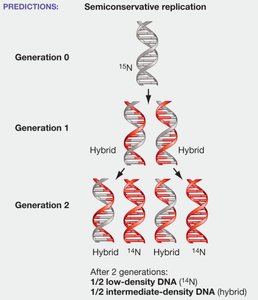
Three models were proposed to explain DNA replication: semi-conservative, conservative, and dispersive.
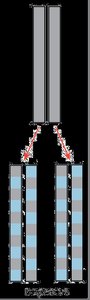
Semi-conservative Replication: Each new DNA molecule consists of one old (parental) strand and one newly synthesized strand.
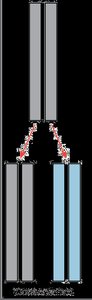
Conservative Replication: The parental DNA remains intact, and a completely new molecule is synthesized.
Dispersive Replication: Both strands of each new DNA molecule contain interspersed segments of old and new DNA.
Experimental Proof of Semi-Conservative Replication
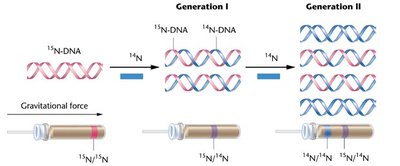
The Meselson-Stahl experiment provided definitive evidence for the semi-conservative model.
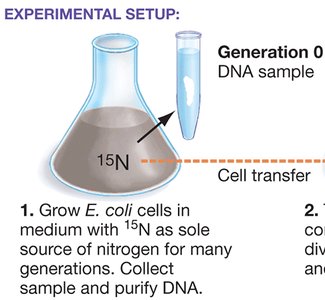
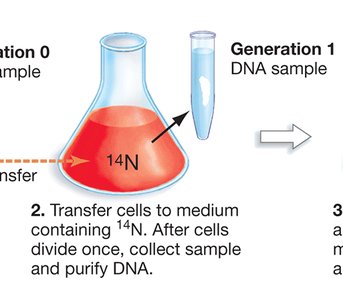
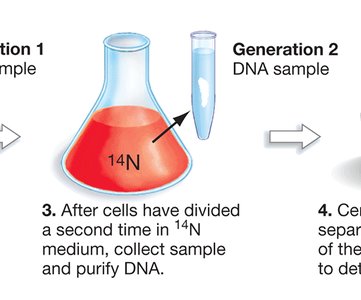
Experimental Setup: E. coli was grown in a medium containing heavy nitrogen (15N), then transferred to a medium with light nitrogen (14N).
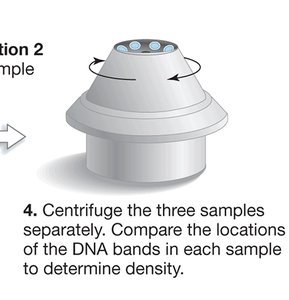
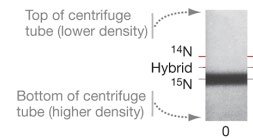
DNA Density: After each generation, DNA samples were centrifuged to separate based on density.
Results: The pattern of DNA bands after successive generations supported the semi-conservative model.
Autoradiography and Chromatid Labeling
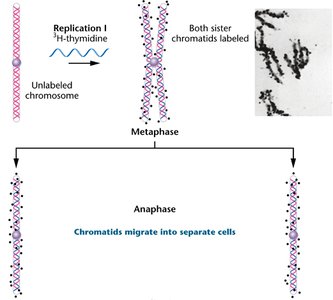
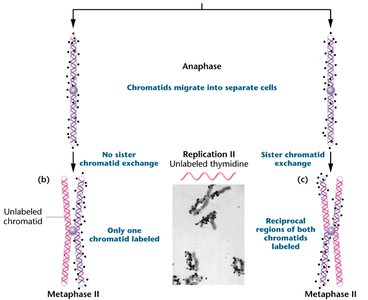
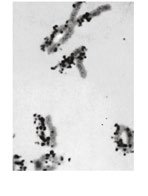
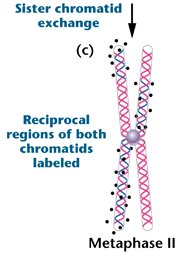
Autoradiography experiments, such as the Taylor-Woods-Hughes experiment, further confirmed semi-conservative replication in eukaryotes.
Chromatid Labeling: Radioactive thymidine was used to label newly synthesized DNA.
Observation: After cell division, labeled chromatids could be visualized, confirming the replication pattern.
Mechanisms and Enzymes of DNA Replication
Origin of Replication and Replication Forks
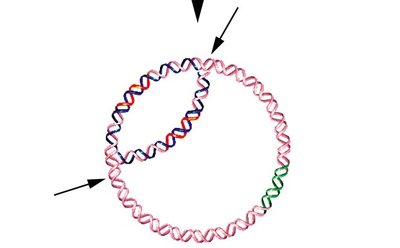
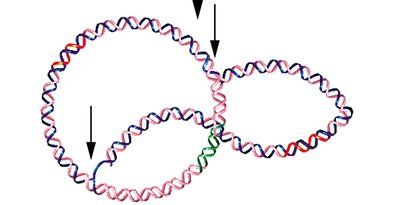
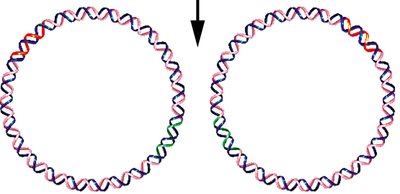
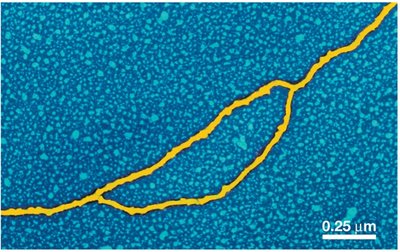
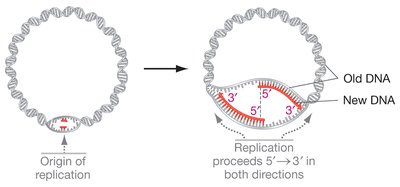
DNA replication begins at specific sites called origins of replication.
Origin of Replication: The location where DNA replication initiates.
Replication Fork: The region where the DNA double helix is unwound and replication occurs.
Replicon: The length of DNA replicated from a single origin.
Key Enzymes and Proteins in DNA Synthesis
DNA replication is a coordinated process involving several enzymes:
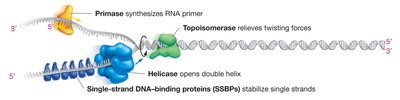
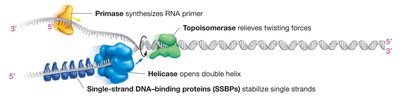
Helicase: Unwinds the DNA double helix by breaking hydrogen bonds.
Single-Strand DNA-Binding Proteins (SSBPs): Stabilize the unwound DNA strands.
Topoisomerase (Gyrase): Relieves supercoiling and twisting forces.
Primase: Synthesizes short RNA primers required for DNA polymerase to initiate synthesis.
DNA Polymerase III: Main enzyme for 5' to 3' polymerization in prokaryotes.
DNA Polymerase I: Removes RNA primers and replaces them with DNA.
DNA Ligase: Joins Okazaki fragments on the lagging strand.
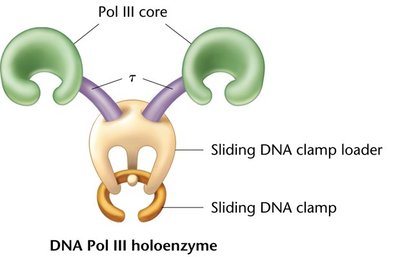

DNA Polymerase III Holoenzyme
The DNA polymerase III holoenzyme is a multi-subunit complex responsible for high-speed and high-fidelity DNA synthesis.
Core Enzyme: Catalytic function (α, ϵ, ϴ subunits).
Sliding Clamp Loader: γ, δ, δ’, χ, ν subunits.
Sliding DNA Clamp: β subunit, holds polymerase to DNA.
τ Subunit: Links core enzyme to clamp loader.
Leading and Lagging Strand Synthesis
Leading Strand: Synthesized continuously in the 5’ to 3’ direction.
Lagging Strand: Synthesized discontinuously, forming Okazaki fragments.
Okazaki Fragments: Short DNA segments synthesized on the lagging strand.
DNA Ligase: Joins Okazaki fragments to form a continuous strand.
Comparison of DNA Replication in Prokaryotes and Eukaryotes
Major Differences
DNA replication differs significantly between prokaryotes and eukaryotes.
Quantity of DNA: Eukaryotes have much more DNA than prokaryotes.
Chromosome Structure: Eukaryotic chromosomes are linear and complexed with histones; prokaryotic chromosomes are circular.
Replication Origins: Eukaryotes have multiple origins of replication; prokaryotes typically have a single origin.
Replication Speed: Eukaryotic DNA polymerase is slower than prokaryotic.
Okazaki Fragments: Eukaryotic Okazaki fragments are smaller.
Eukaryotic Replication Origins and Control
Autonomously Replicating Sequences (ARSs): Found in yeast, contain consensus sequences for origin recognition.
Origin Recognition Complex (ORC): Marks replication origins.
Prereplication Complex (pre-RC): Assembles at origins during G1 phase, ensuring replication occurs only once per cell cycle.
Eukaryotic DNA Polymerases
More Types: Eukaryotes have more DNA polymerase types than prokaryotes.
Pol γ: Specialized for mitochondrial DNA replication.
Telomeres and Telomerase
Replication at Chromosome Ends
The ends of linear chromosomes, called telomeres, pose a unique challenge for DNA replication.
Telomere: Protective cap at the end of a chromosome.
Telomerase: Enzyme that extends telomeres, found in stem cells and most cancer cells but not in most somatic cells.
Senescence: Cells stop dividing when telomeres become too short.
Genetic Recombination
Homologous Recombination
Genetic recombination is a process by which DNA strands are exchanged between homologous chromosomes, increasing genetic diversity.
Predominant Model: Involves endonuclease nicking, strand invasion, ligation, and resolution.
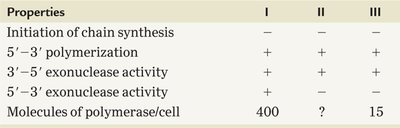
Summary Table: Properties of DNA Polymerases
Properties | I | II | III |
|---|---|---|---|
Initiation of chain synthesis | – | – | – |
5’–3’ polymerization | + | + | + |
3’–5’ exonuclease activity | + | + | + |
5’–3’ exonuclease activity | + | – | – |
Molecules of polymerase/cell | 400 | ? | 15 |
Key Equations
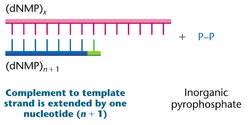
DNA Polymerization Reaction:
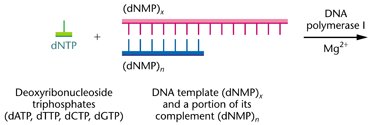
Requirements for DNA Synthesis:
Additional info:
Some details about eukaryotic replication origins and chromatin structure were inferred for completeness.
Descriptions of enzyme functions and replication steps were expanded for academic clarity.
