 Back
DNA Replication and Recombination: Study Notes for Genetics Students
Study Guide - Smart Notes
 Tailored notes based on your materials, expanded with key definitions, examples, and context.
DNA Replication and Recombination
The Central Dogma of Molecular Biology
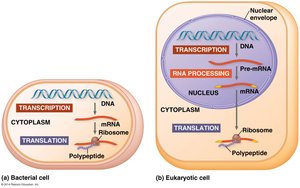
The central dogma describes the flow of genetic information within a cell, from DNA to RNA to protein. This process governs cellular function and trait expression.
Transcription: DNA is transcribed into RNA.
Translation: RNA is translated into protein.
Trait: Proteins determine cellular traits and functions.
Example: In bacteria, transcription and translation occur in the cytoplasm; in eukaryotes, transcription occurs in the nucleus and translation in the cytoplasm.
DNA Replication: Overview
DNA replication is a fundamental process required for cell division and the faithful transmission of genetic material. The human genome contains over 3 billion base pairs, all of which must be duplicated accurately.
Replication is essential for genetic continuity.
Occurs before cell division in all organisms.
Modes of DNA Replication
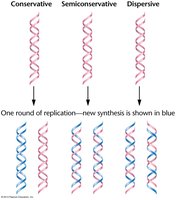
Three theoretical models describe how DNA could replicate:
Conservative: The original DNA helix is conserved, and two newly synthesized strands form a new helix.
Semiconservative: Each new DNA molecule contains one old strand and one new strand.
Dispersive: Parental strands are dispersed into two new double helices.
Semiconservative Replication: Watson and Crick's Proposal
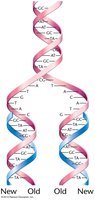
Watson and Crick (1953) proposed that DNA strands are complementary, allowing each strand to serve as a template for the other. Semiconservative replication ensures genetic fidelity.
Each daughter DNA molecule consists of one old and one new strand.
Experimental Evidence: Meselson–Stahl Experiment
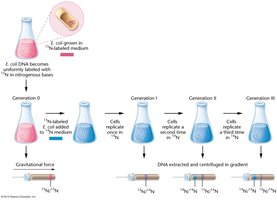
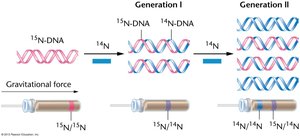
Meselson and Stahl (1958) demonstrated semiconservative replication in E. coli using isotopes of nitrogen (14N and 15N). DNA labeled with 15N is heavier and can be separated from 14N-labeled DNA by centrifugation.
Experimental design: E. coli grown in 15N medium, then transferred to 14N medium.
Results: After replication, DNA showed intermediate density, confirming semiconservative replication.
Origins, Forks, and Replicon
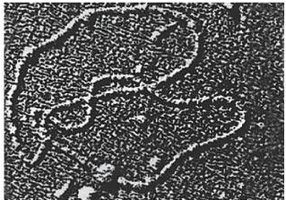
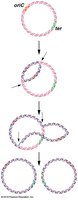
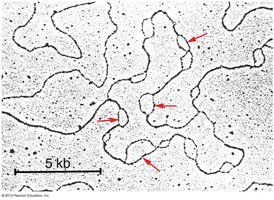
DNA replication begins at specific sites called origins of replication (oriC in E. coli). The unwinding of DNA creates replication forks, and replication proceeds bidirectionally.
Replicon: The length of DNA replicated from a single origin.
Bidirectional replication: Two replication forks move away from the origin.
DNA Polymerases: Structure and Function
DNA polymerases are enzymes that catalyze DNA synthesis. In E. coli, five DNA polymerases (I, II, III, IV, V) are known, each with distinct roles.
DNA Polymerase I: Catalyzes DNA synthesis, removes RNA primers, fills gaps.
DNA Polymerase III: Main enzyme for 5' to 3' polymerization in vivo.
DNA Polymerases II, IV, V: Involved in DNA repair.
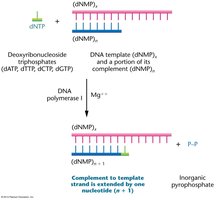
Requirements: Template DNA and four dNTPs (dATP, dGTP, dCTP, dTTP).
DNA Structure and Chain Elongation
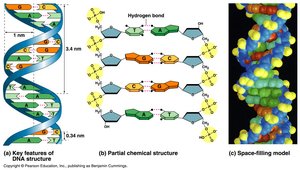
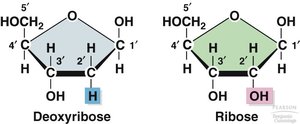
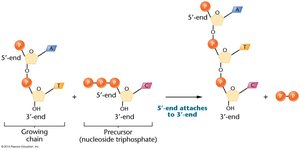
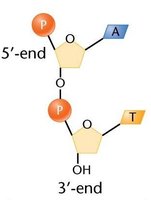
DNA strands are antiparallel and complementary. DNA polymerase catalyzes the formation of phosphodiester bonds between nucleotides, elongating the chain in the 5' to 3' direction.
Phosphodiester linkage: Joins 3'-OH of one nucleotide to the 5'-phosphate of the next.
Chain elongation: Occurs by adding nucleotides to the 3'-OH end.
Properties of DNA Polymerases I, II, and III
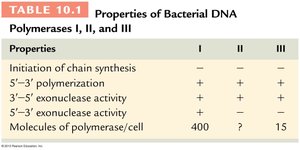
DNA polymerases possess exonuclease activity for proofreading and error correction. Only DNA polymerase I has 5' to 3' exonuclease activity for primer removal.
Polymerase III: Responsible for rapid DNA synthesis.
Polymerase I: Removes primers and fills gaps.
Polymerase II: DNA repair.
Property | I | II | III |
|---|---|---|---|
Initiation of chain synthesis | – | – | – |
5'–3' polymerization | + | + | + |
3'–5' exonuclease activity | + | + | + |
5'–3' exonuclease activity | + | – | – |
Molecules of polymerase/cell | 400 | ? | 15 |
DNA Polymerase III Holoenzyme
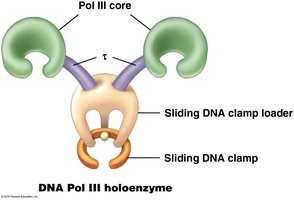
DNA polymerase III is a complex (holoenzyme) composed of multiple subunits, each with specific functions in DNA synthesis and proofreading.
Core enzyme: Elongates chain and proofreads.
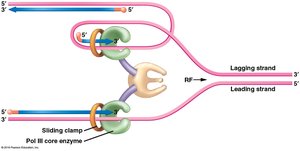
Sliding clamp: Maintains processivity.
Clamp loader: Loads enzyme onto template.
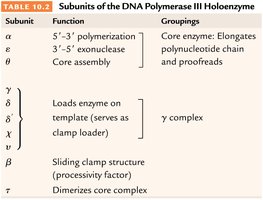
Subunit | Function | Groupings |
|---|---|---|
α | 5'–3' polymerization | Core enzyme |
ε | 3'–5' exonuclease | Core enzyme |
θ | Core assembly | Core enzyme |
γ, δ, δ', χ, ψ | Loads enzyme on template | γ complex |
β | Sliding clamp structure | Processivity factor |
τ | Dimerizes core complex |
Key Steps in DNA Replication
Seven key issues must be resolved during DNA replication:
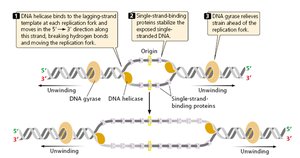
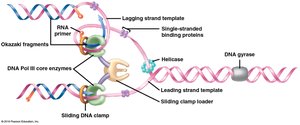
Unwinding of the helix (helicase)
Reduction of supercoiling (DNA gyrase)
Synthesis of a primer (primase)
Discontinuous synthesis of the second strand (DNA Pol III)
Removal of RNA primers (DNA Pol I)
Joining gap-filling DNA (DNA ligase)
Proofreading (DNA Pol I, II, III)
Unwinding the DNA Helix
Proteins such as DnaA, DnaB (helicase), and DnaC (helicase loader) initiate and facilitate the unwinding of DNA at the origin. Single-stranded binding proteins (SSBPs) stabilize the unwound DNA, while DNA gyrase relieves supercoiling.
RNA Primer and Initiation
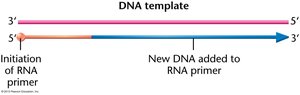
DNA polymerase III requires a primer with a free 3'-OH group. Primase synthesizes an RNA primer, which is extended by DNA polymerase III.
Continuous and Discontinuous DNA Synthesis
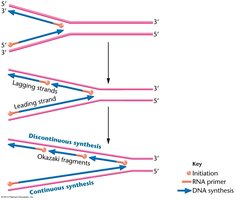
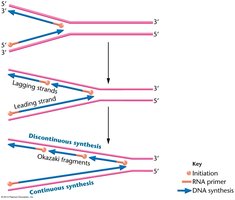
DNA synthesis occurs only in the 5' to 3' direction. The leading strand is synthesized continuously, while the lagging strand is synthesized discontinuously as Okazaki fragments, each initiated by an RNA primer.
DNA polymerase I: Removes RNA primers.
DNA ligase: Joins Okazaki fragments.
Proofreading and Error Correction
All DNA polymerases (I, II, III) possess 3' to 5' exonuclease activity, allowing them to proofread and correct errors during DNA synthesis.
Polymerase III Dimer and Sliding Clamp
The sliding clamp structure is critical for maintaining the processivity of DNA polymerase III, allowing rapid and efficient DNA synthesis.
Replisome: The Replication Machinery
The replisome is a complex of DNA, polymerase, and associated enzymes that coordinate DNA synthesis at the replication fork.
Genetic Control of Replication
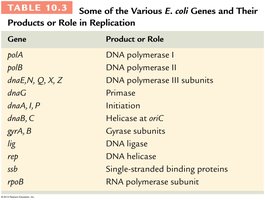
Replication is controlled by a variety of genes encoding enzymes and proteins required for DNA synthesis.
Gene | Product or Role |
|---|---|
polA | DNA polymerase I |
polB | DNA polymerase II |
dnaE, N, Q, X, Z | DNA polymerase III subunits |
dnaG | Primase |
dnaA, I, P | Initiation |
dnaB, C | Helicase at oriC |
gyrA, B | Gyrase subunits |
lig | DNA ligase |
rep | DNA helicase |
ssb | Single-stranded binding proteins |
rpoB | RNA polymerase subunit |
Eukaryotic DNA Replication
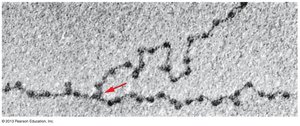
Eukaryotic DNA replication shares many features with bacterial replication but is more complex due to larger genome size, linear chromosomes, and chromatin structure.
Multiple origins: Eukaryotic chromosomes have thousands of origins of replication.
Chromatin: DNA is packaged into nucleosomes.
Multiple Eukaryotic DNA Polymerases
The human genome encodes at least 14 DNA polymerases. Pol α, δ, and ε are the major enzymes for nuclear DNA replication.
Pol α: Synthesizes RNA primers.
Pol δ: Synthesizes lagging strand.
Pol ε: Synthesizes leading strand.
Replication through Chromatin
Nucleosomes and other DNA-binding proteins are stripped away before DNA synthesis and rapidly reassociate with newly formed DNA. Chromatin assembly factors (CAFs) facilitate nucleosome assembly.
Telomeres and the End-Replication Problem
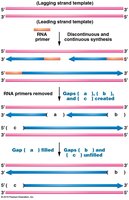
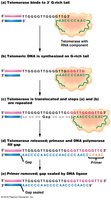
The ends of linear chromosomes (telomeres) consist of repetitive sequences (TTAGGG) that protect chromosome integrity. DNA polymerase cannot fill gaps at the 5' ends, leading to chromosome shortening with each replication cycle.
Telomerase: A ribonucleoprotein enzyme that extends telomeres, preventing loss of genetic information.
Telomerase activity: High in embryonic, germ, stem, and cancer cells; absent in most somatic cells.
Genetic Basis of Aging
Chromosome shortening due to incomplete replication of telomeres is a genetic basis of aging in humans and other mammals. Loss of telomeric DNA can eventually affect gene-encoding regions.
Review Questions
What is the ‘Central Dogma of Molecular biology’?
What is the biological significance of DNA replication in cells?
Compare 3 different modes of DNA replication.
What is the basis of Meselson-Stahl’s experiment to prove the semiconservative mode of DNA replication?
Define the terms: origin of replication, replication fork, replicon, replisome, apoenzyme, holoenzyme.
What reaction is catalyzed by DNA polymerase I? What are its requirements for DNA synthesis?
Compare the properties of DNA polymerases I, II, and III.
Explain the 7 key issues involving DNA replication.
Distinguish between continuous and discontinuous synthesis of DNA strands.
List the functions of all subunits of DNA Pol III holoenzyme.
How is eukaryotic DNA replication similar to bacterial DNA replication, and how is it different?
What is the genetic basis of aging?
Additional info: Some explanations and context were expanded for clarity and completeness based on standard genetics textbooks.
