 Back
DNA Replication and Recombination: Study Notes for Genetics Students
Study Guide - Smart Notes
 Tailored notes based on your materials, expanded with key definitions, examples, and context.
DNA Replication and Recombination
Learning Goals
Explain the three proposed models of DNA replication and interpret the Meselson-Stahl experiment
Describe the major enzymes and proteins of DNA replication and their roles in the process
Compare prokaryotic and eukaryotic replication and explain how telomerase solves the end-replication problem
DNA Replication: Overview
Importance and Timing
DNA replication is a fundamental process required for genetic continuity in all living organisms. It occurs during the S phase of interphase in the cell cycle, ensuring that each daughter cell receives an identical copy of the genome.
High Fidelity: DNA replication is highly accurate, but occasional errors (mutations) are a source of genetic variation and evolution.
Enzymatic Complexity: Multiple enzymes and proteins coordinate the copying and synthesis of new DNA strands.

DNA as a Template
Strand Complementarity
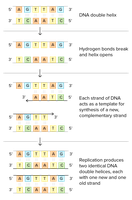
The double-stranded nature of DNA, with complementary base pairing (A-T, G-C), allows each strand to serve as a template for the synthesis of its counterpart during replication.
Template Function: The arrangement of nitrogenous bases enables accurate copying.
Replication: Each new DNA molecule contains one old (template) strand and one newly synthesized strand.
Models of DNA Replication
Three Proposed Modes
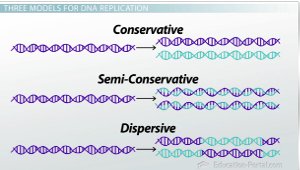
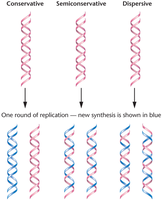
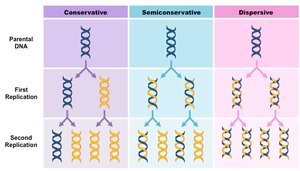
Before the mechanism was established, three models were proposed for DNA replication:
Semiconservative: Each daughter DNA molecule consists of one old strand and one new strand.
Conservative: The parental DNA remains intact, and a completely new molecule is synthesized.
Dispersive: Both daughter molecules contain interspersed segments of old and new DNA.
Meselson-Stahl Experiment
Experimental Proof of Semiconservative Replication
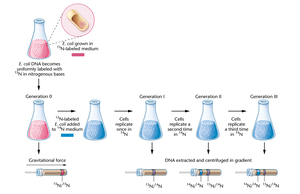
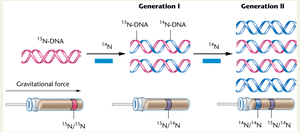
The Meselson-Stahl experiment (1958) used isotopic labeling to distinguish between old and new DNA strands in E. coli. Cells were grown in heavy nitrogen (15N), then transferred to light nitrogen (14N), and DNA was analyzed after each generation.
Key Finding: After one round of replication, DNA was intermediate in density, supporting the semiconservative model.
Technique: Density gradient centrifugation separated DNA based on isotope content.
Origins, Forks, and Units of Replication
Replication Initiation and Structure
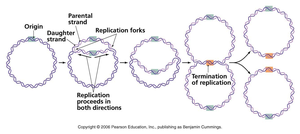
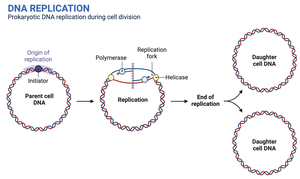
DNA replication begins at specific sites called origins of replication (ORI), where the double helix is unwound, forming replication forks. Replication is typically bidirectional, with two forks moving away from the origin.
Replicon: The length of DNA replicated from a single origin.
Bacterial Replication: Bacteria have a single circular chromosome and one ORI.
Enzymes and Proteins in DNA Replication
Major Enzymes and Their Functions
DNA replication requires a coordinated action of several enzymes and proteins:
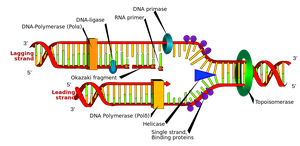
DNA Polymerases: In bacteria, five DNA polymerases (I, II, III, IV, V) are involved. DNA polymerase III is the main enzyme for synthesis; DNA polymerase I removes RNA primers and fills gaps.
Helicase: Unwinds the DNA helix using ATP.
Single-stranded Binding Proteins (SSBPs): Stabilize unwound DNA.
DNA Gyrase (Topoisomerase): Relieves supercoiling ahead of the replication fork.
Primase: Synthesizes short RNA primers to provide a free 3’ – OH group for DNA polymerase.
DNA Ligase: Seals nicks and joins Okazaki fragments on the lagging strand.
DNA Synthesis Mechanism
Elongation and Directionality
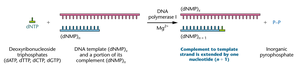
DNA polymerases add nucleotides to the 3’ end of the growing strand, synthesizing DNA in the 5’ to 3’ direction. The process requires a template strand, dNTPs, and magnesium ions.
Chain Elongation: Each nucleotide added releases two terminal phosphates, exposing a new 3’ – OH group.
Proofreading: DNA polymerases possess 3’ – 5’ exonuclease activity to correct errors.
Continuous and Discontinuous DNA Synthesis
Leading and Lagging Strands
Because DNA strands are antiparallel, DNA polymerase synthesizes the leading strand continuously (5’ to 3’), while the lagging strand is synthesized discontinuously as Okazaki fragments.
Okazaki Fragments: Short DNA segments synthesized on the lagging strand, each initiated by an RNA primer.
Primer Removal: DNA polymerase I removes RNA primers and fills gaps with DNA.
DNA Ligase: Joins Okazaki fragments to form a continuous strand.
Concurrent Synthesis and DNA Clamp
Coordination at the Replication Fork
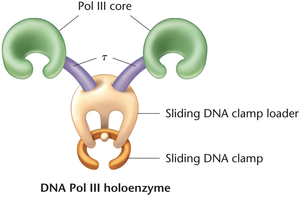
Both DNA strands are synthesized simultaneously at the replication fork. The lagging strand is looped to allow concurrent synthesis. The DNA clamp prevents dissociation of the polymerase from the template.
Proofreading and DNA Repair
Error Correction Mechanisms
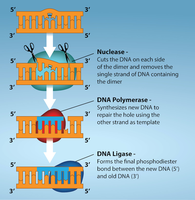
Proofreading and repair are essential for maintaining DNA integrity. DNA polymerases correct errors during synthesis, and specialized enzymes repair damage caused by external factors.
Exonuclease Activity: Removes incorrect nucleotides.
DNA Repair: DNA polymerases I, II, IV, and V participate in repair processes.
Eukaryotic DNA Replication
Complexity and Multiple Origins
Eukaryotic DNA replication is more complex due to larger genomes, linear chromosomes, and chromatin structure. Multiple ORIs facilitate rapid synthesis.
Pre-replication Complex (pre-RC): Assembles at ORIs to initiate replication.
Chromatin: DNA is wrapped around histone proteins, forming nucleosomes that must be removed for replication.
Telomeres and Telomerase
End-Replication Problem and Solution
Linear chromosomes face the end-replication problem: after removal of the RNA primer at the 3’ end, there is no free 3’ – OH for elongation, resulting in chromosome shortening. Telomeres are repetitive sequences at chromosome ends that protect integrity.
Telomerase: An enzyme that adds telomeric repeats to the 3’ end, solving the end-replication problem.
Biological Significance: Telomerase activity is high in stem cells and cancer cells, contributing to cellular immortality. In most somatic cells, telomerase is inactive, and telomeres shorten with age.
Summary Table: DNA Replication Models
Comparison of Replication Modes
Model | First Replication | Second Replication |
|---|---|---|
Conservative | 1 old, 1 new | 1 old, 3 new |
Semiconservative | 2 hybrid | 2 hybrid, 2 new |
Dispersive | 2 mixed | 4 mixed |
Key Equations
DNA Synthesis Reaction
The basic reaction catalyzed by DNA polymerase:
Conclusion
DNA replication is a highly regulated, accurate process essential for genetic inheritance. Understanding the mechanisms, enzymes, and differences between prokaryotic and eukaryotic replication is fundamental for genetics students.
