 Back
BackCh 10 P1 DNA Replication: Mechanisms and Enzymology
Study Guide - Smart Notes
 Tailored notes based on your materials, expanded with key definitions, examples, and context.
Ch 10 P1DNA Replication: Mechanisms and Enzymology
Introduction to DNA Replication
DNA replication is a fundamental process required for genetic continuity between cells following cell division. The process must be highly accurate to ensure that the genetic information is faithfully transmitted to daughter cells. In humans, over 3 billion base pairs must be duplicated with high fidelity during each cell cycle.
Replication: The process by which DNA makes a copy of itself during cell division.
Semiconservative replication: Each new DNA molecule consists of one old (parental) strand and one newly synthesized strand.
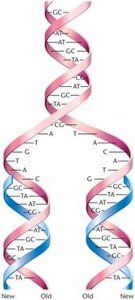
Models of DNA Replication
Three models were originally proposed to explain how DNA replicates:
Semiconservative: Each daughter DNA molecule contains one parental and one new strand.
Conservative: The parental double helix remains intact, and an entirely new double helix is synthesized.
Dispersive: Parental DNA is dispersed throughout both strands of the daughter molecules after replication.
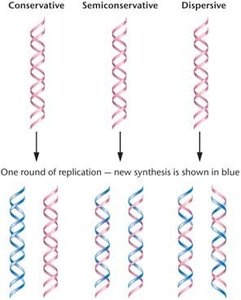
The Meselson–Stahl Experiment
The Meselson–Stahl experiment (1958) provided strong evidence for the semiconservative model of DNA replication in bacteria. They used 15N-labeled E. coli and distinguished between old and new DNA strands using sedimentation equilibrium centrifugation.
After one generation in 14N medium, DNA molecules were of intermediate density (hybrid), supporting semiconservative replication.
After two generations, both hybrid and light DNA were observed, further confirming the model.
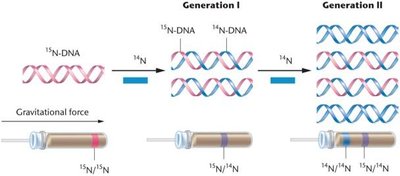
Semiconservative Replication in Eukaryotes
The Taylor–Woods–Hughes experiment (1957) demonstrated semiconservative replication in eukaryotes using autoradiography of labeled thymidine in Vicia faba (broad bean) root tips. Later studies confirmed this mode in other organisms, supporting Watson and Crick’s double helix model.
Origins, Forks, and Units of Replication
Replication Origins and Forks
DNA replication begins at specific sites called origins of replication (ORI). At these sites, the double helix is unwound, creating a replication fork. Replication is typically bidirectional, resulting in two replication forks moving away from the origin.
Replicon: The length of DNA replicated from a single origin.
In bacteria (e.g., E. coli), there is a single origin (oriC), and the entire chromosome (4.6 million base pairs) constitutes one replicon.
Enzymology of DNA Replication
DNA Polymerases
DNA replication is catalyzed by a family of enzymes called DNA polymerases. The first DNA polymerase (Pol I) was isolated by Kornberg in 1957. DNA polymerases require a DNA template and four deoxyribonucleoside triphosphates (dNTPs) to synthesize DNA.
DNA polymerases can only add nucleotides to an existing strand (primer) and cannot initiate synthesis de novo.
They catalyze the addition of nucleotides in the 5′ to 3′ direction, releasing inorganic pyrophosphate.
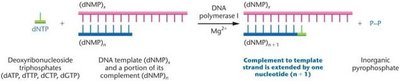
Chain Elongation
Chain elongation by DNA polymerase occurs in the 5′ to 3′ direction. Each new nucleotide is added to the free 3′-OH group of the growing strand, and two terminal phosphates are cleaved off, providing energy for the reaction.
Types and Properties of Bacterial DNA Polymerases
Bacteria possess several DNA polymerases, each with distinct roles:
DNA polymerase I: Removes RNA primers and fills in gaps.
DNA polymerase III: Main enzyme for DNA synthesis in vivo.
DNA polymerases II, IV, V: Involved in DNA repair and other specialized functions.
Property | Pol I | Pol II | Pol III |
|---|---|---|---|
Initiation of chain synthesis | − | − | − |
5′ to 3′ polymerization | + | + | + |
3′ to 5′ exonuclease activity | + | + | + |
5′ to 3′ exonuclease activity | + | − | − |
Molecules per cell | 400 | ? | 15 |
Proofreading and Repair
All three main bacterial DNA polymerases possess 3′ to 5′ exonuclease activity, allowing them to proofread and remove incorrectly paired nucleotides. Only DNA polymerase I has 5′ to 3′ exonuclease activity, which is essential for primer removal and gap filling.
Mechanism of DNA Replication
Unwinding the DNA Helix
DnaA protein: Binds to oriC in E. coli, causing the DNA to unwind and expose single-stranded DNA (ssDNA).
DNA helicase (DnaB): Unwinds the DNA helix using energy from ATP hydrolysis.
Single-stranded binding proteins (SSBPs): Stabilize the unwound DNA and prevent reannealing.
DNA gyrase: A type of topoisomerase that relieves supercoiling tension generated during unwinding by making transient cuts in the DNA.
Initiation of DNA Synthesis Using an RNA Primer
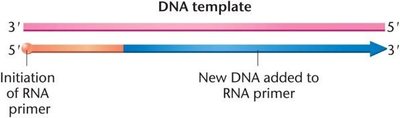
DNA polymerases require a primer with a free 3′-OH group to initiate synthesis. Primase, an RNA polymerase, synthesizes a short RNA primer complementary to the DNA template. DNA polymerase then extends this primer.
Continuous and Discontinuous DNA Synthesis
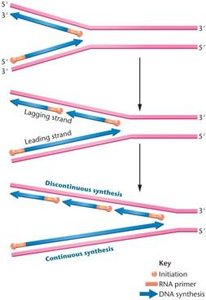
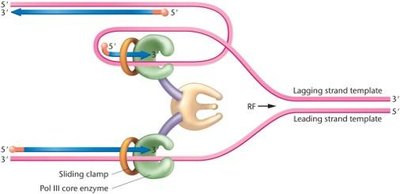
Because the two DNA strands are antiparallel, DNA synthesis occurs continuously on one strand (the leading strand) and discontinuously on the other (the lagging strand). The lagging strand is synthesized in short fragments called Okazaki fragments, each initiated by an RNA primer.
Joining Okazaki Fragments
DNA polymerase I removes RNA primers and fills in the resulting gaps with DNA.
DNA ligase seals the nicks between adjacent fragments by forming phosphodiester bonds.
Summary of Enzymes and Proteins in DNA Synthesis
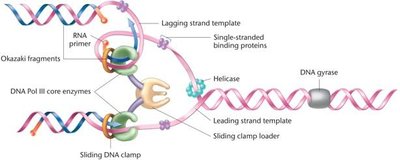
Multiple enzymes and proteins coordinate to ensure accurate and efficient DNA replication:
DNA polymerase III core enzymes
Single-stranded binding proteins (SSBPs)
DNA gyrase
DNA helicase
RNA primers (synthesized by primase)
Genetic Factors Affecting DNA Replication
Mutations Affecting Replication
Mutations in genes encoding replication proteins can interrupt or impair DNA replication. These include:
Lethal mutations: Prevent cell survival.
Conditional mutations: Expressed only under certain conditions (e.g., temperature-sensitive mutations).
Ligase-deficient mutations: Affect joining of DNA fragments.
Proofreading-deficient mutations: Increase mutation rates due to lack of error correction.
Key E. coli Genes and Their Roles in Replication
Gene | Product or Role |
|---|---|
polA | DNA polymerase I |
polB | DNA polymerase II |
dnaE, N, Q, X, Z | DNA polymerase III subunits |
dnaG | Primase |
dnaA, I, P | Initiation |
dnaB, C | Helicase at oriC |
gyrA, B | Gyrase subunits |
lig | DNA ligase |
rep | DNA helicase |
ssb | Single-stranded binding proteins |
rpoB | RNA polymerase subunit |
Role of RNA Polymerase in DNA Replication
RNA polymerase (primase) is required to synthesize short RNA primers that provide the free 3′-OH group necessary for DNA polymerase to initiate DNA synthesis. This is a critical step in both prokaryotic and eukaryotic DNA replication.
