 Back
DNA Replication: Mechanisms, Enzymes, and Regulation
Study Guide - Smart Notes
 Tailored notes based on your materials, expanded with key definitions, examples, and context.
DNA Replication
Overview of DNA Replication
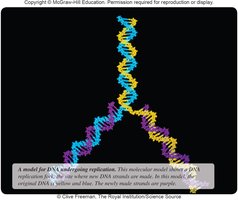
DNA replication is the process by which a cell makes an exact copy of its DNA, ensuring genetic information is faithfully transmitted to daughter cells. This process must occur rapidly, accurately, and at the correct stage of the cell cycle.
Purpose: To duplicate the genetic material before cell division.
Key Features: High speed, high fidelity, and cell cycle regulation.
Basic Mechanism: The two DNA strands separate, each serving as a template for the synthesis of a new complementary strand.
Historical Context and Models of DNA Replication
Several models were proposed to explain how DNA replicates:
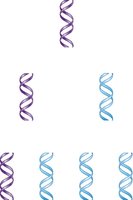
Conservative Model: Both parental DNA strands remain together after replication.
Semiconservative Model: Each double-stranded DNA contains one parental and one daughter strand after replication.
Dispersive Model: Parental and daughter DNA are interspersed in both strands after replication.
The Meselson-Stahl Experiment
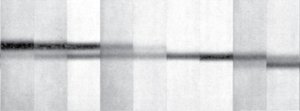
Matthew Meselson and Franklin Stahl designed an experiment using isotopes of nitrogen (15N and 14N) to distinguish between the three models of DNA replication. Their results supported the semiconservative model, where each daughter DNA molecule consists of one parental and one newly synthesized strand.
Method: E. coli were grown in 15N medium, then switched to 14N, and DNA was analyzed by density gradient centrifugation after each generation.
Results: After one generation, DNA was of intermediate density (half-heavy), ruling out the conservative model. After two generations, both light and half-heavy DNA were observed, supporting the semiconservative model.
Mechanism of DNA Replication
Basic Steps of Replication
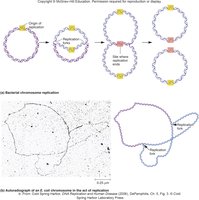
DNA replication involves three main stages: initiation, elongation, and termination.
Initiation: Begins at specific locations called origins of replication (oriC in bacteria).
Elongation: New DNA strands are synthesized by DNA polymerases.
Termination: Replication ends when the entire DNA molecule has been copied.
Proteins and Enzymes Involved in DNA Replication
Multiple proteins coordinate the replication process:
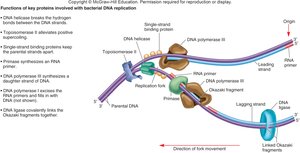
DNA Polymerases: Catalyze the addition of nucleotides to the growing DNA strand. In E. coli, DNA pol III is the main replicative enzyme, while DNA pol I removes RNA primers and fills in gaps.
Helicase: Unwinds the DNA double helix.
Primase: Synthesizes short RNA primers needed for DNA polymerase to begin synthesis.
Ligase: Joins Okazaki fragments on the lagging strand.
Accessory Proteins: Gyrase (relieves supercoiling), single-strand binding proteins (stabilize unwound DNA), and others.
DNA Polymerase Structure and Function
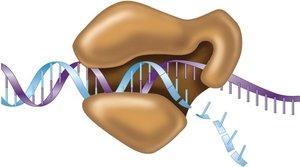
DNA polymerases catalyze the formation of phosphodiester bonds between nucleotides in a 5' to 3' direction. They require a primer with a free 3'-OH group to initiate synthesis and are highly processive, meaning they can add many nucleotides without dissociating from the template.
Proofreading: DNA polymerases possess 3' to 5' exonuclease activity, allowing them to remove incorrectly paired nucleotides and ensure high fidelity.
Initiation of Replication in Bacteria
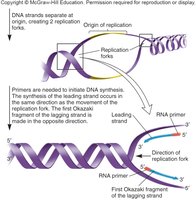
Replication begins at the origin of replication (oriC), which contains specific DNA sequences called DnaA boxes. The DnaA protein binds to these boxes, causing the DNA to unwind at adjacent AT-rich regions, allowing helicase and primase to assemble and begin synthesis.
Primase: Synthesizes a short RNA primer to provide a free 3'-OH group for DNA polymerase.

Elongation: Leading and Lagging Strands
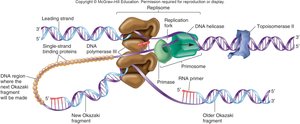
Because DNA is antiparallel, synthesis occurs continuously on the leading strand and discontinuously on the lagging strand, forming Okazaki fragments. DNA ligase joins these fragments to create a continuous strand.
Leading Strand: Synthesized continuously in the direction of the replication fork.
Lagging Strand: Synthesized discontinuously away from the fork in short segments (Okazaki fragments).
Termination of Replication
Replication ends when the replication forks meet or when specific termination sequences are encountered. In bacteria, this typically occurs opposite the origin of replication on the circular chromosome.
Eukaryotic DNA Replication
Complexity of Eukaryotic Replication
Eukaryotic DNA replication is more complex due to large linear chromosomes, nucleosome packaging, and multiple origins of replication. Nucleosomes must be disassembled and reassembled during replication, and chromatin assembly factors (CAFs) help package newly synthesized DNA.
Multiple Origins: Eukaryotic chromosomes have many origins of replication to ensure timely duplication.
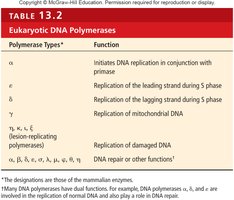
Eukaryotic DNA Polymerases
Several DNA polymerases function in eukaryotic cells, each with specialized roles:
Polymerase Type | Function |
|---|---|
α | Initiates DNA replication in conjunction with primase |
ε | Replication of the leading strand during S phase |
δ | Replication of the lagging strand during S phase |
γ | Replication of mitochondrial DNA |
η, κ, ι, ζ | Replication of damaged DNA |
β, λ, σ, μ, TdT | DNA repair or other functions |
The Ends Replication Problem and Telomeres
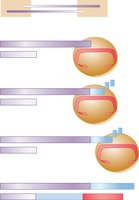
Linear chromosomes present a unique challenge: DNA polymerases cannot fully replicate the 3' ends of the lagging strand, leading to progressive shortening of chromosomes with each cell division. Telomeres, repetitive DNA sequences at chromosome ends, protect genetic information from loss.
Telomerase: An enzyme that extends telomeres by adding repeat sequences, using an RNA template within the enzyme itself. This activity is most prominent in stem cells and cancer cells, but generally inactive in most somatic cells.
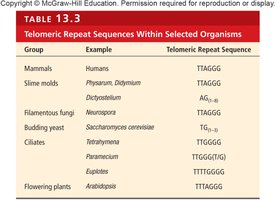
Group | Example | Telomeric Repeat Sequence |
|---|---|---|
Mammals | Humans | TTAGGG |
Slime molds | Physarum, Dictyostelium | TTAGGG, AG1-8 |
Filamentous fungi | Neurospora | TTAGGG |
Budding yeast | Saccharomyces cerevisiae | TG1-3 |
Ciliates | Tetrahymena, Paramecium | TTGGGG, TTGGGG(T/G) |
Flowering plants | Arabidopsis | TTTAGGG |
Summary Table: Key Enzymes and Functions in DNA Replication
Enzyme/Protein | Function |
|---|---|
DNA Polymerase III (prokaryotes) | Main enzyme for DNA synthesis |
DNA Polymerase I (prokaryotes) | Removes RNA primers, fills gaps |
Primase | Synthesizes RNA primers |
Helicase | Unwinds DNA double helix |
Ligase | Joins Okazaki fragments |
Topoisomerase/Gyrase | Relieves supercoiling |
Single-strand binding proteins | Stabilize unwound DNA |
Telomerase | Extends telomeres in eukaryotes |
Additional info: The accuracy of DNA replication is ensured by the intrinsic selectivity of base pairing, the proofreading activity of DNA polymerases, and post-replication repair mechanisms. Errors that escape these systems can lead to mutations, which are the raw material for evolution but may also cause disease.
