 Back
DNA Replication: Mechanisms, Enzymes, and Regulation
Study Guide - Smart Notes
 Tailored notes based on your materials, expanded with key definitions, examples, and context.
DNA Replication
Introduction to DNA Replication
DNA replication is the biological process by which a cell duplicates its DNA, ensuring genetic information is faithfully transmitted to daughter cells. This process is fundamental to cell division and heredity, and is characterized by high speed, accuracy, and regulation.
Key Concept: Complementary base pairing enables accurate copying; antiparallel strand orientation introduces complexity.
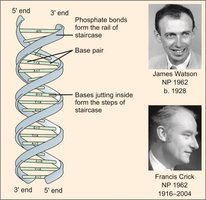
Historical Note: Watson and Crick's model of DNA structure suggested a mechanism for replication based on specific base pairing.
DNA Structure and Its Role in Replication
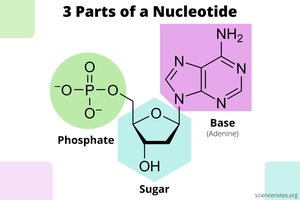
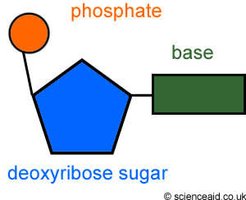
The double helix structure of DNA, composed of nucleotides, underpins the mechanism of replication. Each nucleotide consists of a phosphate group, a deoxyribose sugar, and a nitrogenous base (A, T, G, or C).
Phosphodiester bonds link the 3′ hydroxyl of one sugar to the 5′ phosphate of the next.
Base pairing: Adenine (A) pairs with Thymine (T) via two hydrogen bonds; Guanine (G) pairs with Cytosine (C) via three hydrogen bonds.
Antiparallel strands: One strand runs 5′ to 3′, the other 3′ to 5′.
Models of DNA Replication
Three models were proposed to explain how DNA is copied:
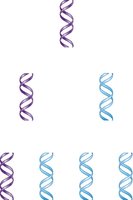
Conservative: Parental strands stay together; new duplex is entirely new.
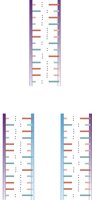
Semiconservative: Each daughter duplex contains one parental and one new strand.
Dispersive: Parental and new DNA are interspersed in both strands.
Meselson-Stahl Experiment: Demonstrating Semiconservative Replication
The Meselson-Stahl experiment used isotopic labeling to distinguish old and new DNA, providing evidence for the semiconservative model.
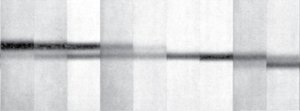
Method: E. coli were grown in 15N (heavy) medium, then switched to 14N (light) medium. DNA was extracted after each generation and separated by density gradient centrifugation.
Results: After one generation, DNA was of intermediate density (hybrid), ruling out the conservative model. After two generations, both hybrid and light DNA were present, ruling out the dispersive model.
Conclusion: DNA replication is semiconservative.
Mechanism of DNA Replication
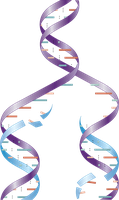
Replication begins at specific sites (origins of replication) and proceeds bidirectionally, forming replication forks. Each parental strand serves as a template for a new strand.
Leading strand: Synthesized continuously in the direction of fork movement.
Lagging strand: Synthesized discontinuously, forming Okazaki fragments.
Result: Two DNA molecules, each with one parental and one new strand, identical in sequence.
Enzymes and Proteins Involved in DNA Replication
Multiple enzymes and accessory proteins coordinate the replication process:
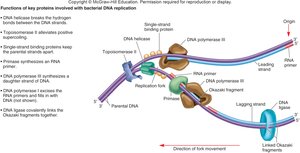
DNA polymerase: Synthesizes new DNA by adding nucleotides to a primer; requires a template, primer, dNTPs, and Mg2+.
Primase: Synthesizes short RNA primers to provide a free 3′ OH group.
Helicase: Unwinds the DNA double helix.
Single-strand binding proteins: Stabilize unwound DNA.
Ligase: Joins Okazaki fragments on the lagging strand.
Topoisomerase (gyrase): Relieves supercoiling ahead of the fork.
DNA Polymerases in Prokaryotes
In E. coli, five DNA polymerases have distinct roles:
Pol III: Main enzyme for leading and lagging strand synthesis; has 3′ to 5′ exonuclease (proofreading) activity.
Pol I: Removes RNA primers and fills gaps with DNA; also involved in repair.
Pol II, IV, V: Function mainly in DNA repair and replication across damaged DNA.
Polymerase | 5′–3′ Polymerization | 3′–5′ Exonuclease | 5′–3′ Exonuclease | Function |
|---|---|---|---|---|
I | Yes | Yes | Yes | Removes primers, fills gaps, repair |
II | Yes | Yes | No | Repair |
III | Yes | Yes | No | Main replication |
Initiation, Elongation, and Termination in Bacterial Replication
Replication in bacteria such as E. coli is highly coordinated and proceeds through three main stages:
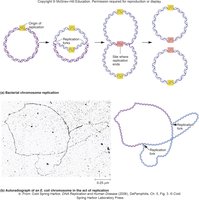
Initiation: Begins at a single origin (oriC), involving DnaA protein binding to DnaA boxes, unwinding the AT-rich region, and recruitment of helicase and primase.
Elongation: DNA polymerase synthesizes new strands; leading strand is continuous, lagging strand is discontinuous (Okazaki fragments).
Termination: Replication forks meet at the terminus region, completing the process.
Replication in Eukaryotes
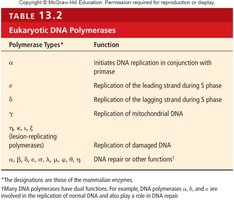
Eukaryotic DNA replication is more complex due to larger, linear chromosomes and chromatin structure. Key differences include:
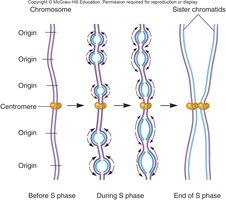
Multiple origins of replication per chromosome, allowing rapid duplication.
Specialized DNA polymerases for leading and lagging strands.
Chromatin assembly factors repackage DNA into nucleosomes after replication.
The End Replication Problem and Telomeres
Linear chromosomes present a unique challenge: the inability of DNA polymerase to fully replicate the 5′ ends of lagging strands, leading to progressive shortening.
Telomeres: Repetitive DNA sequences at chromosome ends, protecting coding regions from loss.
Telomerase: An enzyme with an RNA template and reverse transcriptase activity, extends the 3′ overhang, allowing complete replication of chromosome ends.
Biological significance: Telomerase is active in stem cells and most cancer cells, but inactive in most somatic cells, contributing to cellular aging.
Proofreading and Fidelity of DNA Replication
DNA replication is highly accurate due to several mechanisms:
Base pairing: Instability of mismatched pairs reduces errors.
Induced fit: DNA polymerase active site changes shape when the correct nucleotide is bound.
Proofreading: 3′ to 5′ exonuclease activity removes misincorporated nucleotides.
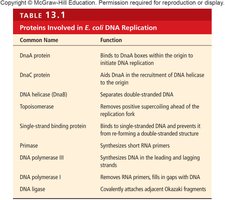
Summary Table: Key Proteins in E. coli DNA Replication
Protein | Function |
|---|---|
DnaA | Binds to DnaA boxes to initiate replication |
DnaB (helicase) | Unwinds DNA |
Topoisomerase | Relieves supercoiling |
Single-strand binding protein | Stabilizes single-stranded DNA |
Primase | Synthesizes RNA primers |
DNA polymerase III | Main DNA synthesis |
DNA polymerase I | Removes primers, fills gaps |
Ligase | Joins Okazaki fragments |
Conclusion
DNA replication is a complex, highly regulated process essential for genetic continuity. It involves a coordinated interplay of enzymes and structural features, with mechanisms in place to ensure speed, accuracy, and the maintenance of chromosome integrity.
