 Back
DNA Replication: Mechanisms, Models, and Telomere Maintenance
Study Guide - Smart Notes
 Tailored notes based on your materials, expanded with key definitions, examples, and context.
DNA Replication: Overview
Fundamental Requirements
DNA replication is the process by which cells make an exact copy of their DNA, ensuring genetic continuity. This process must occur rapidly, accurately, and at the correct stage of the cell cycle.
Speed: DNA replication is highly efficient, with rates up to 750 nucleotides per second in bacteria.
Accuracy: High fidelity is achieved through base pairing, induced fit in polymerase active sites, and proofreading mechanisms.
Timing: Replication is tightly regulated to occur during the S phase of the cell cycle.
Models of DNA Replication
Three Proposed Models
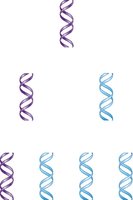
Early hypotheses about DNA replication included three models: conservative, semiconservative, and dispersive. The semiconservative model, proposed by Watson and Crick, was experimentally validated.
Conservative Model: Both parental DNA strands remain together after replication.
Semiconservative Model: Each new DNA molecule contains one parental and one daughter strand.
Dispersive Model: Parental and daughter DNA are interspersed in both strands.
Meselson-Stahl Experiment
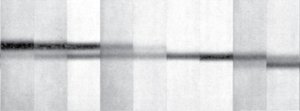
Matthew Meselson and Franklin Stahl distinguished these models using E. coli grown in heavy (15N) and light (14N) nitrogen media, followed by density gradient centrifugation.
Key Finding: After one generation in 14N, DNA was intermediate in density, supporting the semiconservative model.
Second Generation: Both intermediate and light DNA bands were observed, further confirming semiconservative replication.
Mechanism of DNA Replication
Basic Steps
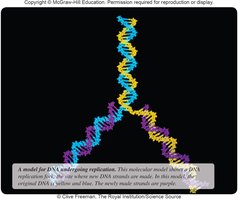
Replication involves the separation of DNA strands, each serving as a template for the synthesis of new, complementary strands.
Parental Strands: The original DNA strands.
Daughter Strands: Newly synthesized strands.
Bidirectional Replication in Bacteria
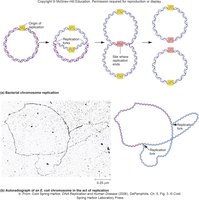
Bacterial chromosomes typically have a single origin of replication (oriC), from which replication proceeds bidirectionally.
Replication Forks: Sites where DNA is actively being unwound and synthesized.
Bidirectional Synthesis: Occurs in both directions from the origin.
Stages of Bacterial DNA Replication
Replication is divided into three stages: initiation, elongation, and termination.
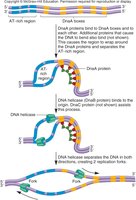
Initiation: Begins at oriC, involving DnaA protein binding to DnaA boxes and unwinding of the AT-rich region.
Elongation: DNA polymerases synthesize new strands, with primase laying down RNA primers.
Termination: Replication ends when forks meet or reach termination sequences.

Proteins and Enzymes Involved in DNA Replication
Key Proteins
Multiple proteins coordinate the replication process, each with specialized functions.
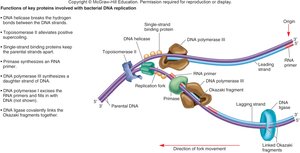
DNA Polymerases: Catalyze the formation of phosphodiester bonds. In E. coli, DNA pol I and III are responsible for normal replication, while pol II, IV, and V are involved in repair.
Primase: Synthesizes RNA primers required for DNA polymerase activity.
Helicase: Unwinds the DNA helix.
Ligase: Joins Okazaki fragments on the lagging strand.
Accessory Enzymes: Gyrases, topoisomerases, and single-strand binding proteins stabilize and manage DNA structure.
DNA Polymerase Structure and Function
DNA polymerases are processive enzymes, meaning they remain attached to the template strand during synthesis. They require a primer with a free 3'-OH group and synthesize DNA in the 5' to 3' direction.
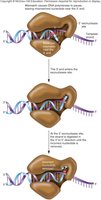
Proofreading: DNA polymerases possess 3' to 5' exonuclease activity for error correction.
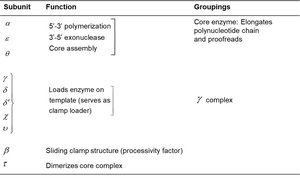
Subunits: DNA pol III holoenzyme consists of multiple subunits, each with distinct roles.
Subunit | Function | Groupings |
|---|---|---|
α | 5'-3' polymerization | Core enzyme: Elongates polynucleotide chain and proofreads |
ε | 3'-5' exonuclease | Core enzyme |
θ | Core assembly | Core enzyme |
γ, δ, δ', χ, ψ | Loads enzyme on template (clamp loader) | γ complex |
β | Sliding clamp structure (processivity factor) | |
τ | Dimerizes core complex |
Initiation and Elongation of DNA Synthesis
Initiation at oriC
Initiation begins at the origin of replication, where DnaA protein binds to DnaA boxes, causing local unwinding of the AT-rich region. Helicase and primase are recruited to form the replication fork.
Elongation: Leading and Lagging Strands
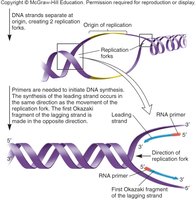
DNA is antiparallel, requiring different synthesis mechanisms for each strand.
Leading Strand: Synthesized continuously in the direction of the replication fork.
Lagging Strand: Synthesized discontinuously, forming Okazaki fragments.
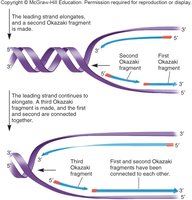
Okazaki Fragments and DNA Ligase
On the lagging strand, DNA pol I removes RNA primers and replaces them with DNA. DNA ligase then joins the fragments to form a continuous strand.
Accuracy and Proofreading
Fidelity of DNA Replication
DNA replication is highly accurate due to several mechanisms:
Base Pairing: Instability of mismatched pairs prevents errors.
Induced Fit: Polymerase active site changes shape when correct nucleotides are bound.
Proofreading: 3' to 5' exonuclease activity removes incorrect nucleotides.
Eukaryotic DNA Replication
Complexity and Multiple Origins
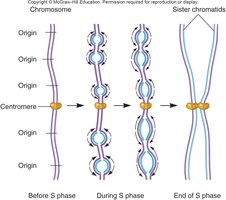
Eukaryotic chromosomes are large and linear, requiring multiple origins of replication for timely duplication. Replication proceeds bidirectionally from each origin, and nucleosomes must be disassembled and reassembled.
Eukaryotic DNA Polymerases
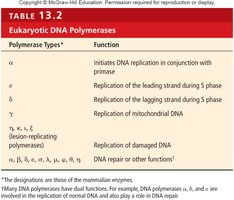
Eukaryotes possess several DNA polymerases, each with specialized functions.
Polymerase Type | Function |
|---|---|
α | Initiates DNA replication with primase |
ε | Replication of leading strand during S phase |
δ | Replication of lagging strand during S phase |
γ | Replication of mitochondrial DNA |
η, κ, ι, ζ | Replication of damaged DNA |
β, λ, σ, μ, θ | DNA repair and other functions |
Telomeres and Telomerase
The Ends Replication Problem
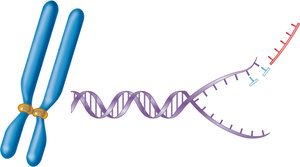
DNA polymerases cannot fully replicate the ends of linear chromosomes, leading to progressive shortening. Telomeres are repetitive DNA sequences at chromosome ends that protect genetic information.
Telomeric Repeat Sequences
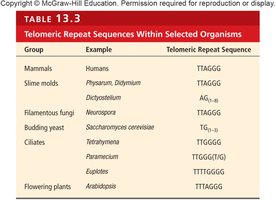
Telomeric sequences are moderately repetitive tandem arrays with a 3' overhang. The sequence varies among organisms.
Group | Example | Telomeric Repeat Sequence |
|---|---|---|
Mammals | Humans | TTAGGG |
Slime molds | Physarum, Dictyostelium | TTAGGG, AG1-8 |
Filamentous fungi | Neurospora | TTAGGG |
Budding yeast | Saccharomyces cerevisiae | TG1-3 |
Ciliates | Tetrahymena, Paramecium | TTGGGG, TTTTGGG |
Flowering plants | Arabidopsis | TTTAGGG |
Telomerase Function
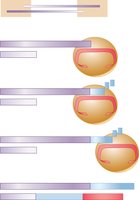
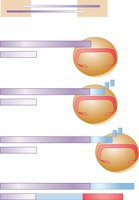
Telomerase is a ribonucleoprotein enzyme that extends telomeres. It contains an RNA template (TERC) and a catalytic protein (TERT). Telomerase is most active in stem cells and cancer cells, but generally inactive in somatic cells.
Binding-Polymerization-Translocation Cycle: Telomerase binds to the 3' overhang, synthesizes new repeats, and translocates to repeat the process.
Summary Table: Key Concepts in DNA Replication
Concept | Description |
|---|---|
Semiconservative Replication | Each new DNA molecule contains one parental and one daughter strand |
Origin of Replication (oriC) | Specific DNA sequence where replication begins |
DNA Polymerase | Enzyme that synthesizes DNA, requires primer |
Proofreading | 3' to 5' exonuclease activity corrects errors |
Okazaki Fragments | Short DNA segments synthesized on lagging strand |
Telomeres | Repetitive DNA sequences at chromosome ends |
Telomerase | Enzyme that extends telomeres, active in stem and cancer cells |
