 Back
DNA Replication: Mechanisms, Models, and Telomere Maintenance
Study Guide - Smart Notes
 Tailored notes based on your materials, expanded with key definitions, examples, and context.
DNA Replication
Overview of DNA Replication
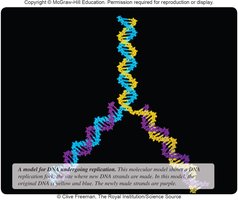
DNA replication is the process by which a cell makes an exact copy of its DNA, ensuring genetic information is accurately transmitted during cell division. This process must occur rapidly, with high fidelity, and at the correct stage of the cell cycle.
Key Point 1: DNA replication relies on the complementarity of DNA strands, where each strand serves as a template for the synthesis of a new strand.
Key Point 2: The original strands are referred to as parental strands, while the newly synthesized strands are called daughter strands.
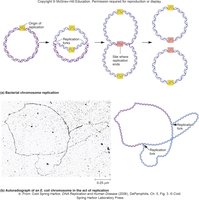
Example: In E. coli, replication occurs at a single origin termed oriC and proceeds bidirectionally.
Models of DNA Replication
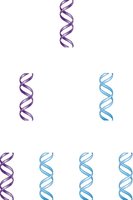
Three models were proposed to explain how DNA is replicated:
Conservative Model: Both parental strands remain together after replication; daughter strands form a new double helix.
Semiconservative Model: Each double-stranded DNA contains one parental and one daughter strand after replication.
Dispersive Model: Parental and daughter DNA are interspersed in both strands following replication.
Meselson-Stahl Experiment
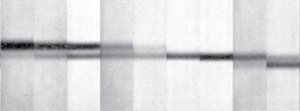
The Meselson-Stahl experiment distinguished between these models by using isotopes of nitrogen (15N and 14N) to label DNA and analyzing density after replication.
Key Point: After one generation in 14N, DNA was intermediate in density, supporting the semiconservative model.
Key Point: After two generations, both intermediate and light DNA were observed, further supporting the semiconservative model.
Mechanism of DNA Replication
Bidirectional Replication in Bacteria
In bacteria, replication initiates at a single origin and proceeds in both directions, forming two replication forks.
Key Point: Replication is coordinated with cell division and involves multiple enzymes, including DNA polymerases, helicases, gyrases, and ligases.
Example: The oriC region in E. coli contains DnaA boxes and an AT-rich region, which are essential for initiation.
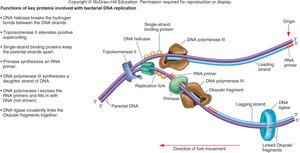
Proteins Involved in DNA Replication ex4dddddddddddd
Several proteins are required for DNA replication, each with specific functions:
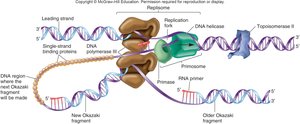
DNA helicase: Unwinds the DNA helix.
Single-strand binding proteins: Stabilize unwound DNA.
Primase: Synthesizes RNA primers.
DNA polymerase III: Synthesizes new DNA strands.
DNA ligase: Joins Okazaki fragments on the lagging strand.
DNA Polymerase Structure and Function
DNA polymerases catalyze the formation of phosphodiester bonds between nucleotides, synthesizing DNA in the 5' to 3' direction.
Key Point: DNA polymerase requires a primer with a free 3'-OH group to initiate synthesis.
Key Point: In E. coli, DNA pol I and III are involved in normal replication, while pol II, IV, and V are involved in DNA repair.
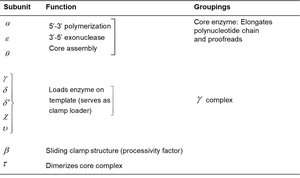
Subunit | Function | Groupings |
|---|---|---|
α | 5'-3' polymerization | Core enzyme: Elongates polynucleotide chain and proofreads |
ε | 3'-5' exonuclease | Core enzyme |
θ | Core assembly | Core enzyme |
γ, δ, δ', ξ, τ | Loads enzyme on template (clamp loader) | γ complex |
β | Sliding clamp structure (processivity factor) | |
τ | Dimerizes core complex |
Initiation of Replication
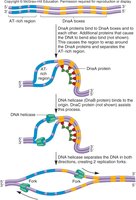
Initiation begins at the origin of replication, where specific DNA sequences (DnaA boxes and AT-rich regions) are recognized by initiator proteins.
Key Point: DnaA protein binds to DnaA boxes, causing DNA to unwind at the AT-rich region.
Key Point: DNA helicase and primase are recruited to the replication fork to begin synthesis.
Elongation: Leading and Lagging Strands
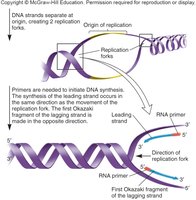
DNA is antiparallel, so synthesis occurs with opposite polarity on the two strands.
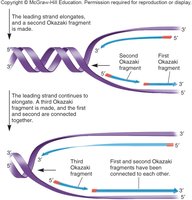
Leading Strand: Synthesized continuously in the direction of the replication fork.
Lagging Strand: Synthesized discontinuously, forming Okazaki fragments.
Termination and Accuracy
Termination: Occurs when replication forks meet or reach termination sequences.
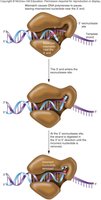
Accuracy: DNA replication is highly accurate due to the instability of mismatched base pairs, induced fit of the polymerase active site, and proofreading by 3'-5' exonuclease activity.
Eukaryotic DNA Replication
Complexity and Multiple Origins
Eukaryotic DNA replication is more complex due to large linear chromosomes, nucleosome packaging, and multiple origins of replication.
Key Point: Multiple origins allow rapid replication of long chromosomes.
Key Point: Chromatin assembly factors (CAFs) are required for nucleosome assembly on daughter strands.
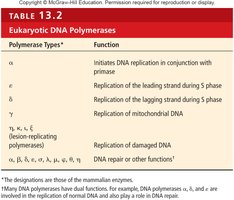
Polymerase Type | Function |
|---|---|
α | Initiates DNA replication with primase |
ε | Replication of leading strand during S phase |
δ | Replication of lagging strand during S phase |
γ | Replication of mitochondrial DNA |
η, κ, ι, ξ | Replication of damaged DNA |
β, λ, σ, μ, θ | DNA repair or other functions |
The Ends Replication Problem and Telomeres
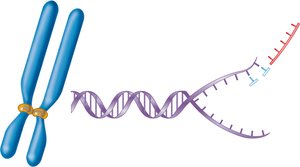
DNA polymerases cannot replicate the very ends of linear chromosomes, leading to progressive shortening.
Key Point: Telomeres are special DNA repeat sequences at chromosome ends, with a 3' overhang.
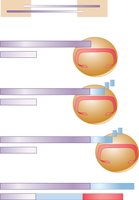
Key Point: Telomerase is an enzyme that maintains telomere length by adding repeats to the 3' overhang.

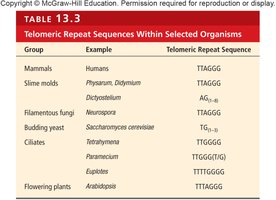
Group | Example | Telomeric Repeat Sequence |
|---|---|---|
Mammals | Humans | TTAGGG |
Slime molds | Physarum, Dictyostelium | TTAGGG |
Filamentous fungi | Neurospora | TTAGGG |
Budding yeast | Saccharomyces cerevisiae | TG1-3 |
Ciliates | Tetrahymena, Paramecium | TTGGGG(T/G) |
Flowering plants | Arabidopsis | TTTAGGG |
Telomerase Mechanism
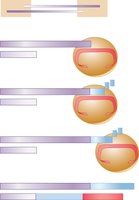
Telomerase contains both protein and RNA components. The RNA serves as a template for adding telomeric repeats.
Key Point: Telomerase is most active in stem cells and cancer cells, allowing continued cell division.
Key Point: In most somatic cells, telomerase is inactive, leading to a limit on cell division.
Summary Table: Key Steps in DNA Replication
Step | Description |
|---|---|
Initiation | Origin recognition, DNA unwinding, primer synthesis |
Elongation | Continuous synthesis on leading strand, discontinuous synthesis on lagging strand (Okazaki fragments) |
Termination | Replication forks meet or reach termination sequences |
Telomere Maintenance | Telomerase extends chromosome ends to prevent shortening |
Additional info: Eukaryotic DNA replication is regulated by the cell cycle, and nucleosome assembly is required for proper chromatin structure. Telomerase activity is a key factor in cellular aging and cancer biology.
