 Back
DNA Sequencing Technologies and Primer Design: Study Notes
Study Guide - Smart Notes
 Tailored notes based on your materials, expanded with key definitions, examples, and context.
DNA Sequencing Technologies and Primer Design
Primer Design
Primers are short, single-stranded DNA sequences essential for initiating DNA synthesis in PCR and sequencing reactions. Proper primer design is crucial for specificity and efficiency in amplifying target DNA regions.
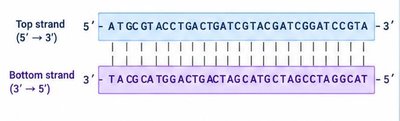
Forward Primer: Matches the nucleotide sequence at the beginning of the targeted DNA region.
Reverse Primer: Reverse complement of the end of the targeted DNA region.
Orientation: Primers are always written 5’ → 3’.
Length: Typically 18–25 nucleotides.
GC Content: Ideally 40–60% for stable binding.
Melting Temperature (Tm): 55–65°C; forward and reverse primers should have similar Tm.
Specificity: Primers must bind only to the intended sequence; avoid long repeats and self-complementarity to prevent primer dimers.
Example: For a given DNA sequence, a forward primer might be ATGCGTACCT, and a reverse primer TAGCCATCCG.
DNA Sequencing Overview
DNA sequencing is the process of determining the precise order of nucleotides within a DNA molecule. Classical and modern sequencing methods have revolutionized genetics, enabling genome analysis and identification of genetic variants.
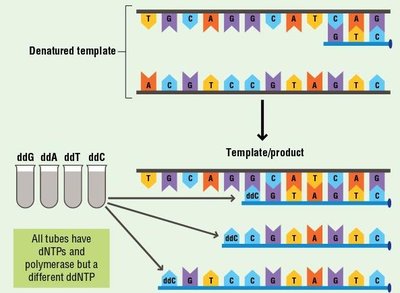
Classical Chain Termination Sequencing: Uses dideoxynucleotides (ddNTPs) to terminate DNA synthesis at specific nucleotides.
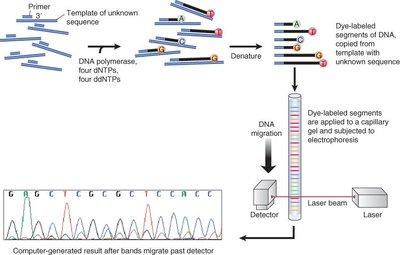
Automation: Fluorescently tagged ddNTPs and capillary gel electrophoresis allow high-throughput sequencing.
Next-Generation Sequencing (NGS): Increases automation, reduces time and cost, and enables sequencing of large genomes.
Sanger Sequencing (Chain Termination Method)
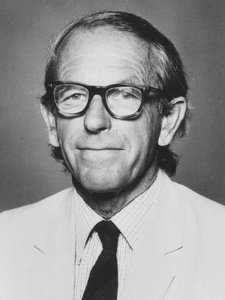
Sanger sequencing, developed by Frederick Sanger, is a foundational method for DNA sequencing. It is highly accurate for sequencing up to 900 base pairs and was used in the Human Genome Project.
Advantages: High-quality sequencing, relatively long reads.
Disadvantages: Expensive and inefficient for longer DNA; NGS is preferred for large-scale sequencing.
Dideoxynucleotides and Chain Termination
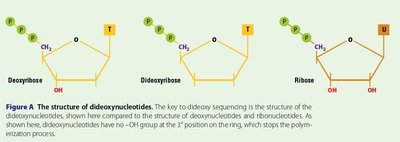
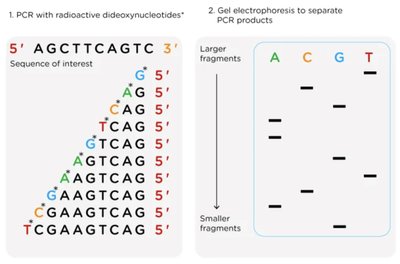
Dideoxynucleotides (ddNTPs) lack a 3'-OH group, preventing further extension of the DNA strand and thus terminating synthesis. This property is exploited in Sanger sequencing to generate DNA fragments of varying lengths.
NTP: Nucleoside triphosphate, used in RNA synthesis.
dNTP: Deoxynucleotide triphosphate, used in DNA synthesis.
ddNTP: Dideoxynucleotide triphosphate, chain terminator.
Components Required for Sanger Sequencing
DNA template
Single sequencing primer
DNA polymerase
dNTPs and ddNTPs
Mg2+ ions
Buffer (for pH maintenance)
Note: Sanger sequencing does not involve exponential amplification like PCR.
Sanger Sequencing Process
Generate DNA fragments of varying length by combining DNA primer, nucleotides, DNA polymerase, DNA sequence, and labeled dideoxynucleotides.
Separate DNA fragments using gel electrophoresis or capillary gel electrophoresis.
Visualize results by using a laser to excite the dye label on each dideoxynucleotide and record the size of fragments passing by the detector.
Electropherogram and Sequencing Results
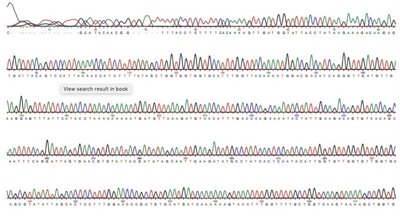
An electropherogram is a plot of DNA sequence fragments, indicating the DNA sequence of the original template. It is used to interpret sequencing results and identify nucleotide positions.
Applications and Utility of Sanger Sequencing
Sanger sequencing is highly accurate and provides long sequence reads, making it ideal for analyzing plasmid sequences, single nucleotide polymorphisms (SNPs), and repetitive regions of the genome.
Comparison of DNA Sequencing Methods
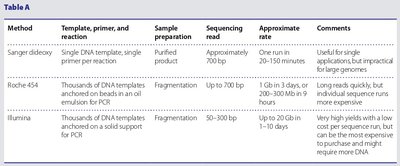
Different DNA sequencing methods vary in their template requirements, sample preparation, sequencing read length, rate, and comments on utility and cost. The following table summarizes key features:
Method | Template, primer, and reaction | Sample preparation | Sequencing read | Approximate rate | Comments |
|---|---|---|---|---|---|
Sanger dideoxy | Single DNA template, single primer per reaction | Purified product | ~700 bp | One run in 20–150 minutes | Useful for single applications but impractical for large genomes |
Roche 454 | Thousands of DNA templates on beads in an oil emulsion for PCR | Fragmentation | Up to 700 bp | 1 GB in 3 days, or 200–300 MB in 8 hours | Long reads quickly, but individual sequencing runs more expensive |
Illumina | Thousands of DNA templates anchored on a solid support for PCR | Fragmentation | 50–300 bp | Up to 20 GB in 1–10 days | High yields with low cost per sequence, but can be more expensive for capture methods and might require more DNA |
Summary
DNA sequencing technologies, especially Sanger sequencing, are fundamental tools in genetics. Understanding primer design, sequencing chemistry, and the interpretation of results is essential for genetic analysis and research.
Additional info: Next-generation sequencing methods (NGS) such as Illumina and Roche 454 have largely replaced Sanger sequencing for large-scale projects due to their speed and cost-effectiveness, but Sanger remains the gold standard for accuracy in targeted sequencing.
