 Back
BackDNA Structure and Analysis – Essentials of Genetics (Chapter 9, Part I)
Study Guide - Smart Notes
 Tailored notes based on your materials, expanded with key definitions, examples, and context.
Ch 9 P1 DNA Structure and Analysis
Introduction to Genetic Material
Genetic material is responsible for storing and transmitting hereditary information from one generation to the next. The identification of DNA as the genetic material was a pivotal moment in genetics, clarifying the molecular basis of inheritance.
Genes contain the information that determines the form and characteristics of an organism.
Early 20th-century scientists debated whether proteins or nucleic acids were the genetic material, with many favoring proteins due to their chemical diversity.
Watson and Crick (1953) proposed the double-helical structure of DNA, revolutionizing our understanding of genetic information.
Characteristics of Genetic Material
For a molecule to serve as genetic material, it must fulfill four essential criteria:
Replication: The molecule must be able to make copies of itself during the cell cycle.
Storage of Information: It must act as a repository for genetic information.
Expression of Information: The information must be accessible for cellular processes.
Variation by Mutation: The molecule must be capable of undergoing changes in its chemical composition, allowing for genetic diversity.
Evidence That DNA Is the Genetic Material
The Tetranucleotide Hypothesis
In 1910, Levene proposed that DNA was composed of equal amounts of four nucleotides, suggesting a simple, repetitive structure incapable of storing complex information. This led many to believe proteins were the genetic material. However, Chargaff later disproved this hypothesis by showing that nucleotide composition varies among species.
Transformation Principle
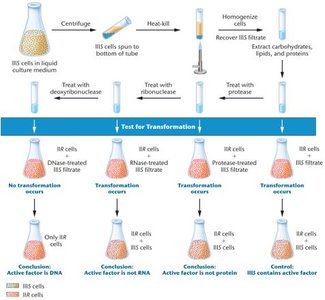
Griffith's experiments with Diplococcus pneumoniae in 1927 laid the foundation for identifying DNA as the genetic material. He observed that non-virulent bacteria could be transformed into virulent forms, suggesting the presence of a 'transforming principle.'
Smooth (S) strain: Virulent, with a polysaccharide capsule.
Rough (R) strain: Avirulent, lacking a capsule.
Avery, MacLeod, and McCarty (1944) demonstrated that DNA is the transforming principle responsible for heredity.
The Hershey–Chase Experiment
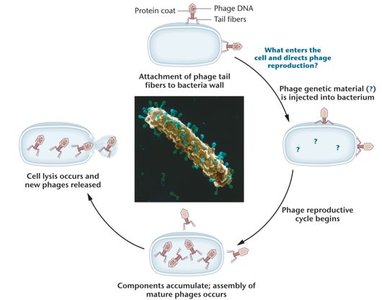
Hershey and Chase (1952) used bacteriophage T2 and Escherichia coli to show that DNA, not protein, is the genetic material. By labeling DNA with radioactive phosphorus and protein with radioactive sulfur, they demonstrated that only DNA enters the bacterial cell and directs viral reproduction.
Transfection Experiments
Transfection involves introducing viral nucleic acid into bacterial cells. These experiments proved that viral DNA alone contains all the information necessary for the production of mature viruses, confirming DNA's role as the universal genetic material.
Indirect Evidence: Mutagenesis
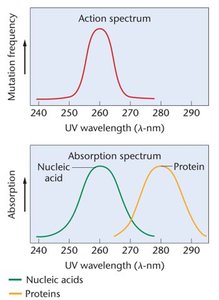
Mutagenesis studies provided indirect evidence for DNA as the genetic material. Ultraviolet (UV) light is most mutagenic at 260 nm, which is also the wavelength at which DNA and RNA absorb UV light most strongly. Proteins absorb UV at 280 nm, where no significant mutagenic effects are observed. This correlation supports DNA as the genetic material.
Direct Evidence: Recombinant DNA Studies
Recombinant DNA technology involves splicing together DNA sequences from different organisms. For example, human insulin genes can be inserted into bacteria, which then produce human insulin. This demonstrates that DNA carries the necessary information for protein synthesis and function.
Genomics: The study of the complete set of DNA sequences in an organism, allowing for the analysis of heritable disorders and genetic variation.
Nucleic Acid Chemistry
Nucleotides: The Building Blocks of Nucleic Acids
DNA is a nucleic acid composed of repeating units called nucleotides. Each nucleotide consists of three components:
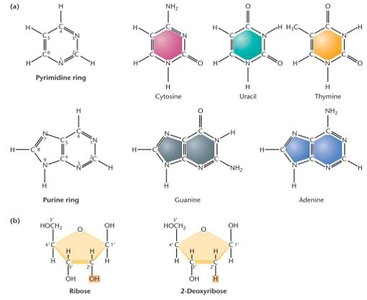
Nitrogenous base: Purines (adenine, guanine) and pyrimidines (cytosine, thymine, uracil).
Pentose sugar: Ribose in RNA, deoxyribose in DNA.
Phosphate group
Nitrogenous Bases
Purines: Adenine (A) and Guanine (G) – double-ring structures.
Pyrimidines: Cytosine (C), Thymine (T), and Uracil (U) – single-ring structures.
DNA contains A, C, T, G; RNA contains A, C, U, G.
Pentose Sugars
Ribose: Found in RNA; contains a hydroxyl group at the 2' carbon.
Deoxyribose: Found in DNA; lacks the 2' hydroxyl group (has a hydrogen instead).
Nucleosides and Nucleotides
A nucleoside consists of a nitrogenous base and a pentose sugar. A nucleotide is a nucleoside with one or more phosphate groups attached. Nucleotides are named according to their nitrogenous base.
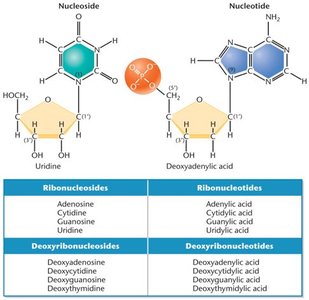
Mono-, Di-, and Triphosphates
Nucleoside monophosphates (NMP): Nucleotides with one phosphate group.
Nucleoside diphosphates (NDP): Nucleotides with two phosphate groups.
Nucleoside triphosphates (NTP): Nucleotides with three phosphate groups (e.g., ATP, GTP), important in cellular energy transfer.
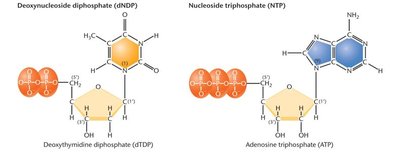
Phosphodiester Bonds
Nucleotides are linked together by phosphodiester bonds, which connect the 5' phosphate group of one nucleotide to the 3' hydroxyl group of the next. This linkage forms the sugar-phosphate backbone of nucleic acids.
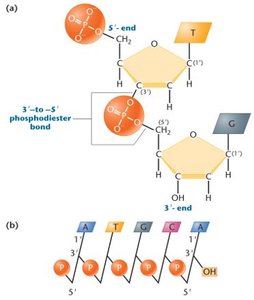
Oligonucleotides and Polynucleotides
Oligonucleotides: Short chains of about 20 nucleotides.
Polynucleotides: Longer chains that can store vast amounts of genetic information and allow for genetic variation.
Base-Composition Studies (Chargaff's Rules)
Chargaff's chromatographic studies revealed that:
The amount of adenine (A) equals thymine (T).
The amount of guanine (G) equals cytosine (C).
The sum of purines (A + G) equals the sum of pyrimidines (C + T).
The percentage of (G + C) is not necessarily equal to (A + T).
Example: If a zebrafish has 19% guanine in its DNA, it will also have 19% cytosine. The remaining 62% is divided equally between adenine and thymine, so each is 31%.

Summary Table: Key Components of Nucleic Acids
Component | DNA | RNA |
|---|---|---|
Nitrogenous Bases | A, T, G, C | A, U, G, C |
Pentose Sugar | Deoxyribose | Ribose |
Strands | Double-stranded (usually) | Single-stranded (usually) |
Main Function | Genetic information storage | Protein synthesis, gene regulation |
