 Back
BackDNA Structure and Analysis: Foundations of Molecular Genetics
Study Guide - Smart Notes
 Tailored notes based on your materials, expanded with key definitions, examples, and context.
DNA Structure and Analysis
Indirect and Direct Evidence for DNA as Genetic Material
Understanding the role of DNA as the genetic material in eukaryotes is supported by both indirect and direct evidence. Indirect evidence includes the correlation between DNA content and chromosome sets, as well as the mutagenic properties of DNA.
DNA Content in Haploid vs Diploid Cells: The amount of DNA in gametes (haploid) and diploid cells correlates with the number of chromosome sets, unlike proteins.
Mutagenic Wavelength: DNA absorbs UV light most strongly at 260 nm, which is also the wavelength most effective for inducing mutations. Proteins absorb at 280 nm, but this wavelength is not mutagenic.
Frederick Griffith’s Transformation Experiment
Griffith’s experiment demonstrated that a chemical component of cells could introduce a new, heritable trait, laying the foundation for identifying DNA as the genetic material.
Key Point: Transformation showed that heritable traits could be transferred chemically, later identified as DNA.
Nucleic Acid Chemistry and DNA Structure
Knowledge of nucleic acid chemistry is essential for understanding DNA structure. DNA is a nucleic acid composed of nucleotides, which are the building blocks of all nucleic acid molecules.
Nucleotides: Each nucleotide consists of a nitrogenous base, a pentose sugar, and a phosphate group.
Nitrogenous Bases: Bases are classified as purines (adenine, guanine) or pyrimidines (cytosine, thymine, uracil).
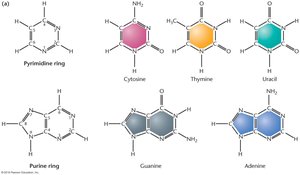
DNA and RNA: Differences in Bases and Backbone
DNA and RNA differ in their nitrogenous bases and sugar backbone. DNA contains deoxyribose and thymine, while RNA contains ribose and uracil.
DNA Bases: Adenine (A), Cytosine (C), Thymine (T), Guanine (G)
RNA Bases: Adenine (A), Cytosine (C), Uracil (U), Guanine (G)
Sugar: DNA has deoxyribose; RNA has ribose.
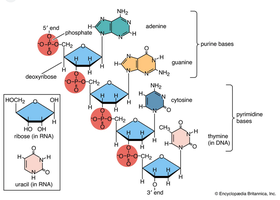
Polynucleotide Formation and Phosphodiester Bonds
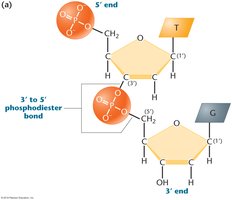
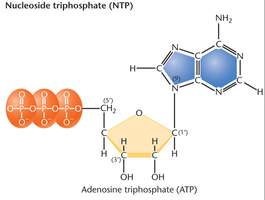
Polynucleotides are formed by linking nucleoside triphosphates (NTPs) through phosphodiester bonds, which are essential for the structure and energy dynamics of nucleic acids.
NTPs: Nucleotides with three phosphate groups, such as ATP and GTP, are precursors in nucleic acid synthesis.
Phosphodiester Bonds: These bonds connect nucleotides, forming the backbone of DNA and RNA.
Chargaff’s Rule and DNA Base Composition
Chargaff’s rule states that the amount of adenine is proportional to thymine, and the amount of cytosine is proportional to guanine. This base composition is crucial for understanding DNA structure.
Base Pairing: A = T, C = G
Base Composition: Percentage of C + G does not equal percentage of A + T
Organism | A | T | G | C | A+T | G+C |
|---|---|---|---|---|---|---|
Human | 30.9 | 29.4 | 19.9 | 19.8 | 60.3 | 39.7 |
Sea Urchin | 32.8 | 32.1 | 17.7 | 17.3 | 64.9 | 35.0 |
E. coli | 24.7 | 23.6 | 26.0 | 25.7 | 48.3 | 51.7 |
Tobacco | 26.0 | 26.0 | 24.0 | 24.0 | 52.0 | 48.0 |
X-Ray Diffraction and DNA Structure
X-ray diffraction studies provided critical evidence for the helical structure of DNA. Rosalind Franklin’s work revealed a 3.4-angstrom periodicity, characteristic of a helical structure.
X-ray Diffraction: Bombardment of DNA with X-rays produces scatter patterns that reveal structural details.

Watson and Crick Model of DNA
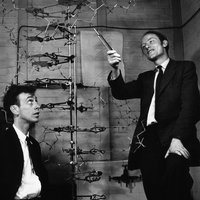
The Watson and Crick model, built upon base composition and X-ray diffraction data, proposed the double helix structure of DNA. This model explained how DNA could serve as the genetic basis for life.
Double Helix: Two antiparallel strands connected by base pairing.
Base Pairing: Stacked nitrogenous bases held together by hydrogen bonds.
Genetic Information: Stored in the sequence of bases.
Replication: Semiconservative model; each strand serves as a template.
Nucleotide Base Pairing and Hydrogen Bonds
Base pairing in DNA occurs via hydrogen bonds, providing complementarity and chemical stability to the helix.
A-T Pair: Double hydrogen bond
G-C Pair: Triple hydrogen bond
The Central Dogma of Molecular Biology
The central dogma describes the flow of genetic information: DNA is transcribed into RNA, which is then translated into protein.
Transcription: DNA → RNA
Translation: RNA → Protein
Structure of RNA
RNA is chemically similar to DNA but is usually single-stranded and contains ribose and uracil instead of deoxyribose and thymine.
Single-Stranded: Most RNA molecules are single-stranded, though some viruses have double-stranded RNA.
Key Differences: Ribose sugar and uracil base
Major Classes of RNA
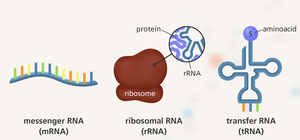
There are three major classes of cellular RNA, each with distinct functions during gene expression.
rRNA (Ribosomal RNA): Structural component of ribosomes for protein synthesis
mRNA (Messenger RNA): Template for protein synthesis; carries genetic information from gene to ribosome
tRNA (Transfer RNA): Carries amino acids for protein synthesis
RNA as Genetic Material in Some Viruses
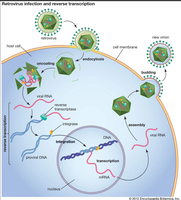
Some viruses use RNA as their genetic material. Retroviruses replicate by using RNA as a template for DNA synthesis via reverse transcriptase.
Retroviruses: RNA serves as template for DNA synthesis
Reverse Transcriptase: RNA-dependent DNA polymerase
Summary Table: DNA vs RNA
Feature | DNA | RNA |
|---|---|---|
Sugar | Deoxyribose | Ribose |
Base | Thymine | Uracil |
Strandedness | Double-stranded | Single-stranded (most) |
Function | Genetic material | Gene expression, genetic material in some viruses |
Key Equations
Chargaff's Rule:
Phosphodiester Bond Formation:
Central Dogma:
