 Back
BackDNA Structure and Analysis: Foundations of Molecular Genetics
Study Guide - Smart Notes
 Tailored notes based on your materials, expanded with key definitions, examples, and context.
DNA Structure and Analysis
Introduction to the Genetic Material
The identification and characterization of the genetic material is a cornerstone of molecular genetics. Early experiments established DNA as the molecule responsible for heredity, information storage, and variation in living organisms.
Replication: Genetic material must be duplicated before cell division, ensuring equal partitioning into daughter cells.
Information Storage: DNA stores vast amounts of genetic information in a stable, heritable form.
Expression: Information is expressed through transcription and translation, producing functional molecules at the correct time and place.
Variation: Mutations in DNA provide the raw material for evolution and diversity.
Historical Perspective: DNA or Protein?
Early 20th-century scientists debated whether proteins or nucleic acids served as the genetic material. Proteins, with their structural diversity, were initially favored, but key experiments shifted consensus to DNA.
Experimental Evidence for DNA as the Genetic Material
Griffith's Transformation Experiment
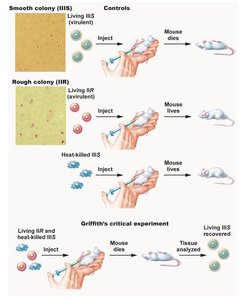
Frederick Griffith (1927) demonstrated that a chemical substance could transform non-virulent bacteria into virulent forms, suggesting the presence of a 'transforming principle.'
Serotype | Colony Morphology | Capsule | Virulence |
|---|---|---|---|
IIR | Rough | Absent | Avirulent |
IIIS | Smooth | Present | Virulent |
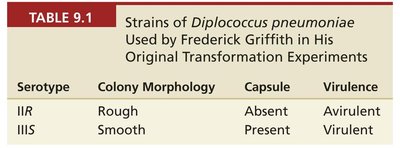
Smooth (S) strain: Virulent, causes disease due to polysaccharide capsule.
Rough (R) strain: Avirulent, lacks capsule.
Key finding: Mixing heat-killed S strain with live R strain transformed R into virulent S type.
Avery, MacLeod, and McCarty: Identifying DNA as the Transforming Principle
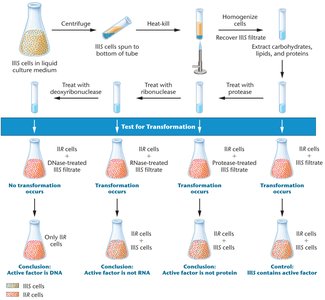
In 1944, Avery, MacLeod, and McCarty demonstrated that DNA, not protein or RNA, was responsible for transformation in bacteria.
Enzymatic treatments: Only DNase (which degrades DNA) destroyed transforming activity, confirming DNA as the genetic material.
Heritability: Transformation was stable and passed to subsequent generations.
Hershey-Chase Experiment
Alfred Hershey and Martha Chase (1952) used bacteriophages labeled with radioactive isotopes to show that DNA, not protein, enters bacterial cells and directs viral replication.
32P-labeled DNA entered bacteria and was found in progeny phages.
35S-labeled protein remained outside the cell and was not inherited.
Indirect Evidence for DNA as Genetic Material
Localization: DNA is concentrated in the nucleus, mitochondria, and chloroplasts—sites of genetic function.
Gametes: Contain half the DNA of somatic cells, matching chromosome number reduction in meiosis.
UV Mutagenesis: DNA absorbs UV light at 260 nm, the same wavelength that induces mutations, while proteins absorb at 280 nm.
Chemistry of Nucleic Acids
Nucleotide Structure
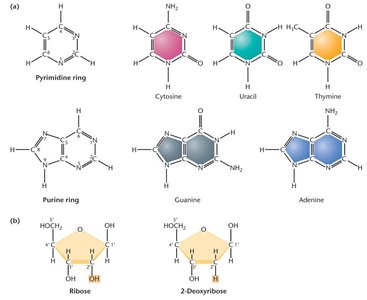
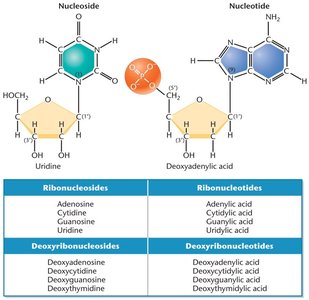
DNA is a nucleic acid composed of repeating nucleotide units. Each nucleotide consists of a nitrogenous base, a pentose sugar, and one or more phosphate groups.
Nitrogenous bases: Purines (adenine, guanine) and pyrimidines (cytosine, thymine in DNA; uracil in RNA).
Pentose sugar: Deoxyribose in DNA, ribose in RNA.
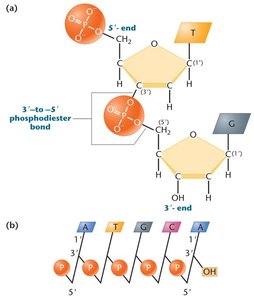
Phosphate group: Links nucleotides via phosphodiester bonds.
Nucleosides vs. Nucleotides
A nucleoside consists of a nitrogenous base and a sugar, while a nucleotide also includes one or more phosphate groups.
Ribonucleosides | Ribonucleotides | Deoxyribonucleosides | Deoxyribonucleotides | |
|---|---|---|---|---|
Adenine | Adenosine | Adenylic acid | Deoxyadenosine | Deoxyadenylic acid |
Cytosine | Cytidine | Cytidylic acid | Deoxycytidine | Deoxycytidylic acid |
Guanine | Guanosine | Guanylic acid | Deoxyguanosine | Deoxyguanylic acid |
Uracil/Thymine | Uridine | Uridylic acid | Deoxythymidine | Deoxythymidylic acid |
Phosphodiester Bonds and DNA Polymers
Nucleotides are joined by 3'-to-5' phosphodiester bonds, forming the sugar-phosphate backbone of DNA. The sequence of bases encodes genetic information.
Oligonucleotide: Short chain of nucleotides.
Polynucleotide: Long chain, as found in DNA and RNA.
The Watson-Crick Model of DNA Structure
Discovery and Key Features
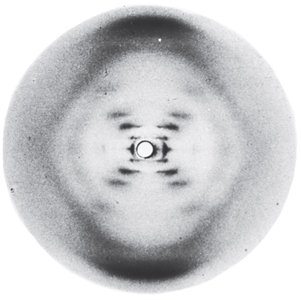
James Watson and Francis Crick (1953) proposed the double helix model of DNA, integrating Chargaff's base pairing rules and Rosalind Franklin's X-ray diffraction data.
Double helix: Two antiparallel polynucleotide chains coil around a central axis.
Base pairing: Adenine pairs with thymine (A-T, 2 H bonds); guanine pairs with cytosine (G-C, 3 H bonds).
Major and minor grooves: Alternating grooves provide binding sites for proteins.
Constant diameter: One purine always pairs with one pyrimidine.
10 base pairs per turn: The helix completes one turn every 10 base pairs (3.4 nm).
Analytical Techniques for DNA Investigation
Absorption of UV Light
DNA absorbs UV light maximally at 260 nm. The hyperchromic shift (increase in absorbance) occurs when DNA is denatured to single strands. The melting temperature (Tm) increases with higher G-C content due to stronger hydrogen bonding.
Molecular Hybridization
Complementary DNA strands can anneal, a principle used in techniques such as fluorescent in situ hybridization (FISH) to detect specific DNA sequences.
Gel Electrophoresis
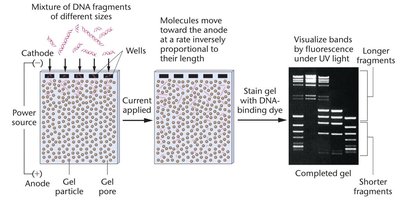
Gel electrophoresis separates DNA fragments by size. DNA samples are loaded into a gel matrix, and an electric current causes fragments to migrate toward the anode. Smaller fragments move faster, allowing size-based separation and visualization under UV light.
Summary Table: Key Experiments Establishing DNA as Genetic Material
Experiment | Organism/System | Key Finding |
|---|---|---|
Griffith (1927) | Streptococcus pneumoniae | Transformation by a chemical principle |
Avery, MacLeod, McCarty (1944) | Streptococcus pneumoniae | DNA is the transforming principle |
Hershey-Chase (1952) | Bacteriophage T2 | DNA, not protein, is inherited |
Additional info: This guide integrates foundational experiments, chemical structure, and analytical techniques essential for understanding DNA as the genetic material in molecular genetics.
