 Back
BackDNA Structure and Analysis – Genetics Study Notes
Study Guide - Smart Notes
 Tailored notes based on your materials, expanded with key definitions, examples, and context.
DNA Structure and Analysis
Introduction
This chapter explores the chemical nature, structure, and experimental evidence for DNA as the genetic material. It also discusses RNA as genetic material in some viruses, the chemistry of nucleic acids, and analytical techniques used in their study.
Genetic Material: Criteria and Central Dogma
Characteristics of Genetic Material
Replication: Must be able to copy itself accurately for transmission to the next generation.
Storage of Information: Must contain the information necessary for the structure and function of cells.
Expression of Information: Must be able to direct the synthesis of proteins and other molecules.
Variation by Mutation: Must be capable of change to allow evolution and diversity.
The Central Dogma of Molecular Genetics
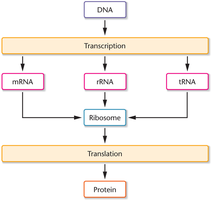
The central dogma describes the flow of genetic information: DNA is transcribed into RNA, which is then translated into protein.
Historical Perspective: Protein vs. DNA as Genetic Material
Protein as the Favored Candidate
Proteins were considered the genetic material due to their chemical diversity and abundance.
The tetranucleotide hypothesis suggested DNA was too simple to carry genetic information, as it was thought to be a repetitive polymer of four nucleotides.
Experimental Evidence for DNA as Genetic Material
Griffith’s Transformation Experiment
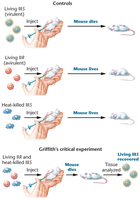
Frederick Griffith demonstrated that non-virulent bacteria could be transformed into virulent forms by exposure to heat-killed virulent bacteria, suggesting the presence of a "transforming principle."
Avery, MacLeod, and McCarty Experiment
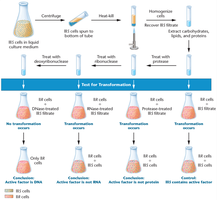
In 1944, these researchers identified DNA as the "transforming principle" by showing that only DNA, not protein or RNA, could transform non-virulent bacteria into virulent forms.
Hershey and Chase Experiment
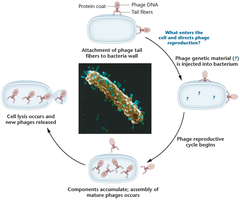
Using bacteriophage T2 and radioisotopes, Hershey and Chase demonstrated that DNA, not protein, enters bacterial cells and directs viral reproduction.
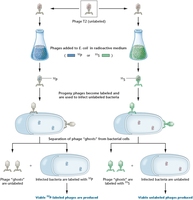
Transfection
Transfection: Introduction of only viral nucleic acid into bacteria is sufficient to produce mature viruses, confirming DNA as the genetic material.
Evidence for DNA as Genetic Material in Eukaryotes
Indirect Evidence
Distribution of DNA: Amount of DNA correlates with chromosome number in gametes and diploids, unlike proteins.
Mutagenesis: DNA absorbs UV light at 260 nm, the same wavelength that induces mutations, while proteins absorb at 280 nm.
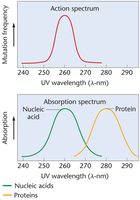
Direct Evidence: Recombinant DNA Studies
Genes from eukaryotes can be inserted into bacteria, which then express the gene product (e.g., insulin production), directly demonstrating DNA's role as genetic material.
RNA as Genetic Material in Some Viruses
RNA Viruses
Some viruses, such as Tobacco Mosaic Virus (TMV), use RNA as their genetic material.
Replication of viral RNA depends on the enzyme RNA replicase.
Retroviruses and Reverse Transcriptase
Retroviruses use RNA as a template for DNA synthesis via the enzyme reverse transcriptase (an RNA-dependent DNA polymerase).
Chemistry of Nucleic Acids
Nucleotides: Building Blocks of DNA and RNA
Nucleotide: Consists of a nitrogenous base, a pentose sugar, and a phosphate group.
Nitrogenous Bases: Two types—purines (adenine, guanine) and pyrimidines (cytosine, thymine, uracil).
Pentose Sugar: Ribose in RNA, deoxyribose in DNA.
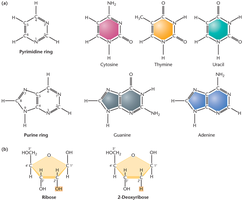
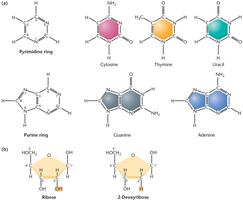
Nucleosides and Nucleotides
Nucleoside: Nitrogenous base + pentose sugar.
Nucleotide: Nucleoside + phosphate group.
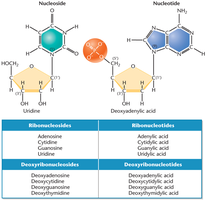
Mono-, Di-, and Triphosphates
Nucleoside monophosphate (NMP): One phosphate group.
Nucleoside diphosphate (NDP): Two phosphate groups.
Nucleoside triphosphate (NTP): Three phosphate groups (e.g., ATP, GTP).
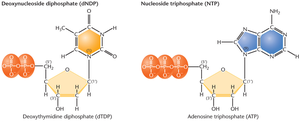
Phosphodiester Bonds
Nucleotides are linked by phosphodiester bonds between the 3' hydroxyl of one sugar and the 5' phosphate of the next.
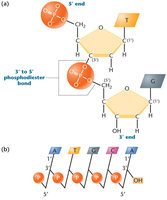
DNA Structure
Watson and Crick Model
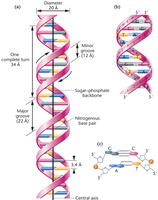
DNA is a double helix with two antiparallel strands held together by base pairing.
Chargaff's rules: Amount of A = T, and G = C; (A + T) ≠ (G + C).
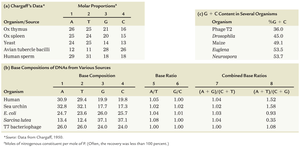
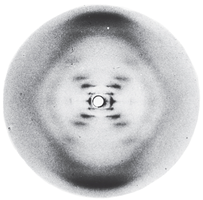
X-Ray Diffraction
Rosalind Franklin's X-ray diffraction studies revealed the helical structure of DNA with a 3.4 Å periodicity.
Double Helix Structure
DNA has a diameter of 20 Å, with one complete turn every 34 Å.
Major and minor grooves are present along the helix.
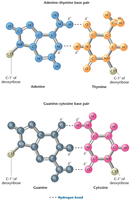
Base Pairing and Hydrogen Bonds
Adenine pairs with thymine via two hydrogen bonds; guanine pairs with cytosine via three hydrogen bonds.
This complementarity provides stability and fidelity in replication.
Semiconservative Replication
Each new DNA molecule consists of one parental and one newly synthesized strand.
Genetic information is stored in the sequence of bases; mutations arise from changes in this sequence.
Alternative Forms of DNA
DNA Conformations
B-DNA: Standard form under physiological conditions; right-handed helix.
A-DNA: More compact, right-handed; forms under high-salt or dehydration conditions.
Z-DNA: Left-handed helix; occurs in sequences with alternating purines and pyrimidines.
Other forms (C, D, E, P-DNA) are less common and less biologically significant.
RNA Structure and Types
Chemical Structure of RNA
RNA contains ribose sugar and uracil instead of thymine.
Most RNA molecules are single-stranded, though some viruses have double-stranded RNA.
Major Classes of RNA
Messenger RNA (mRNA): Carries genetic information from DNA to ribosomes for protein synthesis.
Ribosomal RNA (rRNA): Structural and functional component of ribosomes.
Transfer RNA (tRNA): Brings amino acids to the ribosome during translation.
Unique RNAs in Eukaryotes
Telomerase RNA and RNA primers: Involved in DNA replication.
Small nuclear RNA (snRNA): Processes mRNA.
MicroRNA (miRNA), short interfering RNA (siRNA), long noncoding RNA (lncRNA): Involved in gene regulation.
Analytical Techniques for DNA and RNA
Denaturation and Renaturation
DNA can be denatured (separated into single strands) by heat or chemical stress.
Denaturation is monitored by the hyperchromic shift (increase in UV absorption at 260 nm).
Renaturation (reannealing) is the reassociation of complementary strands.
Molecular Hybridization
Denaturation and renaturation form the basis for in situ molecular hybridization, allowing detection of specific DNA sequences in chromosomes.
Fluorescence In Situ Hybridization (FISH)
Uses fluorescent probes to detect specific DNA sequences on chromosomes in fixed cells.
Electrophoresis of Nucleic Acids
Separates DNA and RNA fragments by size using an agarose gel matrix.
Smaller fragments migrate faster than larger ones.
Additional info: This summary covers the essential concepts, experiments, and analytical techniques related to DNA and RNA structure and function, as outlined in a typical college-level genetics course.
