 Back
DNA Structure and Analysis: Study Notes for Genetics Students
Study Guide - Smart Notes
 Tailored notes based on your materials, expanded with key definitions, examples, and context.
DNA Structure and Analysis
Genetic Material: Criteria and Central Dogma
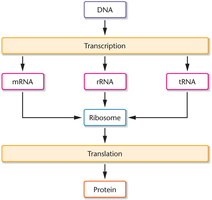
The genetic material is the information contained in genes that is passed to new generations and is the source of variability among organisms. To serve as genetic material, a molecule must be able to replicate, store information, express information, and allow variation by mutation. The central dogma of molecular genetics describes the flow of genetic information: DNA makes RNA (transcription), which makes proteins (translation).
Replication: The ability to copy itself accurately.
Information Storage: Encodes instructions for cellular functions.
Expression: Information is used to direct cellular activities.
Variation by Mutation: Changes in genetic material allow evolution.
Historical Perspective: Protein vs. DNA as Genetic Material
Until 1944, proteins were favored as the genetic material due to their diversity and abundance. The tetranucleotide hypothesis suggested DNA was composed of repeating units of four nucleotides, implying a lack of chemical diversity and information storage capacity. However, experimental evidence began to favor DNA.
Experimental Evidence: DNA as Genetic Material
Griffith’s Transformation Experiment
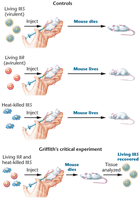
Griffith (1927) showed that avirulent strains of Diplococcus pneumoniae could be transformed to virulence, suggesting a "transforming principle." This experiment laid the foundation for later discoveries.
Avery, MacLeod, and McCarty
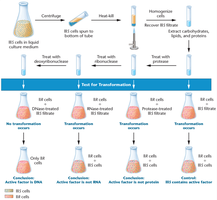
In 1944, Avery, MacLeod, and McCarty demonstrated that DNA, not protein, was the transforming principle by using DNase to destroy DNA and abolish transformation.
Hershey and Chase Experiment
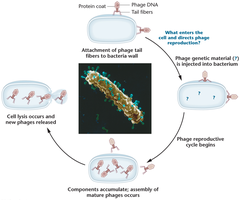
Hershey and Chase (1952) used radioisotopes to show that DNA, not protein, enters bacterial cells during infection and directs viral reproduction. This experiment used bacteriophage T2 and E. coli.
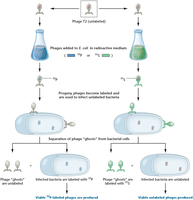
Transfection
Transfection involves infecting bacteria with only viral nucleic acid, proving that viral DNA alone contains all necessary information for virus production.
Evidence for DNA as Genetic Material in Eukaryotes
Indirect Evidence
Distribution of DNA: Correlation between DNA amount and chromosome sets in gametes and diploids.
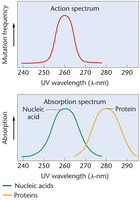
Mutagenesis: DNA absorbs UV light at 260 nm, the wavelength most mutagenic for cells, while proteins absorb at 280 nm.
Direct Evidence
Recombinant DNA Technology: Eukaryotic DNA inserted into bacteria can produce eukaryotic gene products, such as insulin and interferon.
RNA as Genetic Material in Some Viruses
Some viruses, such as Tobacco mosaic virus (TMV), have RNA as their genetic material. RNA replicase is required for replication. Retroviruses use RNA as a template for DNA synthesis via reverse transcriptase, an RNA-dependent DNA polymerase.
Nucleic Acid Chemistry: Nucleotides and Structure
Nucleotides
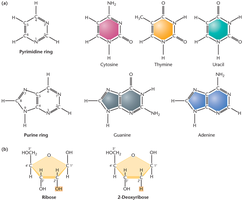
Nucleotides are the building blocks of nucleic acids, consisting of a nitrogenous base, a pentose sugar, and a phosphate group.
Nitrogenous Bases: Purines (adenine, guanine) and pyrimidines (cytosine, thymine, uracil).
Sugars: DNA contains deoxyribose; RNA contains ribose.
Phosphate Group: Links nucleotides together.
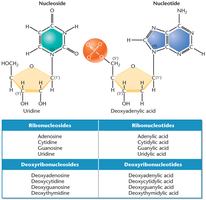
Nucleosides and Nucleotides
A nucleoside consists of a nitrogenous base and a pentose sugar. A nucleotide is a nucleoside with a phosphate group added.
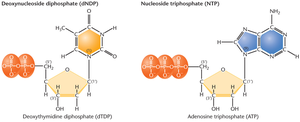
Mono-, Di-, and Triphosphates
Nucleoside monophosphates (NMP), diphosphates (NDP), and triphosphates (NTP) differ by the number of phosphate groups. ATP and GTP are important energy carriers.
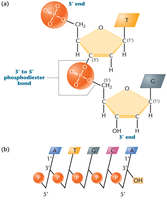
Phosphodiester Bonds
Nucleotides are linked by phosphodiester bonds between the phosphate group at the 5' position and the OH group on the 3' position of adjacent sugars, forming the backbone of nucleic acids.
DNA Structure: Key Features and Function
Watson and Crick Model
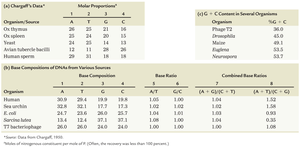
Watson and Crick (1953) proposed the double helix structure of DNA, with two antiparallel strands connected by base pairing and stacked nitrogenous bases. Chargaff's rules state that the amount of A is proportional to T, and C to G, but (A+T) does not equal (C+G).
X-Ray Diffraction
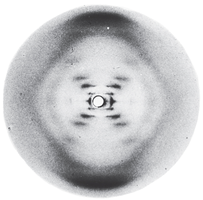
Rosalind Franklin's X-ray diffraction studies revealed DNA's helical structure with a 3.4-angstrom periodicity.
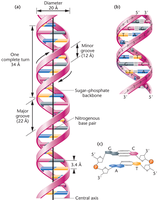
Double Helix Structure
The double helix has a diameter of 20 Å, a major groove (22 Å), a minor groove (12 Å), and a complete turn every 34 Å. The sugar-phosphate backbone is on the outside, and nitrogenous bases pair in the center.
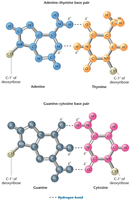
Base Pairing and Hydrogen Bonds
Base pairing provides complementarity and stability: A-T pairs have two hydrogen bonds, G-C pairs have three.
Semiconservative Model of Replication
DNA replication is semiconservative: each new molecule contains one old and one new strand. Genetic information is stored in the sequence of bases, and mutations arise from alterations in these bases.
Alternative Forms of DNA
DNA can adopt several conformations under different conditions:
B-DNA: Standard form under aqueous, low-salt conditions; biologically significant.
A-DNA: More compact, right-handed helix, prevalent under high-salt or dehydration conditions.
C-, D-, E-, P-DNA: Right-handed, less compact forms.
Z-DNA: Left-handed double helix.
RNA Structure and Types
RNA is chemically similar to DNA but is usually single-stranded. It contains ribose sugar and uracil instead of thymine. Some animal viruses have double-stranded RNA.
Messenger RNA (mRNA): Carries genetic information from DNA to ribosome.
Ribosomal RNA (rRNA): Structural component of ribosomes.
Transfer RNA (tRNA): Carries amino acids for protein synthesis.
Unique RNAs: Telomerase RNA, snRNA, miRNA, siRNA, lncRNA involved in replication and gene regulation.
Analytical Techniques for DNA and RNA
Denaturation and Renaturation: DNA can denature due to heat or stress, resulting in a hyperchromic shift (increase in UV absorption). Used to determine melting temperature.
Molecular Hybridization: Denaturation and renaturation are the basis for in situ hybridization, targeting specific chromosomal areas.
Fluorescence in situ Hybridization (FISH): Uses fluorescent probes to monitor hybridization in mitotic cells.
Electrophoresis: Separates DNA and RNA fragments by size using agarose gel; smaller fragments migrate faster.
Key Equations
Chargaff's Rule:
Phosphodiester Bond Formation:
Summary Table: DNA and RNA Components
Component | DNA | RNA |
|---|---|---|
Sugar | Deoxyribose | Ribose |
Bases | A, T, C, G | A, U, C, G |
Strandedness | Double | Single (mostly) |
