 Back
BackDNA Structure and Replication: Foundations of Molecular Genetics
Study Guide - Smart Notes
 Tailored notes based on your materials, expanded with key definitions, examples, and context.
DNA Structure and Replication
Introduction
This chapter explores the molecular basis of heredity by examining the structure and replication of DNA. It covers the experimental evidence that established DNA as the hereditary material, the chemical and physical properties of DNA, the mechanisms of DNA replication, and modern techniques for DNA analysis.
DNA as the Hereditary Material
Qualities of a Hereditary Molecule
Information Storage: Must store and transmit biological information across generations.
Chromosomal Component: Integral part of chromosomes, present in a stable form in cells.
Complexity: Sufficiently complex to encode all necessary information for structure, function, development, and reproduction.
Replication: Capable of accurate self-replication to ensure genetic continuity.
Mutability: Undergoes rare mutations, providing genetic variation for evolution.
Discovery of Transformation
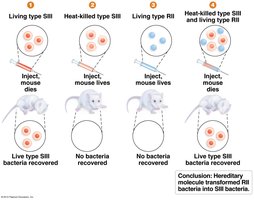
Frederick Griffith's 1928 experiments with Streptococcus pneumoniae demonstrated the phenomenon of transformation, where a 'hereditary factor' from dead, virulent bacteria could convert non-virulent bacteria into a virulent form.
Smooth (S) strain: Virulent, causes disease.
Rough (R) strain: Non-virulent, does not cause disease.
Key finding: Mixing heat-killed S with live R bacteria killed mice and live S bacteria were recovered, indicating transfer of hereditary material.
Avery, MacLeod, and McCarty Experiment (1944)
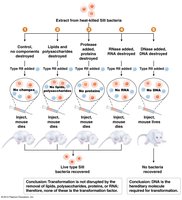
This experiment identified DNA as the 'transforming factor' by systematically destroying different macromolecules in extracts from S cells and testing for transformation ability.
Destruction of proteins, lipids, polysaccharides, or RNA: Did not prevent transformation.
Destruction of DNA: Blocked transformation, proving DNA is necessary for heredity.
Hershey-Chase Experiment (1952)
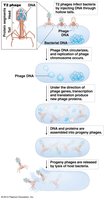
Alfred Hershey and Martha Chase used bacteriophages labeled with radioactive isotopes to show that DNA, not protein, is the genetic material transferred to bacteria during infection.
Phage DNA labeled with 32P: Entered bacterial cells and directed viral replication.
Phage protein labeled with 35S: Remained outside the bacterial cells.
Chemical Structure of DNA
Nucleotide Structure
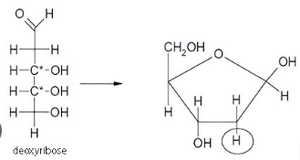
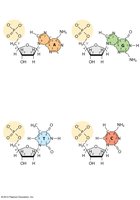
DNA is a polymer of nucleotides, each consisting of a deoxyribose sugar, a phosphate group, and a nitrogenous base.
Deoxyribose: A five-carbon sugar lacking a 2' oxygen atom.
Nitrogenous bases: Purines (adenine, guanine) and pyrimidines (cytosine, thymine).
Phosphodiester bonds: Link nucleotides into a sugar-phosphate backbone.
Base Pairing and Chargaff's Rules
Complementary base pairing: Adenine pairs with thymine (A=T), guanine pairs with cytosine (G≡C).
Chargaff's rules: In any DNA, the amount of A equals T and G equals C; total purines equal total pyrimidines.
Species | A (%) | G (%) | C (%) | T (%) | G+C (%) | G/C |
|---|---|---|---|---|---|---|
E. coli | 23.8 | 26.8 | 26.3 | 23.1 | 53.1 | 1.02 |
S. cerevisiae | 31.3 | 18.7 | 17.1 | 32.9 | 35.8 | 1.09 |
N. crassa | 23.0 | 27.1 | 26.6 | 23.3 | 53.7 | 1.02 |
C. elegans | 31.2 | 19.3 | 20.5 | 29.1 | 39.8 | 0.94 |
D. melanogaster | 27.3 | 22.5 | 22.5 | 27.6 | 45.0 | 1.00 |
A. thaliana | 29.1 | 20.5 | 20.7 | 29.7 | 41.2 | 0.99 |
M. musculus | 29.2 | 21.7 | 19.7 | 29.4 | 41.4 | 1.10 |
H. sapiens | 30.6 | 19.7 | 19.8 | 30.3 | 39.5 | 0.99 |
Double Helix Structure
Antiparallel strands: DNA consists of two strands running in opposite directions (5' to 3' and 3' to 5').
Major and minor grooves: Important for protein-DNA interactions.
Stability: Hydrogen bonds between bases and hydrophobic interactions stabilize the double helix.
Helical parameters: About 10.5 base pairs per turn.
DNA Replication
Properties of DNA Replication
Semiconservative: Each daughter DNA molecule contains one parental and one newly synthesized strand.
Bidirectional: Replication proceeds in both directions from each origin.
Experimental Evidence: Meselson-Stahl Experiment
Matthew Meselson and Franklin Stahl (1957) used isotopic labeling to demonstrate semiconservative replication.
15N-labeled DNA: Heavy DNA used to distinguish parental from new strands.
After replication in 14N medium: Hybrid DNA observed, consistent with semiconservative model.
Origins of Replication
Bacteria: Single origin (ORI), replication is bidirectional.
Eukaryotes: Multiple origins, each initiating bidirectional replication.
Mechanism of DNA Replication
Initiator proteins: Bind to origins and begin unwinding DNA.
Helicase: Unwinds the double helix at replication forks.
Single-strand binding proteins: Stabilize unwound DNA.
Topoisomerase: Relieves supercoiling ahead of the fork.
Primase: Synthesizes short RNA primers to provide a 3' OH group for DNA polymerase.
DNA Polymerase III (prokaryotes): Main enzyme for new DNA synthesis, adds nucleotides to the 3' end.
Leading strand: Synthesized continuously in the 5' to 3' direction.
Lagging strand: Synthesized discontinuously as Okazaki fragments.
DNA Polymerase I: Removes RNA primers and replaces them with DNA.
DNA Ligase: Seals nicks between Okazaki fragments.
Proofreading and Fidelity
DNA Polymerase III and I: Possess 3' to 5' exonuclease activity for proofreading, reducing error rates to ~1 in 109 nucleotides.
Replication at Telomeres
Linear chromosomes face end-replication problems on the lagging strand, leading to progressive shortening.
Telomerase: A ribonucleoprotein enzyme that extends telomeres by adding repetitive DNA sequences to the 3' end, using an RNA template.
Biological significance: Telomerase is active in germ-line and some stem cells; its reactivation in somatic cells is associated with cancer.
Techniques Related to DNA Replication
Polymerase Chain Reaction (PCR)
PCR is a technique to amplify specific DNA segments in vitro, enabling millions of copies to be made from a single molecule.
Components: Template DNA, Taq DNA polymerase, DNA primers, dNTPs, Mg2+, buffer, heat.
Steps: Denaturation, annealing, extension.
Applications: Genetic testing, forensics, cloning, diagnostics.
Dideoxy (Sanger) Sequencing
This method determines the nucleotide sequence of DNA by incorporating chain-terminating dideoxynucleotides (ddNTPs) during DNA synthesis.
Key principle: Incorporation of a ddNTP blocks further elongation due to the absence of a 3' OH group.
Modern sequencing: Uses fluorescently labeled ddNTPs and automated detection.
Summary Table: Key Enzymes and Functions in DNA Replication
Enzyme/Protein | Function |
|---|---|
Helicase | Unwinds DNA double helix |
Single-strand binding protein | Stabilizes unwound DNA |
Topoisomerase | Relieves supercoiling |
Primase | Synthesizes RNA primers |
DNA Polymerase III | Main DNA synthesis |
DNA Polymerase I | Removes RNA primers, fills gaps |
Ligase | Seals nicks between fragments |
Telomerase | Extends telomeres |
Key Equations
Chargaff's Rule: and
Purine/Pyrimidine Balance:
Additional info: This summary integrates foundational experiments, chemical structure, replication mechanisms, and modern molecular techniques, providing a comprehensive overview for genetics students.
