 Back
DNA Structure and Replication: Foundations of Genetic Material
Study Guide - Smart Notes
 Tailored notes based on your materials, expanded with key definitions, examples, and context.
Genetic Material and Its Characteristics
Definition and Importance
Genetic material is the substance in cells that carries hereditary information from one generation to the next. It is responsible for the expression of traits, storage of complex information, capacity for variation, and accurate replication. - Expression of information: Genetic material determines phenotype. - Storage: It stores complex instructions for cellular function. - Variation: It allows for diversity among organisms. - Replication: It must be copied accurately for inheritance.
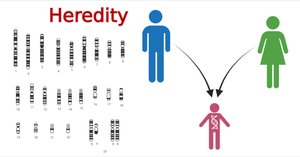
DNA vs. Protein: The Debate Over Genetic Material
Historical Context and Key Experiments
Early 20th-century scientists debated whether DNA or protein was the hereditary molecule. Proteins, with 20 amino acids, were thought to have greater variability than DNA's four nucleotides. Three pivotal experiments resolved this debate:
Griffith Transformation Experiment (1928): Demonstrated that a chemical component could transform avirulent bacteria into virulent ones.
Avery, MacLeod, and McCarty (1944): Identified DNA as the transforming principle by showing that DNase destroyed transforming activity.
Hershey-Chase Phage Experiment (1952): Used radioisotopes to show that DNA, not protein, is the genetic material in bacteriophages.
Structure of DNA
Nucleotides and Nucleosides
DNA is composed of nucleotides, each consisting of a pentose sugar, a nitrogenous base, and a phosphate group. - Nucleoside: Contains only a sugar and a base. - Nucleotide:
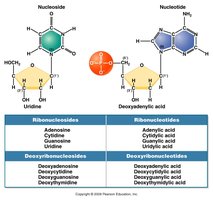
A nucleoside with one or more phosphate groups.
Phosphate Group and Sugar
The phosphate group is attached to the 5’ carbon of the sugar, and nucleotides can have one, two, or three phosphate groups (NMPs, NDPs, NTPs). The sugar in DNA is deoxyribose, while RNA contains ribose.
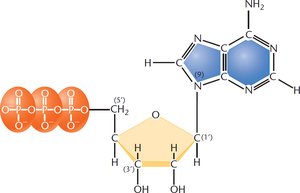
Nitrogenous Bases
DNA contains four bases: adenine (A), thymine (T), guanine (G), and cytosine (C). RNA replaces thymine with uracil (U).
Polynucleotide Strands and Bonds
Nucleotides are linked by phosphodiester bonds between the 5’ phosphate and 3’ hydroxyl groups, creating strand polarity.
Chargaff’s Rules and DNA Composition
Base Pairing and Quantitative Relationships
Chargaff’s rules state: - Amount of A equals T - Amount of C equals G - Percentage of (C + G) does not equal percentage of (A + T) These rules provided evidence for base pairing and complementarity in DNA.
Discovery of DNA’s Secondary Structure
Rosalind Franklin’s X-ray Diffraction
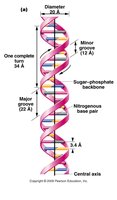
X-ray diffraction studies revealed DNA’s helical structure, with a periodicity of 3.4 angstroms per base pair and 34 angstroms per helical turn.
Watson and Crick Model
Watson and Crick used Franklin’s data and Chargaff’s rules to propose the double helix model: - Two antiparallel polynucleotide strands form a right-handed helix. - Major and minor grooves alternate, affecting gene expression. - Each turn contains 10 bases (34 Å).
Base Pairing and Stability
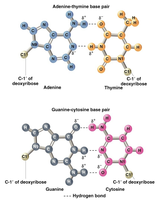
Purines (A, G) pair with pyrimidines (T, C): - A-T pairs have two hydrogen bonds. - G-C pairs have three hydrogen bonds. This pairing explains Chargaff’s rule and provides chemical stability.
Alternative DNA Structures
Forms of DNA
- B-DNA: Biologically significant, right-handed helix. - A-DNA: More compact, right-handed. - Z-DNA: Left-handed, may have regulatory roles.
RNA Structure and Function
Comparison to DNA
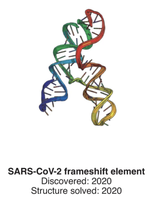
RNA is similar to DNA but is single-stranded and contains ribose and uracil. Most RNA molecules form double-stranded regions through folding.
Classes of RNA
- mRNA: Template for protein synthesis. - rRNA: Ribosome component. - tRNA: Carries amino acids for protein synthesis.
The Central Dogma of Molecular Biology
Flow of Genetic Information
The central dogma describes the flow of information: DNA → RNA → Protein. Transcription produces mRNA, rRNA, and tRNA; translation synthesizes proteins. 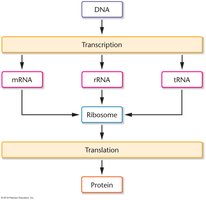
Analytical Techniques for Nucleic Acids
UV Absorption
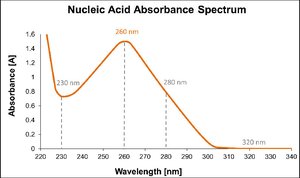
Nucleic acids absorb UV light strongly at 254–260 nm due to their ring structures.
Denaturation and Renaturation
Heating DNA causes denaturation, increasing absorbance (hyperchromic shift). The melting temperature (Tm) is the point where half the DNA is single-stranded. 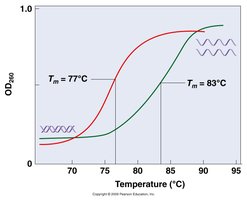 Formulas: For sequences < 14 nucleotides: For sequences > 13 nucleotides:
Molecular Hybridization and FISH
Denaturation and renaturation are the basis for hybridization techniques, such as FISH, which uses fluorescent probes to detect specific DNA sequences. 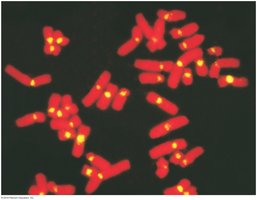
Nucleic Acid Electrophoresis
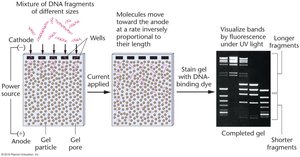
Electrophoresis separates DNA and RNA fragments by size; smaller fragments migrate faster through the gel.
Denaturation Graphs
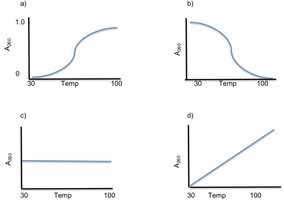
Heating DNA from 30°C to 100°C produces a characteristic absorbance curve, indicating denaturation.
DNA Replication and Recombination
Accuracy and Speed
DNA replication must be highly accurate and rapid. For example, E. coli replicates at 1000 nucleotides/second.
Models of Replication
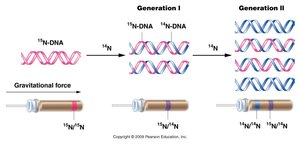
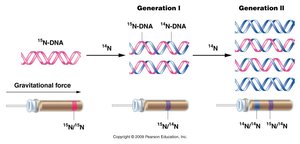
Three models were proposed: - Conservative: Entire DNA serves as template for new strands. - Semiconservative: Each strand serves as template for a new strand. - Dispersive: DNA breaks into pieces, each serving as template.
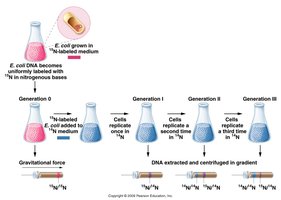
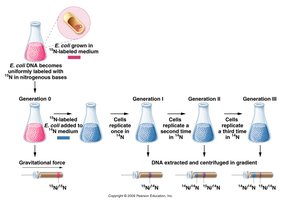
Meselson and Stahl Experiment
Used isotopes of nitrogen (14N and 15N) to distinguish old and new DNA strands. E. coli grown in 15N, then transferred to 14N, and DNA analyzed by density gradient centrifugation.
Replication Terminology
- Origin of replication (ORI): Site where replication begins. - Replication fork: Region where DNA is unwound. - Replicon: Length of DNA replicated from a single origin.
Bacterial Replication
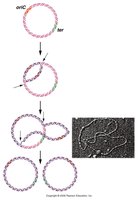
E. coli has a single circular DNA molecule; replication is bidirectional from oriC, creating two forks that merge at the termination region (ter).
Linear Eukaryotic Replication
Eukaryotic chromosomes are linear and contain multiple origins of replication, allowing rapid genome duplication.
Summary Table: DNA vs. RNA
Feature | DNA | RNA |
|---|---|---|
Sugar | Deoxyribose | Ribose |
Strands | Double-stranded | Single-stranded |
Bases | A, T, G, C | A, U, G, C |
Stability | More stable | Less stable |
Function | Genetic storage | Protein synthesis, regulation |
Key Equations
DNA Melting Temperature (Tm): For sequences < 14 nucleotides: For sequences > 13 nucleotides:
Conclusion
DNA is the hereditary material, with a structure that enables accurate replication, variation, and expression of information. Analytical techniques and historical experiments have established its role and properties, forming the foundation for modern genetics. Additional info: Expanded explanations and context were added for clarity and completeness.
