 Back
DNA Structure and Replication: Study Notes for Genetics Students
Study Guide - Smart Notes
 Tailored notes based on your materials, expanded with key definitions, examples, and context.
DNA Structure and Replication
DNA as the Hereditary Molecule
The identification of DNA as the hereditary material was a pivotal moment in genetics. Early studies established several essential characteristics for hereditary material, including localization to the nucleus, stability, complexity, accurate replication, and mutability.
Localization: DNA is found in the nucleus and is a component of chromosomes.
Stability: DNA is present in a stable form in cells, ensuring continuity across generations.
Complexity: DNA contains the information required for structure, function, development, and reproduction.
Replication: DNA can accurately replicate itself, ensuring daughter cells inherit identical genetic information.
Mutability: DNA can undergo mutations at a low rate, introducing genetic variation and enabling evolution.
Historical Experiments Identifying DNA as Hereditary Material
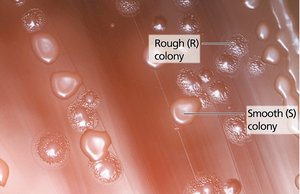
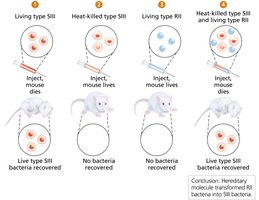
Griffith's Transformation Experiment: Demonstrated that a 'transformation factor' could transfer hereditary information between bacterial strains.
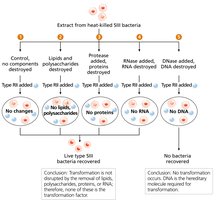
Avery, MacLeod, and McCarty: Identified DNA as the transformation factor responsible for heredity.
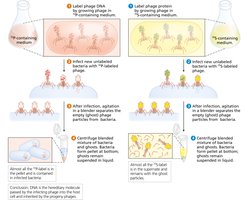
Hershey and Chase: Used bacteriophages to show that DNA, not protein, is the hereditary material in viruses.
DNA Double Helix Structure
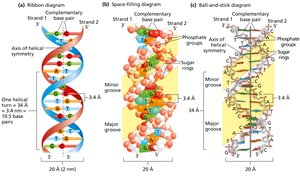
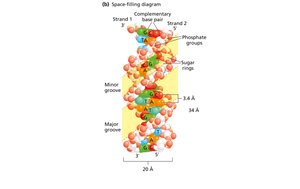
The secondary structure of DNA, identified by Franklin and modeled by Watson and Crick, consists of two complementary and antiparallel strands forming a double helix.
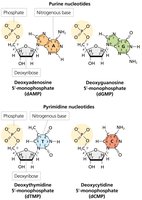
Nucleotide Components: Each DNA nucleotide contains a five-carbon sugar (deoxyribose), a phosphate group, and one of four nitrogenous bases (A, T, C, G).
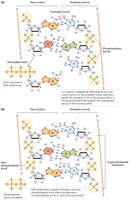
Phosphodiester Bonds: Nucleotides are joined by covalent phosphodiester bonds, forming a sugar-phosphate backbone.
Directionality: DNA strands have directionality, with a 5' end and a 3' end.
Complementary Base Pairing: A pairs with T (two hydrogen bonds), G pairs with C (three hydrogen bonds).
Antiparallel Strands: The two strands run in opposite directions, essential for stable hydrogen bonding.
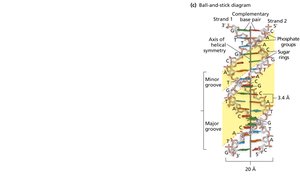
Forms of DNA
B-form: Most common, right-handed helix.
A-form: Right-handed, more compact, found under dehydrating conditions.
Z-form: Left-handed, zigzag backbone, often near transcription start sites.
Form | Handedness | Features |
|---|---|---|
B-form | Right | Most common, major/minor grooves |
A-form | Right | Compact, protective under low water |
Z-form | Left | Zigzag backbone, regulatory role |
DNA Replication: Mechanisms and Models
DNA replication is essential for genetic continuity. The process is semiconservative and bidirectional, ensuring each daughter cell receives an identical copy of genetic material.
Semiconservative Replication: Each daughter duplex contains one parental and one daughter strand.
Conservative Replication: One duplex contains both parental strands, the other both daughter strands.
Dispersive Replication: Each duplex contains interspersed parental and daughter segments.
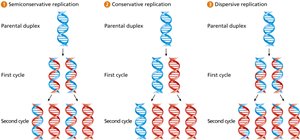
Origin and Directionality of Replication
Origin of Replication: Specific site where replication begins (e.g., oriC in E. coli).
Bidirectional Replication: Replication proceeds in both directions, forming a replication bubble with forks at each end.
Multiple Origins in Eukaryotes: Eukaryotic chromosomes have many origins, allowing rapid replication.
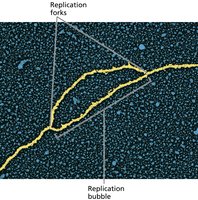
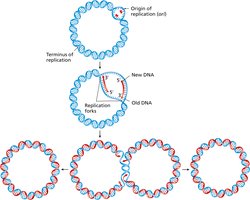
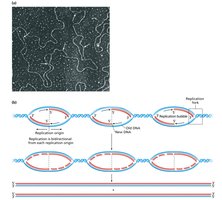
DNA Replication Process in Bacteria, Archaea, and Eukaryotes
Replication origins contain conserved sequences that attract replication enzymes. The process involves initiation, elongation, and termination, with variations among domains of life.
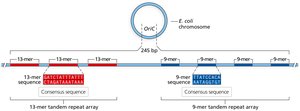
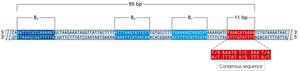
Bacterial Origins: E. coli oriC contains 13-mer and 9-mer consensus sequences.
Archaeal Origins: ORBs (origin recognition bases) are long or mini sequences.
Eukaryotic Origins: Yeast ARS (autonomously replicating sequences) are well characterized.
Molecular Biology of Replication Initiation
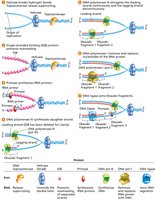
Initiating Enzymes: In E. coli, DnaA binds 9-mer sequences, bends DNA, and breaks H bonds in 13-mer region. DnaB (helicase) unwinds DNA. SSB (single-stranded binding protein) prevents reannealing.
Replication Initiation in Eukaryotes/Archaea: Complexes like ORC, Cdc6, and MCM are involved.
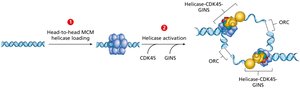
DNA Replication: Elongation and Strand Synthesis
DNA polymerase elongates DNA strands by adding nucleotides to the 3' end. RNA primers, synthesized by primase, are required to initiate synthesis.
Leading Strand: Synthesized continuously in the direction of the replication fork.
Lagging Strand: Synthesized discontinuously in short Okazaki fragments, each requiring an RNA primer.
Replisome: Large protein complex at each replication fork, containing two DNA polymerases and other proteins.
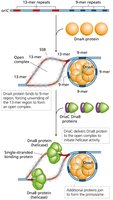
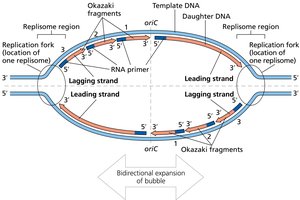
RNA Primer Removal and Okazaki Fragment Ligation
Exonuclease Activity: DNA polymerase removes RNA primers.
Polymerase Activity: Adds DNA nucleotides to fill gaps.
DNA Ligase: Seals gaps among DNA segments.
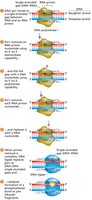
Processivity and Proofreading in DNA Replication
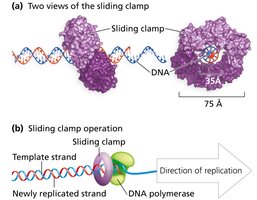
DNA polymerases require auxiliary proteins for high processivity. The sliding clamp anchors the polymerase to the template, enabling rapid and efficient synthesis. Proofreading ensures high fidelity.
Sliding Clamp: Encircles DNA, anchors polymerase, and enhances processivity.
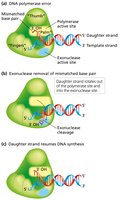
Proofreading: DNA polymerase detects mismatches, removes incorrect nucleotides via exonuclease activity, and resumes correct synthesis.
Error Rate: Approximately 1 in a billion nucleotides due to proofreading.
Supercoiling and Topoisomerases
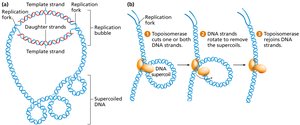
Unwinding DNA during replication creates torsional stress, leading to supercoiling. Topoisomerases relieve this stress by controlled cleavage and rejoining of DNA.
Topoisomerase Function: Cuts DNA strands, allows rotation to remove supercoils, and rejoins DNA.
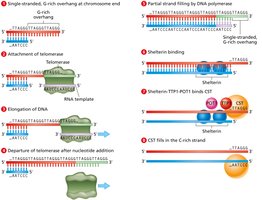
Replication at Chromosome Ends: Telomeres and Telomerase
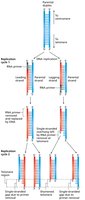
Linear chromosomes face challenges in replicating their ends, especially the lagging strand. Telomeres, repetitive sequences at chromosome ends, and telomerase, a ribonucleoprotein enzyme, solve this problem.
Telomeres: Repetitive DNA sequences that protect chromosome ends.
Telomerase: Synthesizes telomere repeats using its RNA template, preventing loss of genetic material.
Biological Importance: Telomere length affects chromosome stability, cell longevity, and is implicated in aging and cancer.
Methods of Molecular Genetic Analysis: PCR
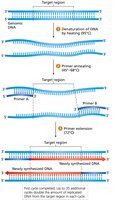
Polymerase chain reaction (PCR) is a widely used method for amplifying specific DNA segments. It relies on principles of DNA replication and uses heat-stable DNA polymerase.
Components: DNA template, four nucleotides, heat-stable polymerase (e.g., Taq), two primers, buffer.
Steps: Denaturation (heat separates strands), primer annealing (primers bind target), extension (polymerase synthesizes DNA).
Applications: DNA cloning, diagnostics, forensics, research.
Separation of PCR Products
Gel Electrophoresis: Separates amplified DNA fragments by size, measured in base pairs.
Summary Table: Key Concepts in DNA Structure and Replication
Concept | Definition | Example/Application |
|---|---|---|
Hereditary Material | DNA is the molecule responsible for inheritance | Griffith, Avery, Hershey-Chase experiments |
Double Helix | Two antiparallel strands with complementary base pairing | Watson and Crick model |
Replication | Semiconservative, bidirectional duplication of DNA | Meselson-Stahl experiment |
Telomeres | Repetitive sequences at chromosome ends | Telomerase activity in germ cells |
PCR | In vitro amplification of DNA | Forensic DNA analysis |
Key Equations
Chargaff's Rule:
DNA Replication: (template-directed synthesis)
PCR Amplification:
Additional info: Academic context was added to clarify mechanisms, historical experiments, and applications. Tables were inferred for comparison and summary purposes.
