 Back
BackDNA Structure, Replication, and Gene Expression: Foundational Concepts in Genetics
Study Guide - Smart Notes
 Tailored notes based on your materials, expanded with key definitions, examples, and context.
Introduction to Genetics
Genetics and Heredity
Genetics is the study of heredity and the variation of inherited traits in populations. Not all features are determined by a single gene, and inheritance can be complex, influenced by both genetic and environmental factors. - Gene: A segment of DNA that encodes instructions for a specific tool or building block (usually a protein). - Trait: Observable characteristic, influenced by genes and environment. - Genome: The complete set of genetic instructions in an organism, organized into chromosomes.
Chromosome Theory of Inheritance
The chromosome theory of inheritance states that genes are located on chromosomes, which are transmitted through gametes, ensuring genetic continuity. - Diploid (2n): Two sets of chromosomes (one from each parent). - Haploid (n): One set of chromosomes (as in gametes). - Autosomes: Non-sex chromosomes (22 pairs in humans). - Sex chromosomes: Determine biological sex (XX or XY in humans).
DNA Structure and Analysis
DNA as Genetic Material
DNA is the primary genetic material in all living organisms except some viruses. Its structure allows for accurate replication, information storage, expression, and variation by mutation.
Nucleotide Structure
DNA and RNA are composed of nucleotides, each consisting of: - Phosphate group (negatively charged) - Pentose sugar (deoxyribose in DNA, ribose in RNA) - Nitrogenous base (Adenine, Thymine, Guanine, Cytosine in DNA; Uracil replaces Thymine in RNA)
Base Pairing and Double Helix
The Watson–Crick model describes DNA as a right-handed double helix with antiparallel strands held together by hydrogen bonds between complementary bases: - A-T: Two hydrogen bonds - C-G: Three hydrogen bonds - Antiparallel: Strands run in opposite directions (5' to 3' and 3' to 5') 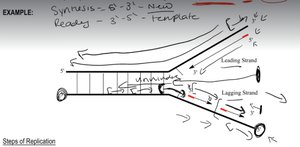
Chargaff's Rules
- The amount of Adenine equals Thymine, and Guanine equals Cytosine. - The sum of purines (A+G) equals the sum of pyrimidines (C+T).
RNA Structure
RNA is usually single-stranded, contains ribose sugar, and uses Uracil instead of Thymine. It plays roles in transcription, translation, and gene regulation.
DNA Replication
Semiconservative Replication
DNA replication is semiconservative: each new double helix contains one old strand and one new strand. 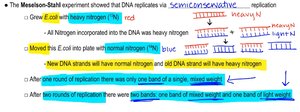
Meselson–Stahl Experiment
This experiment demonstrated semiconservative replication by tracking nitrogen isotopes in E. coli DNA. - After one round: DNA was of mixed weight (hybrid). - After two rounds: DNA separated into light and hybrid bands. 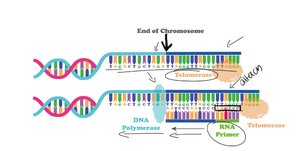
Replication Fork and Directionality
DNA replication occurs at replication forks, proceeding bidirectionally from origins of replication. - Leading strand: Synthesized continuously (5' to 3'). - Lagging strand: Synthesized discontinuously in Okazaki fragments (5' to 3'). 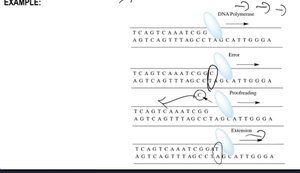
Key Enzymes in Replication
- DNA polymerase III: Main enzyme for DNA synthesis. - Primase: Synthesizes RNA primers. - DNA polymerase I: Removes RNA primers and fills gaps. - DNA ligase: Joins Okazaki fragments. - Helicase: Unwinds DNA. - Topoisomerase: Relieves supercoiling.
Proofreading and Error Correction
DNA polymerases possess exonuclease activity for proofreading, ensuring high fidelity in replication. 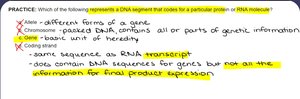
Replication in Eukaryotes
Eukaryotic DNA replication is more complex due to multiple origins, linear chromosomes, and chromatin structure.
Telomeres and Telomerase
Telomeres are repetitive sequences at chromosome ends, maintained by telomerase to prevent shortening during replication. - Telomerase: An RNA-containing enzyme that adds repeats to the 3' end of chromosomes. - G-rich sequence: TTAGGG in humans. 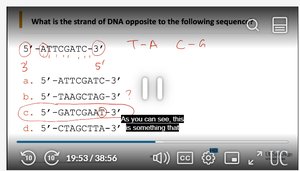
Gene Expression: Transcription and Translation
Central Dogma of Molecular Biology
The central dogma describes the flow of genetic information: DNA → RNA → Protein. - Transcription: DNA is used as a template to synthesize mRNA. - Translation: mRNA is decoded by ribosomes to assemble amino acids into proteins.
Genetic Code
The genetic code consists of nucleotide triplets (codons) in mRNA, each specifying an amino acid or a stop signal. 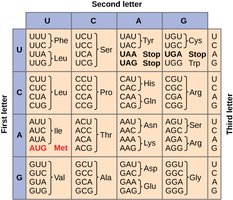
Codon | Amino Acid |
|---|---|
AUG | Met (Start) |
UAA, UAG, UGA | Stop |
UUU, UUC | Phe |
UCU, UCC, UCA, UCG | Ser |
GUU, GUC, GUA, GUG | Val |
Types of RNA
- mRNA: Carries genetic information from DNA to ribosome. - tRNA: Brings amino acids to ribosome during translation. - rRNA: Structural and functional component of ribosomes.
Genetic Variation and Mutation
Mutation
Mutation is any heritable change in the DNA sequence, serving as the source of genetic variation. - Allele: Alternative form of a gene. - Genotype: Set of alleles for a trait. - Phenotype: Observable trait.
Recombination and Gene Conversion
Homologous Recombination
Exchange of genetic material between homologous chromosomes, increasing genetic diversity.
Gene Conversion
Nonreciprocal genetic exchange between closely linked genes, altering allele distribution.
Summary Table: DNA Replication Modes
Mode | Description | Result |
|---|---|---|
Semiconservative | Each new helix has one old and one new strand | Hybrid DNA after first round |
Conservative | Original helix conserved, new helix formed | One old, one new helix |
Dispersive | Strands are mixtures of old and new DNA | Mixed DNA in all strands |
Practice and Application
Example: DNA Strand Complementarity
Given a DNA sequence, the complementary strand is determined by base pairing rules (A-T, C-G).
Example: Coding Strand and Gene Expression
The coding strand of DNA has the same sequence as the RNA transcript (except T is replaced by U in RNA). 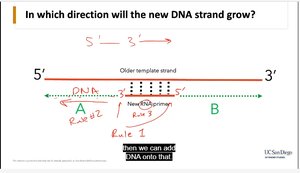
Key Equations
Number of Unique Protein Sequences
For a protein of length n, with 20 possible amino acids at each position:
Base Pairing Percentages
If cytosine (C) is 17.5% in double-stranded DNA: - Guanine (G) = 17.5% - Adenine (A) = 32.5% - Thymine (T) = 32.5%
Conclusion
Understanding DNA structure, replication, and gene expression is fundamental to genetics. These processes ensure genetic continuity, variation, and the expression of traits, forming the basis for advanced study in molecular biology, biotechnology, and genomics.
