 Back
BackDNA: The Chemical Nature of the Gene – Structure, Function, and Chromosomal Organization
Study Guide - Smart Notes
 Tailored notes based on your materials, expanded with key definitions, examples, and context.
DNA: The Chemical Nature of the Gene
Properties Required by Genetic Material
The genetic material of living organisms must fulfill several essential properties to serve its biological role:
Contain complex information: Must store vast amounts of genetic instructions.
Replicate faithfully: Must be copied accurately during cell division.
Encode traits: Must direct the synthesis of proteins and determine phenotype.
Be capable of variation: Must allow for genetic diversity and evolution.
Identification of DNA as Genetic Material
Historical Experiments Leading to DNA Identification
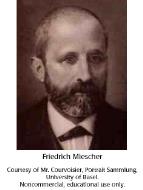
Friedrich Miescher (1871): Isolated "nuclein" (now known as DNA) from cell nuclei, noting its acidic nature and high phosphorus content.
Kossel & Levene: Identified DNA as composed of nucleotides (adenine, cytosine, guanine, thymine, and uracil). Levene distinguished RNA from DNA and proposed the (incorrect) tetranucleotide hypothesis.
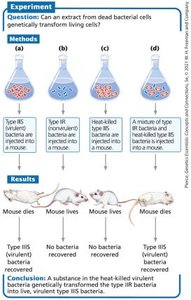
Fred Griffith (1928): Demonstrated transformation in Streptococcus pneumoniae, showing that a "transforming principle" could transfer virulence from dead to live bacteria.
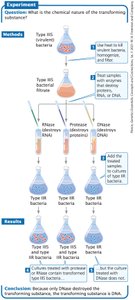
Avery, MacLeod, McCarty (1944): Identified DNA as the transforming principle by showing that only DNase destroyed the ability to transform non-virulent bacteria.
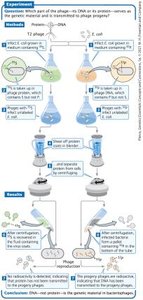
Hershey-Chase Experiment (1952): Used bacteriophages labeled with radioactive isotopes to show that DNA, not protein, is the genetic material transmitted to progeny phages.
Erwin Chargaff (~1950): Discovered that in DNA, the amount of adenine equals thymine (A = T) and guanine equals cytosine (G = C), disproving the tetranucleotide hypothesis and supporting DNA's role as genetic material.
Watson, Crick, and Franklin (1953): Used X-ray diffraction data to propose the double helix structure of DNA, explaining its ability to replicate and store information.
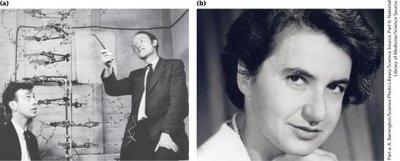
Structure of DNA
Nucleic Acids: DNA and RNA
Deoxyribonucleic acid (DNA) is the hereditary material in all cellular organisms, forming chromosomes and containing the genome. Ribonucleic acid (RNA) includes mRNA, rRNA, and tRNA, which are essential for protein synthesis. Both DNA and RNA are polymers of nucleotides joined by phosphodiester bonds.
Nucleotide Structure
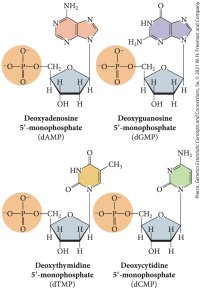
Nucleotide: Consists of a nitrogenous base, a five-carbon (pentose) sugar, and a phosphate group.
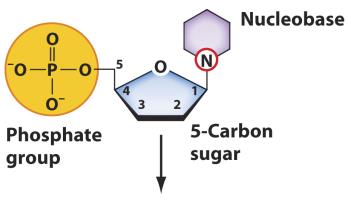
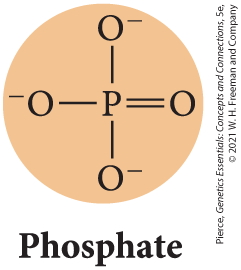
Phosphate group: Negatively charged, contributes to the acidic nature of DNA.
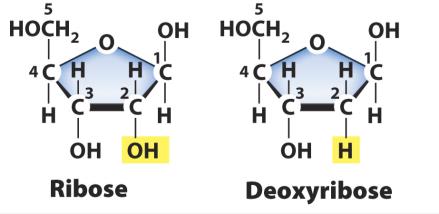
Pentose sugar: Ribose in RNA, deoxyribose in DNA (lacks an oxygen atom at the 2' position).
Nitrogenous bases: Purines (adenine, guanine) have two rings; pyrimidines (cytosine, thymine, uracil) have one ring.
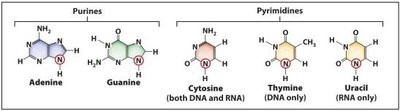
Four nucleotides in DNA: dAMP, dGMP, dTMP, dCMP (deoxyadenosine, deoxyguanosine, deoxythymidine, deoxycytidine monophosphates).
Formation of the DNA Strand
Nucleotides are joined by phosphodiester bonds between the 5' phosphate and 3' hydroxyl groups of adjacent sugars.
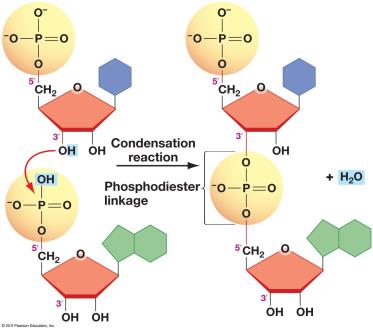
The orientation of a nucleic acid strand is indicated by the free 5' phosphate and 3' hydroxyl ends.
Double Helix Structure
DNA is an antiparallel double helix, with two strands held together by hydrogen bonds between complementary bases (A-T, G-C).
A-T pairs have two hydrogen bonds; G-C pairs have three hydrogen bonds.

The double helix has a major groove and a minor groove, important for protein binding and regulation.
Forms of DNA
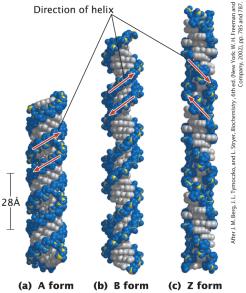
B-DNA: Right-handed helix, 10 base pairs per turn, 2 nm diameter, most common in cells.
A-DNA: Right-handed, shorter and wider than B-DNA.
Z-DNA: Left-handed, may play a role in gene expression.
Structure of Chromosomes
Genome Size and DNA Packaging
Cells must compact large amounts of DNA to fit within the cell or nucleus. For example, the human genome contains over 3 billion base pairs, stretching over 6 feet in length if fully extended.
Prokaryotes (e.g., E. coli): Have a single circular chromosome, organized in twisted loops and usually negatively supercoiled.
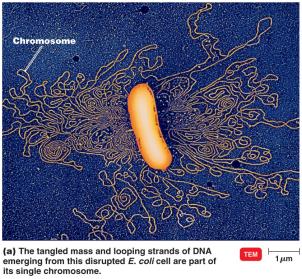
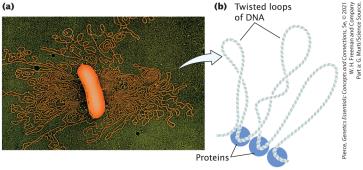
Eukaryotes: Have multiple linear chromosomes, found in the nucleus, and packaged with proteins into chromatin.
Chromatin Structure
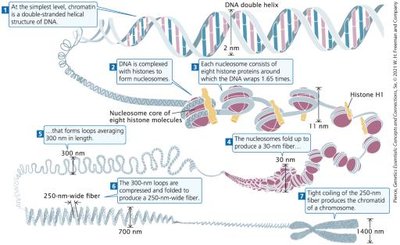
Chromatin: DNA-protein complex; DNA is wrapped around histone proteins to form nucleosomes ("beads on a string").
Nucleosome: Core of 8 histone proteins with DNA wrapped 1.65 times (~147 bp); histone H1 clamps DNA onto the core.
Higher-order structures include 30-nm fibers, 300-nm loops, and 250-nm-wide fibers, leading to the highly condensed chromosome structure during cell division.
Chromosome Features: Centromeres and Telomeres
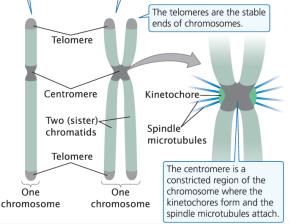
Centromeres: Constricted regions where kinetochores form and spindle fibers attach during mitosis; composed of heterochromatin.
Telomeres: Repetitive DNA sequences at chromosome ends, providing stability and aiding in replication of linear DNA.
Sequence Variation in Eukaryotic DNA
Unique sequence DNA: Includes protein-coding genes.
Moderately repetitive DNA: Includes rRNA and tRNA genes, tandem and interspersed repeats (e.g., Alu elements).
Highly repetitive DNA: Short sequences repeated millions of times, often at centromeres or telomeres.
In the human genome, ~76% is transcribed into RNA, but only ~1.2% encodes proteins.
