 Back
BackDominance and Its Variations in Genetics
Study Guide - Smart Notes
 Tailored notes based on your materials, expanded with key definitions, examples, and context.
Dominance in Genetics
Introduction to Dominance
Dominance describes the relationship between alleles of a gene and their associated phenotypes. The type of dominance determines how traits are expressed in heterozygotes and influences phenotypic ratios in offspring. Understanding dominance is essential for predicting inheritance patterns and interpreting genetic crosses.
Types of Dominance
Complete Dominance
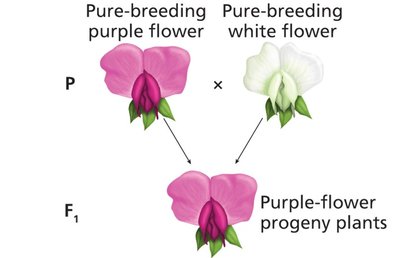
In complete dominance, the phenotype of the heterozygote is identical to that of one of the homozygotes. This is the classic Mendelian inheritance pattern.
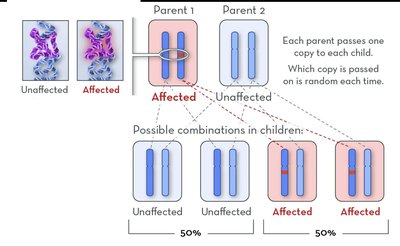
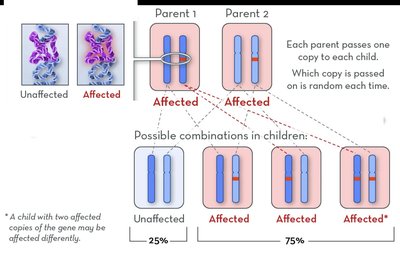
Dominant allele: Expressed in the phenotype when present in one or two copies.
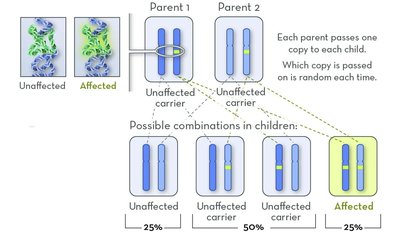
Recessive allele: Expressed only when two copies are present.
Genotypic ratio (Aa x Aa): 1 AA : 2 Aa : 1 aa
Phenotypic ratio: 3 dominant : 1 recessive
Incomplete Dominance
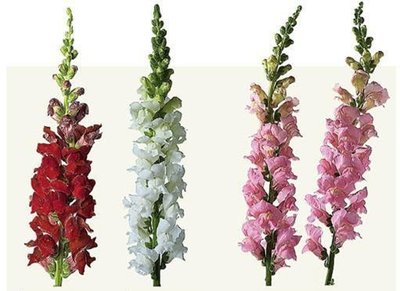
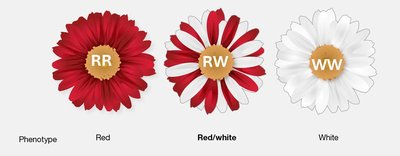
Incomplete dominance occurs when the heterozygote displays a phenotype intermediate between those of the two homozygotes. Neither allele is completely dominant over the other.
Example: Snapdragon flower color
Genotypes: A1A1 (red), A2A2 (white), A1A2 (pink)
F2 phenotypic ratio (A1A2 x A1A2): 1 red : 2 pink : 1 white
Genotypic ratio: 1:2:1
Codominance
In codominance, both alleles in a heterozygote are fully and simultaneously expressed, resulting in a phenotype that shows both parental traits distinctly.
Example: M/N blood groups in humans
Genotypes: MM (M antigen), NN (N antigen), MN (both M and N antigens)
F2 phenotypic ratio (MN x MN): 1 M : 2 MN : 1 N
Summary Table: Types of Dominance
Type | Heterozygote Phenotype | Example |
|---|---|---|
Complete Dominance | Same as one parent | Mendelian traits (e.g., pea color) |
Incomplete Dominance | Intermediate between parents | Snapdragon flower color |
Codominance | Both parental phenotypes present | M/N blood groups |
Expression: Penetrance and Expressivity
Penetrance
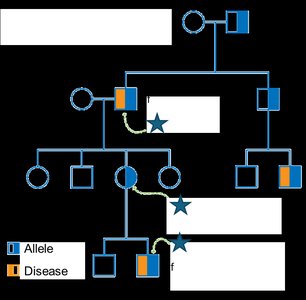
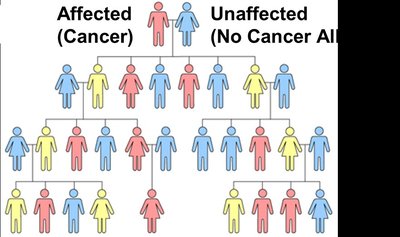
Penetrance refers to the proportion of individuals with a particular genotype who actually express the expected phenotype. It can be complete or incomplete.
Complete penetrance: All individuals with the genotype express the phenotype.
Incomplete penetrance: Some individuals with the genotype do not express the phenotype.
Quantifying penetrance:
Variable Expressivity
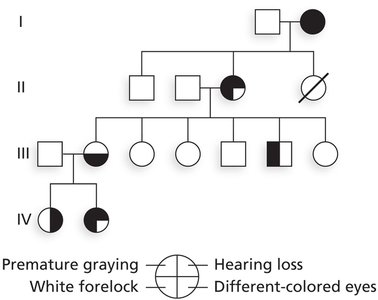
Variable expressivity describes the degree to which a genotype is expressed in an individual. All individuals with the genotype show the phenotype, but to varying extents.
Example: Polydactyly (extra fingers or toes)
All individuals with the allele have extra digits, but the number and form can vary.
Environmental Effects on Phenotype
Some phenotypes are influenced by environmental factors rather than genetics alone. Environmental effects can modify the expression of genetic traits.
Example: Feather color in flamingos is determined by diet (carotenoid pigments from brine shrimp).
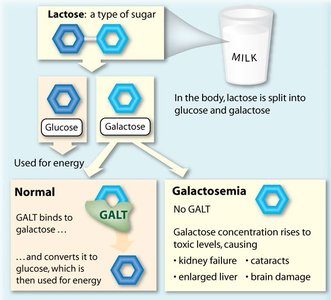
Example: Galactosemia requires a galactose-free diet to prevent symptoms.

Statistical Analysis: Chi-Square Test
Chi-Square Test for Goodness of Fit
The chi-square test is used to determine whether observed genetic ratios fit expected Mendelian ratios or suggest alternative inheritance patterns.
Formula:
O = observed count, E = expected count
Degrees of freedom (df): Number of phenotypic classes minus 1
Interpretation: If p < 0.05, reject the null hypothesis (e.g., simple Mendelian inheritance)
Alleles and Dominance at the Molecular Level
Genes and Alleles
Genes are regions of DNA that encode functional products, usually proteins. Alleles are different versions of a gene that may produce variations in the protein product and phenotype.
Alleles can be dominant, recessive, codominant, or show incomplete dominance.
Allelic variation can result from changes in protein function or expression level.
Types of Alleles
Null allele: Produces no functional product.
Hypomorphic allele: Produces reduced function (leaky mutation).
Dominant negative allele: Abnormal product interferes with normal protein function.
Hypermorphic allele: Overexpression of product.
Neomorphic allele: New function not seen in wild type.
Biochemical Basis of Dominance
Dominance relationships often reflect the molecular function of gene products. For example, in snapdragons, the ANS gene encodes an enzyme for pigment production:
An1 allele: Active enzyme, red pigment
An2 allele: Null allele, no pigment (white)
An1An2 heterozygote: Intermediate pigment (pink) due to haploinsufficiency
Practice Problems and Applications
Example: Incomplete Dominance in Snapdragons
Crossing two heterozygotes (An1An2 x An1An2): 1 red : 2 pink : 1 white
Test cross (An1An2 x An2An2): 1 pink : 1 white
Example: Variable Expressivity in Brachydactyly
Some individuals have both thumbs affected, others only one—evidence of variable expressivity.
All individuals with the dominant allele are affected—no evidence of incomplete penetrance.
Summary
Dominance describes how alleles interact to produce phenotypes.
Incomplete dominance and codominance are non-Mendelian inheritance patterns.
Penetrance and expressivity explain variation in phenotype among individuals with the same genotype.
Environmental factors and gene interactions can further modify expression.
Statistical tests like chi-square help distinguish between Mendelian and non-Mendelian inheritance.
