 Back
BackEpigenetic Regulation in Gene Expression: Mechanisms and Examples
Study Guide - Smart Notes
 Tailored notes based on your materials, expanded with key definitions, examples, and context.
Epigenetic Regulation in Gene Expression
Introduction to Epigenetics
Epigenetics is the study of heritable changes in gene expression that do not involve alterations to the underlying DNA sequence. These changes can be influenced by environmental factors, developmental cues, and cellular context, and are often reversible. Epigenetic mechanisms play a crucial role in development, cellular differentiation, disease, and inheritance.
Genetics refers to the study of genes and heredity, focusing on changes in the DNA sequence (mutations).
Epigenetics involves modifications that affect gene activity without changing the DNA sequence, such as DNA methylation and histone modification.
Epigenetic changes can be mitotically heritable (passed to daughter cells) and, in some cases, meiotically heritable (transgenerational inheritance).
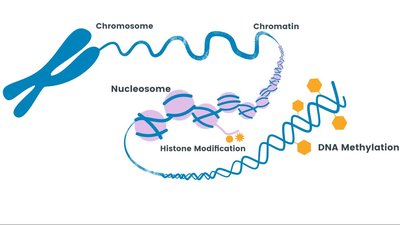
Key Epigenetic Mechanisms
Several molecular mechanisms underlie epigenetic regulation, each contributing to the control of gene expression in different ways.
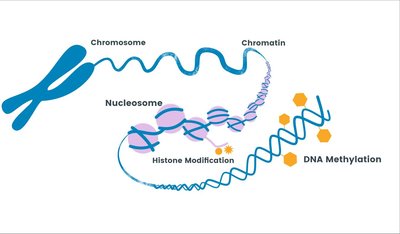
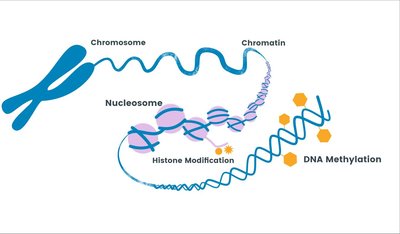
DNA Methylation: Addition of methyl groups (CH3) to cytosine bases, typically at CpG dinucleotides, leading to gene silencing.
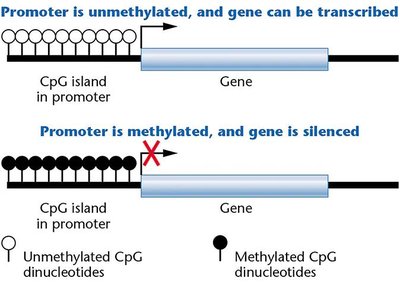
Histone Modification: Covalent modifications (e.g., acetylation, methylation) of histone proteins, affecting chromatin structure and gene accessibility.
Chromatin Remodeling: ATP-dependent complexes reposition or eject nucleosomes, altering DNA accessibility for transcription.
Non-coding RNAs (ncRNAs): RNA molecules that regulate gene expression at the transcriptional and post-transcriptional levels.
DNA Methylation
DNA methylation is a key epigenetic modification that typically represses gene expression. It is catalyzed by DNA methyltransferases (DNMTs) and can be reversed by TET enzymes.
Writers: DNMT1 (maintenance), DNMT3A/3B (de novo methylation)
Erasers: TET enzymes (active demethylation)
Readers: Methyl-CpG-binding domain proteins (MBDs)
Promoter methylation usually silences gene expression.

Histone Modifications
Histone proteins can be modified by the addition of chemical groups, influencing chromatin structure and gene activity. The 'histone code' hypothesis suggests that combinations of modifications can specify unique chromatin states.
Acetylation: Generally associated with gene activation.
Methylation: Can activate or repress genes, depending on the specific amino acid residue modified.
Writers: Histone acetyltransferases (HATs), histone methyltransferases (HMTs)
Erasers: Histone deacetylases (HDACs), histone demethylases (HDMs)
Readers: Bromodomain and chromodomain proteins
Chromatin Remodeling
Chromatin remodelers are large, ATP-dependent complexes that reposition or eject nucleosomes, making DNA more or less accessible for transcription, replication, and repair.
Examples: SWI/SNF, ISWI, CHD, INO80 complexes
Essential for gene regulation and genome stability
Non-coding RNAs (ncRNAs)
Non-coding RNAs play diverse roles in epigenetic regulation, including chromatin remodeling, histone modification, and gene silencing.
Short ncRNAs: microRNAs (miRNA), short interfering RNAs (siRNA), piwi-interacting RNAs (piRNA)
Long ncRNAs (lncRNA): Over 200 nucleotides, regulate gene expression at multiple levels
Epigenetic Phenomena and Examples
Epigenetics in Development and Differentiation
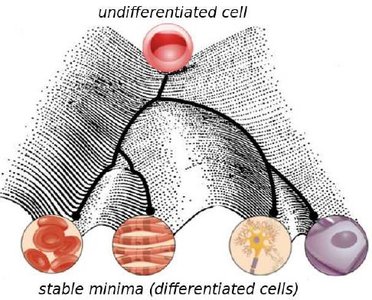
Epigenetic mechanisms enable a single genome to give rise to multiple cell types by regulating gene expression patterns during development and differentiation.
Totipotent stem cells differentiate into specialized cell types through epigenetic changes.
Epigenetic 'landscape' models illustrate how cells commit to specific fates.

Epigenetic Phenomena in Honey Bees
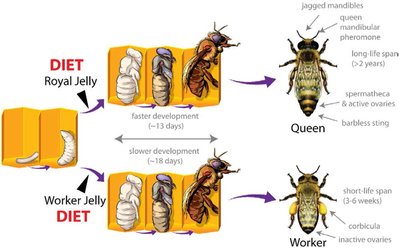
Diet-induced epigenetic changes can result in distinct phenotypes from the same genetic background, as seen in honey bee castes.
Queens and workers have identical DNA but develop differently due to diet (royal jelly vs. worker jelly).
Epigenetic modifications drive differences in development, lifespan, and reproductive capacity.
Epigenetics in Identical Twins
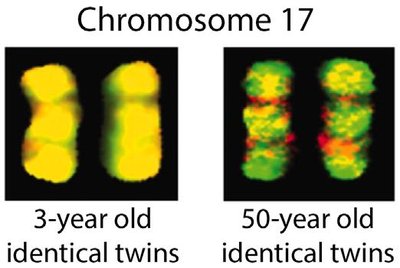
Monozygotic (identical) twins start with the same DNA but can develop different phenotypes due to epigenetic divergence over time.
Environmental factors and lifestyle can lead to differences in gene expression and disease susceptibility.
Epigenetic markers diverge with age, contributing to phenotypic differences.
Epigenetics and Aging
Epigenetic modifications accumulate with age, leading to increased gene expression noise and phenotypic variation among cells. Environmental factors can accelerate or decelerate epigenetic aging.
Epigenetic clocks use DNA methylation patterns to predict biological age.
Diet, lifestyle, and stress influence the rate of epigenetic aging.

Epigenetics in Cancer
Epigenetic dysregulation is a hallmark of cancer. Cancer cells often exhibit global hypomethylation and locus-specific hypermethylation, particularly at tumor suppressor gene promoters.
BRCA1 gene silencing by promoter hypermethylation is associated with breast and ovarian cancer.
Epimutations can be inherited or acquired due to environmental exposures or aging.
X Chromosome Inactivation
In female mammals, one X chromosome is randomly inactivated in each somatic cell to achieve dosage compensation. This process is regulated by the Xist long non-coding RNA and involves DNA methylation and histone modifications.
Inactive X chromosome forms a Barr body (heterochromatin).
Key modifications: DNA methylation, H3K27me3, H3K9me3
Genomic Imprinting
Genomic imprinting is an epigenetic phenomenon where certain genes are expressed in a parent-of-origin-specific manner. Imprinted genes are marked by DNA methylation and histone modifications during gamete formation.
Imprinted genes are monoallelically expressed (only one parental allele is active).
Imprinting is essential for normal development and is involved in several diseases.
Examples of Genomic Imprinting
Callipyge mutation in sheep: Only expressed if inherited from the father.
IGF2/IGF2R genes: IGF2 is paternally expressed (promotes growth), IGF2R is maternally expressed (inhibits growth).
Imprinting diseases: Beckwith-Wiedemann syndrome, Angelman syndrome, Prader-Willi syndrome.
Transgenerational Epigenetic Inheritance
Epigenetic changes can sometimes be transmitted across generations if they occur in germ cells. Maternal diet or environmental exposures can affect offspring phenotype without altering DNA sequence.
Agouti viable yellow locus in mice: methylation status affects coat color and health, and can be inherited.
Some epigenetic marks escape erasure during germline reprogramming.
Summary Table: Key Epigenetic Mechanisms
Mechanism | Tag/Modification | Enzymes | Effect |
|---|---|---|---|
DNA Methylation | Methyl group (CH3) at CpG | DNMTs (writers), TETs (erasers) | Gene silencing |
Histone Modification | Acetyl, methyl, phosphate, etc. | HATs/HMTs (writers), HDACs/HDMs (erasers) | Activation or repression (context-dependent) |
Chromatin Remodeling | Nucleosome repositioning | SWI/SNF, ISWI, CHD, INO80 | DNA accessibility |
Non-coding RNAs | miRNA, siRNA, lncRNA | Various | Gene silencing, chromatin modification |
Key Equations and Concepts
DNA Methylation Reaction:
$\mathrm{Cytosine} + \mathrm{S\text{-}adenosylmethionine} \xrightarrow{DNMT} 5\text{-}methylcytosine + \mathrm{S\text{-}adenosylhomocysteine}$
Epigenetic Inheritance: Epigenetic marks are maintained through cell division by maintenance enzymes (e.g., DNMT1 for DNA methylation).
Conclusion
Epigenetic regulation is fundamental to gene expression, development, and disease. Understanding the mechanisms and consequences of epigenetic modifications provides insight into complex biological processes and offers potential for therapeutic intervention in diseases such as cancer and imprinting disorders.
