 Back
BackEpigenetic Regulation in Gene Expression: Mechanisms and Examples
Study Guide - Smart Notes
 Tailored notes based on your materials, expanded with key definitions, examples, and context.
Epigenetics: An Overview
Definition and Distinction from Genetics
Epigenetics is the study of heritable changes in gene expression that do not involve alterations to the underlying DNA sequence. Unlike genetics, which focuses on the sequence of nucleotides in DNA, epigenetics examines how gene activity is regulated by chemical modifications and structural changes to chromatin.
Genetics: Concerns the DNA sequence itself (mutations, inheritance).
Epigenetics: Involves modifications such as DNA methylation, histone modification, chromatin remodeling, and non-coding RNAs that regulate gene expression without changing the DNA sequence.
Key Point: Epigenetic changes can be reversible and are influenced by environmental factors, development, and disease states.
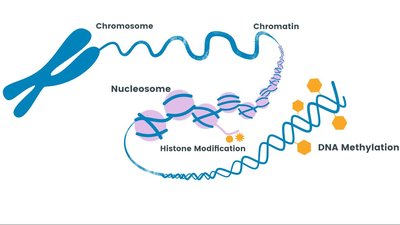
Major Molecular Mechanisms of Epigenetic Regulation
DNA Methylation
DNA methylation involves the addition of a methyl group (CH3) to the 5' position of cytosine residues, typically at CpG dinucleotides. This modification is associated with gene silencing and is crucial for development, X-chromosome inactivation, and genomic imprinting.
Writers: DNA methyltransferases (DNMTs) add methyl groups.
Erasers: TET enzymes remove methyl groups via oxidation.
Readers: Methyl-CpG-binding domain proteins recognize methylated DNA and mediate downstream effects.
Function: Methylation of gene promoters typically represses transcription.
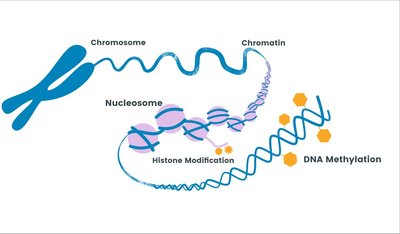

Histone Modifications
Histone proteins, around which DNA is wrapped, can be chemically modified at their N-terminal tails. Common modifications include acetylation, methylation, phosphorylation, and ubiquitination. These modifications influence chromatin structure and gene accessibility.
Acetylation: Generally associated with gene activation (by neutralizing positive charges on histones, loosening DNA-histone interaction).
Methylation: Can activate or repress gene expression depending on the specific amino acid residue modified.
Writers: Histone acetyltransferases (HATs), histone methyltransferases (HMTs).
Erasers: Histone deacetylases (HDACs), histone demethylases (HDMs).
Readers: Bromodomain and chromodomain proteins recognize specific modifications.
Chromatin Remodeling
Chromatin remodeling complexes use ATP to reposition, eject, or restructure nucleosomes, thereby regulating DNA accessibility for transcription, replication, and repair.
Examples: SWI/SNF, ISWI, CHD, INO80 complexes.
Function: Facilitate transitions between euchromatin (open, active) and heterochromatin (closed, inactive).
Non-coding RNAs (ncRNAs)
Non-coding RNAs are RNA molecules that are not translated into proteins but play critical roles in regulating gene expression at the transcriptional and post-transcriptional levels.
Types: microRNAs (miRNA), short interfering RNAs (siRNA), Piwi-interacting RNAs (piRNA), long non-coding RNAs (lncRNA).
Functions: Chromatin remodeling, histone modification, DNA methylation, gene silencing.
Epigenetic Phenomena and Examples
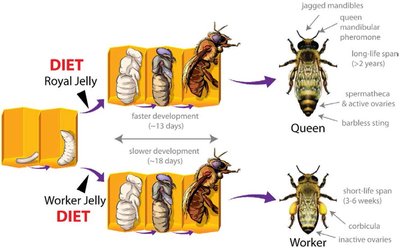
Epigenetics in Development: Honey Bee Caste Differentiation
Epigenetic mechanisms underlie the differentiation of queen and worker bees, despite their identical genomes. Diet (royal jelly vs. worker jelly) during larval development triggers distinct epigenetic modifications, leading to different phenotypes.
Queen bees: Fed royal jelly throughout development, develop reproductive organs and live longer.
Worker bees: Fed worker jelly after two days, develop into sterile workers with shorter lifespans.
Epigenetics in Identical Twins
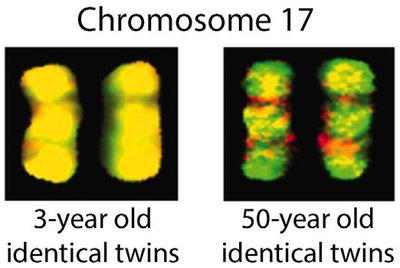
Monozygotic twins share the same DNA sequence but can exhibit differences in gene expression and phenotype due to epigenetic divergence over time, influenced by environmental factors and lifestyle.
At birth: Twins have nearly identical epigenomes.
With age: Epigenetic differences accumulate, leading to phenotypic divergence (e.g., disease susceptibility, appearance).
Epigenetics and Aging
Epigenetic modifications accumulate with age, contributing to increased gene expression variability and phenotypic diversity among cells. Environmental factors such as diet, stress, and lifestyle can accelerate or decelerate epigenetic aging.
Epigenetic clocks: DNA methylation patterns at specific loci can be used to estimate biological age.
Implications: Age-related epigenetic changes are linked to organ dysfunction and age-associated diseases.

Epigenetics in Cancer
Cancer cells often display global DNA hypomethylation and site-specific hypermethylation, particularly at tumor suppressor gene promoters, leading to gene silencing and uncontrolled cell growth.
Example: Hypermethylation of the BRCA1 gene promoter is associated with breast and ovarian cancer.
Epimutations: Can be inherited or acquired due to environmental exposures or aging.
X Chromosome Inactivation
In female mammals, one of the two X chromosomes is randomly inactivated in each somatic cell to achieve dosage compensation. This process is regulated by epigenetic mechanisms, including DNA methylation, histone modifications, and non-coding RNAs (e.g., Xist).
Barr body: The inactivated X chromosome forms a dense, heterochromatic structure.
Key players: Xist lncRNA coats the inactive X, Tsix prevents inactivation on the active X.
Genomic Imprinting
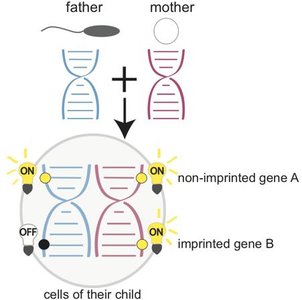
Genomic imprinting is an epigenetic phenomenon where certain genes are expressed in a parent-of-origin-specific manner. Imprinted genes are marked by DNA methylation and histone modifications during gametogenesis, leading to monoallelic expression in offspring.
Maternally imprinted: Paternally expressed (maternal allele silenced).
Paternally imprinted: Maternally expressed (paternal allele silenced).
Imprinting disorders: Beckwith-Wiedemann syndrome, Prader-Willi syndrome, Angelman syndrome.
Epigenetics in Assisted Reproduction Technologies (ART)
Sub-optimal culture conditions during in vitro fertilization (IVF) can disrupt normal epigenetic programming, leading to imprinting disorders such as Beckwith-Wiedemann syndrome and Large Offspring Syndrome (LOS).
Monoallelic expression: Maintained during early embryo development; sensitive to environmental conditions.
Transgenerational Epigenetic Inheritance
Epigenetic modifications can sometimes escape reprogramming during gametogenesis and be transmitted to subsequent generations. Environmental exposures (e.g., maternal diet) can affect the phenotype of offspring without altering DNA sequence.
Example: Agouti viable yellow locus in mice—methylation status of a retrotransposon upstream of the agouti gene affects coat color and health across generations.
Summary Table: Key Epigenetic Mechanisms
Mechanism | Modification | Enzymes | Effect on Gene Expression |
|---|---|---|---|
DNA Methylation | Methyl group on cytosine (CpG) | DNMTs (writers), TETs (erasers) | Repression (silencing) |
Histone Acetylation | Acetyl group on lysine | HATs (writers), HDACs (erasers) | Activation |
Histone Methylation | Methyl group on lysine/arginine | HMTs (writers), HDMs (erasers) | Activation or repression (context-dependent) |
Chromatin Remodeling | Nucleosome repositioning | SWI/SNF, ISWI, CHD, INO80 | Activation or repression |
Non-coding RNAs | miRNA, siRNA, lncRNA | RNA polymerases, Dicer, Argonaute | Gene silencing, chromatin modification |
Key Equations and Concepts
DNA Methylation Reaction:
$\mathrm{Cytosine} + \mathrm{S{-}adenosylmethionine} \xrightarrow{DNMT} 5\text{-}methylcytosine + \mathrm{S{-}adenosylhomocysteine}$
Epigenetic Inheritance: Epigenetic marks can be mitotically heritable (passed to daughter cells) and, in some cases, meiotically heritable (across generations).
Conclusion
Epigenetic regulation is essential for normal development, cellular differentiation, and adaptation to environmental changes. Disruptions in epigenetic mechanisms can lead to diseases such as cancer, imprinting disorders, and contribute to aging. Understanding epigenetics provides insight into the dynamic regulation of the genome and the interplay between genes and the environment.
