 Back
BackCh 10 P2 Eukaryotic DNA Replication and Telomere Maintenance
Study Guide - Smart Notes
 Tailored notes based on your materials, expanded with key definitions, examples, and context.
Ch 10 P2 DNA Replication in Eukaryotes and Prokaryotes
Shared Features of DNA Replication
DNA replication is a fundamental process in both eukaryotic and prokaryotic cells, ensuring the accurate duplication of genetic material prior to cell division. Despite differences in complexity, several core mechanisms are conserved:
Double-stranded DNA unwinding occurs at the origin of replication (ORI).
Replication forks are formed, allowing bidirectional synthesis.
Leading and lagging strands are synthesized simultaneously.
DNA polymerases require four deoxyribonucleoside triphosphates, a template, and a primer to initiate synthesis.
Complexity of Eukaryotic DNA Replication
Eukaryotic DNA replication is more complex than in prokaryotes due to:
Larger genome size and more DNA to replicate.
Linear chromosomes (as opposed to circular in prokaryotes).
DNA packaging with nucleosomes and chromatin structure.
Initiation of Replication at Multiple Origins
Multiple Replication Origins in Eukaryotes
Eukaryotic chromosomes contain multiple origins of replication (ORIs), which allow for the rapid and efficient duplication of large genomes. Under the electron microscope, these appear as multiple 'replication bubbles' along the DNA molecule.
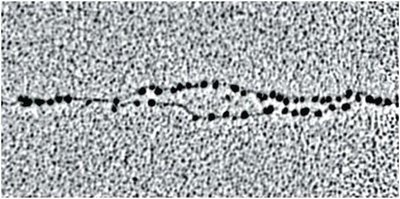
Each bubble represents a region where DNA is actively being replicated.
This strategy enables the cell to complete DNA replication in a timely manner.
DNA Replication in Yeast
Yeast serves as a model organism for studying eukaryotic DNA replication:
Yeast genomes contain 250–400 replication origins.
Origins are called Autonomously Replicating Sequences (ARSs).
Each ARS contains a consensus sequence of about 120 base pairs, which is highly conserved among yeast species.
Eukaryotic DNA Polymerases
Types and Functions
The human genome encodes at least 14 different DNA polymerases, but only three are primarily responsible for nuclear DNA replication:
Pol α (alpha): Involved in the initiation of DNA synthesis and RNA primer synthesis on both leading and lagging strands. It has low processivity.
Pol δ (delta): Takes over from Pol α for elongation, synthesizing the lagging strand.
Pol ε (epsilon): Responsible for synthesizing the leading strand.
Polymerase switching refers to the process where Pol α is replaced by Pol δ or Pol ε after primer synthesis to continue elongation.
Replication Through Chromatin
Challenges of Chromatin Structure
Unlike prokaryotic DNA, eukaryotic DNA is packaged into chromatin, with DNA wrapped around histone proteins to form nucleosomes:
Each nucleosome consists of ~200 base pairs of DNA wrapped around a histone octamer.
Nucleosomes must be temporarily displaced for the replication machinery to access the DNA template.
After replication, chromatin assembly factors (CAFs) help reassemble nucleosomes on the newly synthesized DNA strands.
Telomeres and the End-Replication Problem
Challenges at Chromosome Ends
Linear chromosomes present a unique challenge during DNA replication. The ends, known as telomeres, can be mistaken for double-stranded breaks and are susceptible to degradation by nucleases. Additionally, the conventional replication machinery cannot fully replicate the 3' ends of linear DNA, leading to progressive shortening with each cell division.
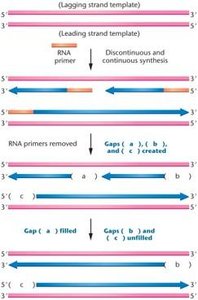
After removal of RNA primers, gaps remain at the ends of the lagging strand, which cannot be filled by DNA polymerase.
Structure and Function of Telomeres
Telomeres are long stretches of short, repeating DNA sequences that protect chromosome ends. In humans, the telomeric repeat sequence is:
5'-TTAGGG-3' (repeated thousands of times)
Telomeres are stabilized by specialized structures and protein complexes:
T-loops: Loop structures formed by telomeric DNA to protect the ends.
Shelterin complex: A group of proteins that bind telomeres and prevent them from being recognized as DNA breaks.
Telomerase: Enzyme for Telomere Maintenance
Mechanism of Telomerase Action
Telomerase is a ribonucleoprotein enzyme that extends the G-rich strand of telomeres, compensating for the end-replication problem. It contains two essential components:
TERC (Telomerase RNA Component): Serves as a template for adding telomeric repeats.
TERT (Telomerase Reverse Transcriptase): The catalytic protein subunit that synthesizes DNA from the RNA template.
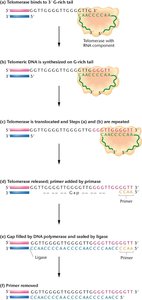
Telomerase binds to the 3' overhang and adds multiple repeats using its RNA template.
After extension, conventional DNA polymerases fill in the complementary strand, and the remaining gap is sealed by DNA ligase.
Telomeres in Disease, Aging, and Cancer
Biological and Medical Implications
Telomere length and telomerase activity are critical for cellular health and longevity:
Loss of telomerase activity leads to progressive telomere shortening, chromosomal instability, and cellular senescence (cessation of cell division).
Short telomeres are associated with aging and several human diseases.
In contrast, most human cancer cells reactivate telomerase, enabling unlimited cell division and contributing to their 'immortality.'

Example Question: In Tetrahymena, if the telomerase RNA component (TERC) contains the sequence 3′CCCCAA5′, what sequence would be generated on the telomere?
The correct answer is D: 5′GGGGTT3′ (complementary to the RNA template, synthesized in the 5' to 3' direction).
