 Back
BackEukaryotic DNA Replication: Mechanisms, Enzymes, and Telomere Maintenance
Study Guide - Smart Notes
 Tailored notes based on your materials, expanded with key definitions, examples, and context.
Eukaryotic DNA Replication
Overview of Eukaryotic DNA Replication
Eukaryotic DNA replication is a fundamental process required for cell division and inheritance. While sharing many similarities with bacterial DNA replication, eukaryotic replication is more complex due to the structure and regulation of eukaryotic chromosomes.
Large linear chromosomes: Eukaryotes possess chromosomes that are much larger and linear, unlike the circular chromosomes of bacteria.
Chromatin structure: DNA is tightly packed within nucleosomes, affecting accessibility and regulation.
Complex cell cycle regulation: Replication is tightly controlled and coordinated with the cell cycle.
Multiple Origins of Replication
To efficiently replicate their large genomes, eukaryotic chromosomes utilize multiple origins of replication. This ensures timely duplication of DNA during the S phase of the cell cycle.
Bidirectional replication: DNA replication initiates at several origins and proceeds in both directions, forming replication bubbles.
Experimental evidence: Radiolabeled nucleosides incorporated into DNA revealed multiple replication initiation sites.
Replication bubbles: These bubbles eventually merge, resulting in fully replicated chromosomes.
Eukaryotic Origins of Replication
Origins of replication in eukaryotes are defined by both DNA sequence and chromatin structure. In simple eukaryotes, such as Saccharomyces cerevisiae, origins are well-characterized.
ARS elements: Autonomously Replicating Sequences (ARS) are about 50 base pairs long and rich in A and T nucleotides.
ARS consensus sequence: ATTTAT(A or G)TTTA
Complex eukaryotes: Origins are less defined and often determined by chromatin structure rather than DNA sequence alone.
Assembly of the Prereplication Complex (preRC)
Replication begins with the formation of the prereplication complex, which licenses origins for DNA synthesis.
Origin Recognition Complex (ORC): A six-subunit protein complex that marks the origin and initiates assembly.
MCM helicase: Binding of MCM helicase completes licensing, allowing DNA synthesis to begin.
Eukaryotic DNA Polymerases
Eukaryotes possess numerous DNA polymerases, each with specialized functions in replication and repair.
DNA pol ⍺: Associates with primase to synthesize a short RNA-DNA hybrid primer (10 RNA + 20–30 DNA nucleotides).
Polymerase switch: DNA pol ⍺ is replaced by DNA pol ε (leading strand) or DNA pol δ (lagging strand) for elongation.
DNA pol γ: Replicates mitochondrial DNA.
Functions of DNA Polymerases in DNA Repair
Many DNA polymerases are involved in DNA repair, including translesion-replicating polymerases that can synthesize DNA across damaged regions.
Translesion synthesis: Allows replication to continue past DNA lesions.
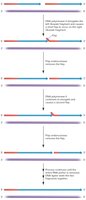
Removal of RNA Primers: Flap Endonuclease Mechanism
Unlike prokaryotes, eukaryotes use flap endonuclease to remove RNA primers from Okazaki fragments during lagging strand synthesis.
Polymerase δ: Displaces the RNA primer, creating a flap structure.
Flap endonuclease: Cleaves the short flap, removing the primer.
Dna2 nuclease/helicase: Processes long flaps into short flaps for removal.
Telomeres and DNA Replication
Telomeres are specialized structures at the ends of linear chromosomes, consisting of repetitive DNA sequences and associated proteins. They protect chromosome ends and solve the replication problem inherent to linear DNA.
Telomeric DNA: Moderately repetitive tandem arrays with a 3’ overhang (12–16 nucleotides).
Sequence composition: Rich in guanine and thymine nucleotides.
Replication Problem at Chromosome Ends
DNA polymerases can only synthesize DNA in the 5’ to 3’ direction and require a primer. This creates a problem at the 3’ ends of linear chromosomes, where the end cannot be fully replicated, leading to progressive shortening.
Solution: Telomerase, a ribonucleoprotein enzyme, extends telomeres by adding DNA repeats to the 3’ overhang.
Telomerase mechanism: The RNA component of telomerase is complementary to the telomeric repeat, allowing binding and extension.
Steps: Binding, polymerization, and translocation are repeated to lengthen the telomere.
Telomere Length and Cellular Aging
Telomeres shorten with each cell division, eventually leading to cellular senescence when they become critically short. Telomerase activity can prevent this shortening.
Telomere length: Approximately 8,000 bp at birth, decreasing to about 1,500 bp in elderly individuals.
Senescence: Cells lose the ability to divide when telomeres are short.
Telomerase insertion: Can block senescence and maintain telomere length.
Telomere Length and Cancer
Cancer cells often acquire mutations that increase telomerase activity, preventing telomere shortening and enabling unlimited cell division. Targeting telomerase is a potential strategy for anti-cancer therapies.
Telomerase in cancer: Maintains telomere length, allowing continued proliferation.
Therapeutic target: Inhibiting telomerase may limit cancer cell division.
