 Back
BackEukaryotic Gene Regulation and Epigenetic Mechanisms
Study Guide - Smart Notes
 Tailored notes based on your materials, expanded with key definitions, examples, and context.
Eukaryotic Gene Regulation
Benefits of Gene Regulation
Gene regulation in eukaryotes is essential for responding to environmental changes, expressing only necessary proteins, and defining tissues and cells with specific functions within multicellular organisms.
Environmental Response: Allows cells to adapt to changing conditions.
Selective Protein Expression: Ensures only required proteins are produced, conserving energy and resources.
Cellular Differentiation: Enables specialization of cells and tissues.
Chromosome Territories in Interphase
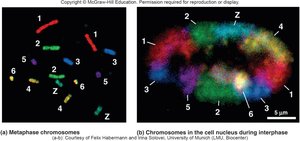
During interphase, each chromosome occupies a distinct domain within the nucleus, known as a chromosome territory. This spatial organization is important for gene regulation and RNA processing.
Discrete Domains: Each chromosome is located in a specific region.
Interchromatin Compartments: Contain RNA processing machinery; transcripts move from chromosome territories to these compartments for maturation.
Chromatin Packaging and Gene Expression
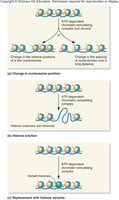
Chromatin exists in two main forms: heterochromatin (tightly packed, generally transcriptionally inactive) and euchromatin (loosely packed, transcriptionally active). Chromatin remodeling alters accessibility for transcription.
Open Conformation: Promotes transcription.
Closed Conformation: Reduces transcription.
ATP-Dependent Remodeling: Protein complexes use ATP to reposition, remove, or replace nucleosomes.
Histone Variants and Modification
Histones are proteins around which DNA is wrapped. Variants and post-translational modifications of histones play specialized roles in chromatin structure and gene regulation.
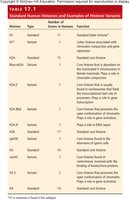
Histone Variants: Multiple histone genes exist, with some variants having unique functions.
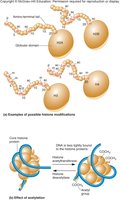
Modification Types: Acetylation, methylation, and phosphorylation alter chromatin conformation and protein interactions.
Nucleosome Positioning Around Genes
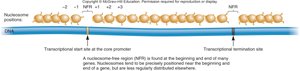
Active genes often have a nucleosome-free region (NFR) around the core promoter, flanked by well-positioned nucleosomes (-1 and +1), marking the transcription start site.
NFR: About 150 bp long, facilitates access for transcription machinery.
Positioned Nucleosomes: Help define transcriptional boundaries.
Transcriptional Activation and Chromatin Remodeling
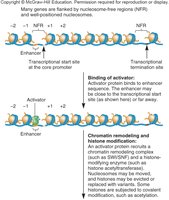
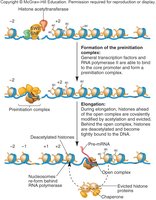
Transcriptional activators recruit chromatin-remodeling and histone-modifying enzymes to promoters, facilitating gene expression by altering nucleosome locations and composition.
Activator Binding: Activators bind to enhancer sequences and recruit remodeling complexes.
Chromatin Remodeling: Nucleosomes are repositioned or modified to allow transcription.
DNA Methylation and Epigenetic Regulation
DNA Methylation
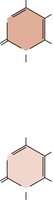
DNA methylation involves the addition of a methyl group to cytosine, typically at CpG sequences, and is carried out by DNA methyltransferase. This modification can inhibit transcription and is heritable.
CpG Islands: Regions near promoters with high CpG content; unmethylated in housekeeping genes, methylated in tissue-specific genes when not expressed.
Transcriptional Inhibition: Methylation can block activator binding or recruit proteins that induce closed chromatin conformation.
Heritability: Methylation patterns are maintained during cell division via maintenance methylation.





Epigenetics
Epigenetics is the study of heritable changes in gene expression that do not involve changes to the DNA sequence. Mechanisms include chromatin remodeling, DNA methylation, histone variants, and histone modification.
Long-term Maintenance: Epigenetic changes can be passed from cell to cell or generation to generation.
Reversibility: Epigenetic modifications are reversible.
Transcriptional Control and Regulatory Transcription Factors
Combinatorial Control
Gene expression is regulated by multiple factors, including chromatin structure, DNA methylation, and regulatory transcription factors (activators and repressors).
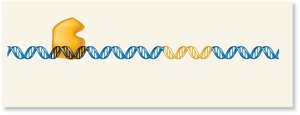
Regulatory Transcription Factors: Proteins that influence the rate of transcription by binding to DNA elements near the promoter.
Enhancers and Silencers: DNA elements bound by activators (enhancers) or repressors (silencers).
Orientation Independence: Many response elements can function in either direction and at various distances from the promoter.
TFIID and Mediator
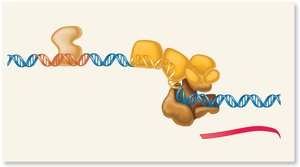
Regulatory transcription factors exert their effects through general transcription factors (such as TFIID) and the Mediator complex, which facilitate RNA polymerase II binding and transcription initiation.
TFIID: Recruits RNA polymerase to the promoter.
Mediator: Bridges regulatory transcription factors and RNA polymerase II.
Regulation After Transcription
Alternative Splicing
Alternative splicing allows a single pre-mRNA to be spliced in multiple ways, producing different protein isoforms with unique characteristics. RNA-binding proteins regulate tissue-specific splicing.
Splice Site Selection: RBPs can hide splice sites to promote alternative splicing.
Species Variation: Extent of alternative splicing varies among species.
mRNA Stability
The stability of mRNA can be regulated by the length of the polyA tail and the presence of destabilizing elements, often found in the 3′ untranslated region (3′ UTR).
PolyA Tail: PolyA-binding protein enhances stability; shortening the tail leads to rapid degradation.
Destabilizing Elements: Promote mRNA decay.
RNA Interference (RNAi)
Noncoding RNAs, such as siRNAs and miRNAs, guide post-transcriptional silencing by base pairing with target mRNAs and blocking translation.
siRNAs: Small interfering RNAs.
miRNAs: Micro RNAs.
Translational Regulation
Some mRNAs are translated only under specific conditions, such as actin mRNA localization and translation during cell movement.
Zip Code Binding Protein 1 (ZBP1): Directs actin mRNA localization.
Posttranslational Modifications
Proteins can be modified after translation by acetylation, methylation, phosphorylation, and ubiquitination, affecting their activity, binding, or degradation.
Kinases and Phosphatases: Mediate phosphorylation and dephosphorylation.
Ubiquitin Ligases: Target proteins for degradation.
Tables
Standard Human Histones and Examples of Histone Variants
Histone | Type | Number of Genes in Humans | Function |
|---|---|---|---|
H1 | Standard | 11 | Standard histone associated with chromatin compaction and gene regulation |
H2A | Standard | 16 | Core histone that is abundant in nucleosomes |
H2A.Z | Variant | 2 | Variant histone found in nucleosomes at gene promoters. Plays a role in chromatin compaction. |
H2A.X | Variant | 1 | Variant histone that is usually phosphorylated in response to DNA damage. |
H2A.Bbd | Variant | 1 | Variant histone that promotes the formation of less compact chromatin. |
H2B | Standard | 17 | Core histone found in nucleosomes |
H3 | Standard | 10 | Core histone found in nucleosomes |
H3.3 | Variant | 2 | Variant histone found in actively transcribed genes |
CENP-A | Variant | 1 | Variant histone found at centromeres |
H4 | Standard | 14 | Core histone found in nucleosomes |
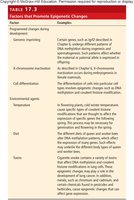
Factors That Promote Epigenetic Changes
Factor | Example |
|---|---|
Genomic imprinting | Certain genes, such as IGF2, exhibit different patterns of DNA methylation during spermatogenesis and oogenesis. Such patterns affect whether the maternal or paternal allele is expressed in offspring. |
X-chromosome inactivation | As described in Chapter 5, X-chromosome inactivation occurs during embryonic development in mammals. |
Cell differentiation | The differentiation of cells into particular cell types involves epigenetic changes such as DNA methylation and histone modification. |
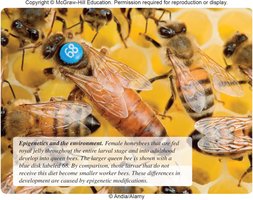
Environmental agents | Examples: Smoking, diet, and stress can influence epigenetic patterns. For example, in honeybees, diet alters the methylation of genes, resulting in queen or worker bee development. |
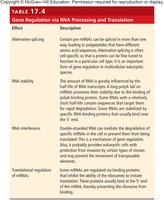
Gene Regulation via RNA Processing and Translation
Effect | Description |
|---|---|
Alternative splicing | Certain pre-mRNAs can be spliced in more than one way, leading to proteins that have different amino acid sequences. Alternative splicing is often cell-specific so that a protein can be fine-tuned for its role in a particular cell type. It is an important mechanism of gene regulation in multicellular eukaryotes. |
mRNA stability | The amount of mRNA is greatly influenced by its stability. The polyA tail and destabilizing elements in the 3′ UTR affect mRNA stability. Short-lived mRNAs are rapidly degraded, while stable mRNAs persist longer and produce more protein. |
RNA interference | Double-stranded RNA can mediate the degradation of specific mRNAs. This process prevents translation and is mediated by siRNAs and miRNAs, which guide the RNA-induced silencing complex (RISC) to target mRNAs. |
Translational regulation of mRNAs | Some mRNAs are regulated at the level of translation, such as actin mRNA, which is localized to specific regions of the cell and translated only when needed, promoting the 'zip code' binding protein for localization and translation. |
