 Back
BackEvidence for Evolution: Genetic and Anatomical Perspectives
Study Guide - Smart Notes
 Tailored notes based on your materials, expanded with key definitions, examples, and context.
Evidence for Evolution
Introduction
Evolution is the process by which species change over time through the inheritance and mutation of genetic information. Multiple lines of evidence support the theory of evolution, including biogeography, the fossil record, embryology, anatomy, and molecular genetics. This section summarizes the main sources of evidence and their significance in understanding evolutionary processes.
Biogeography
Definition and Importance
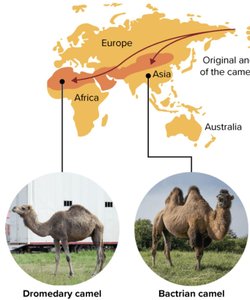
Biogeography is the study of the past and present geographical distribution of organisms. It provides insight into how species have spread and diversified across the globe, often in response to environmental changes and geographic barriers.
Unusual species assemblages are often found on remote islands, such as the Galapagos, where unique combinations of species and behaviors are observed.
Closely related species are typically found in geographically proximate areas, supporting the idea of common ancestry and local adaptation.

Modern Paleontology and Plate Tectonics
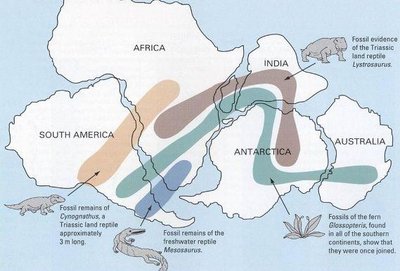
Fossil discoveries over the last century have revealed patterns in the distribution of ancient species. The theory of plate tectonics explains how continents have shifted, accounting for the presence of similar fossils on now-distant landmasses.
Darwin’s Hypotheses Regarding Remote Islands
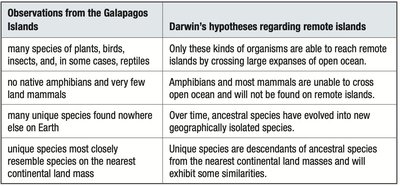
Charles Darwin proposed that remote oceanic islands are populated by species that arrived via water or air, and that these species evolved into new forms over time. Island species often resemble those on the nearest continental landmass, supporting the concept of descent with modification.
Observations from the Galapagos Islands | Darwin’s hypotheses regarding remote islands |
|---|---|
many species of plants, birds, insects, and, in some cases, reptiles | Only these kinds of organisms are able to reach remote islands by crossing large expanses of open ocean. |
no native amphibians and very few land mammals | Amphibians and most mammals are unable to cross open ocean and will not be found on remote islands. |
many unique species found nowhere else on Earth | Over time, ancestral species have evolved into new geographically isolated species. |
unique species most closely resemble species on the nearest continental land mass | Unique species are descendants of ancestral species from the nearest continental land masses and will exhibit some similarities. |
Homologous and Analogous Features
Homologous Features
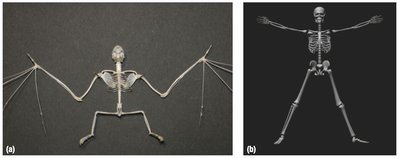
Homologous features are anatomical structures that share a common origin but may serve different functions in modern species. These similarities provide evidence for common ancestry.
Example: The forelimbs of bats and humans have similar bone arrangements but serve different purposes (flight vs. manipulation).
All mammals have nearly identical numbers and arrangements of bones in their limbs.
Embryological Evidence
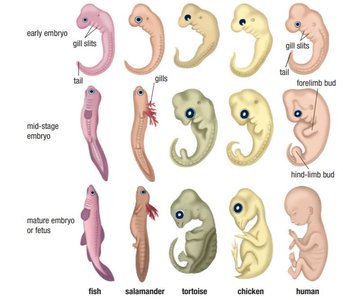
During early development, embryos of vertebrates display similar features, such as tails and gill slits, indicating shared evolutionary origins.
Analogous Features
Analogous features are structures that perform similar functions but have different evolutionary origins and structures. These arise due to convergent evolution, not common ancestry.
Example: The wings of insects and birds serve the same function (flight) but have different anatomical structures and evolutionary histories.
Vestigial Features and Anatomical Oddities
Definition and Examples
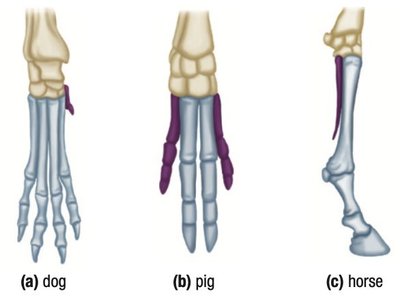
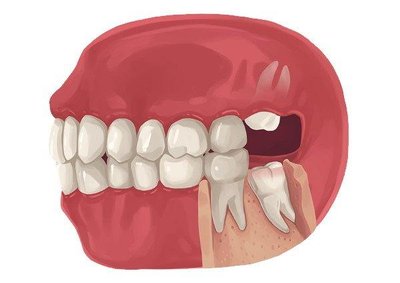
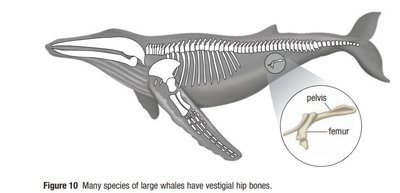
Vestigial features are anatomical structures that have lost most or all of their original function in a species but are retained from ancestors. Their presence is strong evidence for evolutionary change.
Human appendix and wisdom teeth are examples of vestigial organs.
Some fish living in dark caves have vestigial, non-functional eyes.
Additional Examples
Large snakes and whales possess vestigial hip bones, homologous to the hip bones that support hind limbs in other vertebrates.
Other examples include the human tailbone (coccyx) and goosebumps.
Pseudogenes
Definition and Significance
Pseudogenes are genes that have accumulated mutations and no longer produce functional proteins. They are remnants of once-functional genes and provide molecular evidence for evolution.
Example: Dolphins have many olfactory receptor genes, but most are pseudogenes since they do not rely on smell.
Humans have a defective GULO gene for vitamin C synthesis, which is not harmful due to dietary intake.
Competition within Populations
Population Dynamics and Natural Selection
Darwin observed that anatomical features, biogeography, and the fossil record all supported evolution. He was influenced by Thomas Malthus, who argued that populations are limited by environmental resources, leading to competition and natural selection.
Populations cannot grow indefinitely due to limited resources, resulting in competition for survival.
Individuals with advantageous traits are more likely to survive and reproduce, driving evolutionary change.
Assessing the Evidence
Scientific and Social Context
Although Darwin's evidence for evolution was strong, he recognized that his ideas would be controversial, especially in light of prevailing religious beliefs. He spent many years gathering data before publishing his theory, which has since become a cornerstone of modern biology.
