 Back
BackExtensions of Mendelian Genetics: Complex Patterns of Inheritance
Study Guide - Smart Notes
 Tailored notes based on your materials, expanded with key definitions, examples, and context.
Extensions of Mendelian Genetics
Overview
While Mendel's principles of segregation and independent assortment form the foundation of classical genetics, many traits in nature exhibit inheritance patterns more complex than simple dominant and recessive relationships. These extensions include incomplete dominance, codominance, multiple alleles, lethal alleles, epistasis, polygenic inheritance, pleiotropy, X-linked traits, sex-influenced and sex-limited traits, and environmental effects on gene expression.
Allelic Variation and Phenotypic Change
Types of Allelic Interactions
Incomplete Dominance: The heterozygote displays a phenotype intermediate between the two homozygotes; neither allele is fully dominant.
Codominance: Both alleles in a heterozygote are fully expressed, resulting in a phenotype that shows characteristics of both alleles.
Multiple Alleles: More than two alleles exist for a single gene within a population, though an individual can only carry two alleles.
Lethal Alleles: Mutations in essential genes can result in alleles that cause death when present in certain combinations.
Mutation Effects
Loss-of-function: Mutation reduces or eliminates normal gene function.
Gain-of-function: Mutation enhances or creates new gene function.
Neutral mutation: Mutation has no effect on phenotype or fitness.
Symbolism in Genetics
Allele Notation
Dominant: Italic uppercase letter (e.g., D) or group of letters (e.g., Wr).
Recessive: Italic lowercase letter (e.g., d) or group of letters (e.g., wr).
Mutant: Italic letter (e.g., e).
Wild-type: Italic letter plus superscript (e.g., e+).
No dominance: Italic uppercase letters and superscripts (e.g., R1, R2).
Incomplete Dominance
Definition and Example
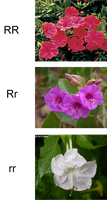
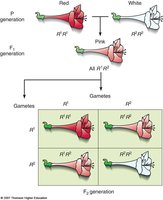
Incomplete dominance occurs when the heterozygote has a phenotype intermediate between the two homozygotes. Classic example: flower color in snapdragons.
F1 Generation: Cross between red (RR) and white (rr) yields pink (Rr).
F2 Generation: 1 red : 2 pink : 1 white (genotypic ratio 1:2:1).
Codominance
Definition and Example
Codominance occurs when both alleles in a heterozygote are fully expressed, resulting in a phenotype that shows both traits distinctly. Example: MN blood group in humans.
Alleles: LM and LN
Cross: LMLN × LMLN yields 1 LMLM : 2 LMLN : 1 LNLN
Phenotypic ratio: 1:2:1
Multiple Alleles
ABO Blood Group System
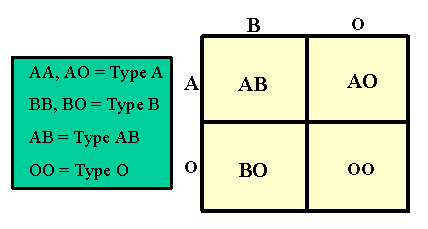
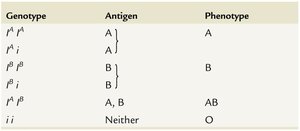
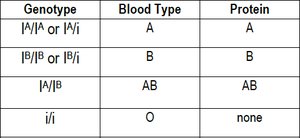
Multiple alleles exist for the ABO blood group gene in humans, resulting in four possible blood types.
Alleles: IA, IB, i
Dominance: IA and IB are dominant to i; IA and IB are codominant to each other.
Phenotypes: A, B, AB, O
Lethal Alleles
Essential Genes and Lethality
Lethal alleles are mutations in essential genes that can cause death. They may be dominant or recessive.
Recessive lethal: Only lethal when both alleles are mutated (homozygous).
Dominant lethal: One mutant allele is sufficient to cause death (e.g., Huntington's disease).
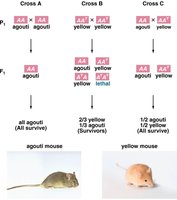
Agouti gene in mice: AY allele is dominant for coat color but recessive lethal for viability.
Pleiotropy
Definition and Example
Pleiotropy occurs when a single gene affects multiple phenotypic traits. Example: porphyria variegata, an autosomal dominant disorder causing a toxic buildup of porphyrins, resulting in diverse symptoms such as abdominal pain, muscular weakness, and vision issues.
Polygenic Inheritance
Definition and Example
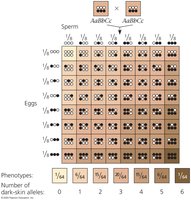
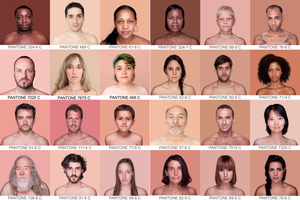
Polygenic inheritance involves multiple genes contributing additively to a single phenotype. Most variable human traits, such as height, weight, and skin color, are polygenic.
Skin pigmentation: As many as 378 genes contribute to human skin color.
Epistasis
Definition and Types
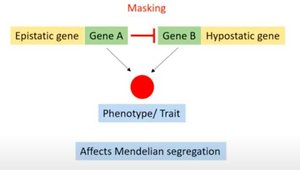
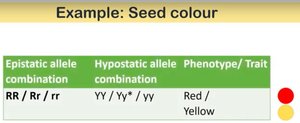
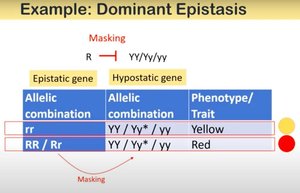
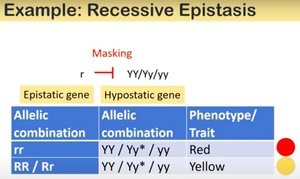
Epistasis occurs when the expression of one gene masks or modifies the effect of another gene. This interaction alters expected Mendelian ratios.
Dominant epistasis: Dominant allele of one gene masks effects of another gene.
Recessive epistasis: Recessive allele of one gene masks effects of another gene.
Epistasis in Labradors
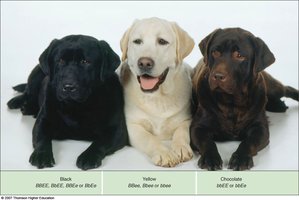
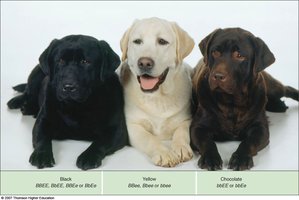
Coat color in Labradors is determined by two genes: one for color (B/b) and one for pigment deposition (E/e). The ee genotype masks color, resulting in yellow fur regardless of B/b alleles.
Recessive Epistasis in Mice
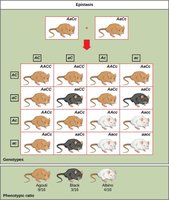
In mice, pigment production requires at least one dominant C allele. The cc genotype results in albino mice, regardless of agouti (A/a) alleles. Cross AaCc × AaCc yields a 9:3:4 ratio (agouti:solid color:albino).
Bombay Phenotype in Humans
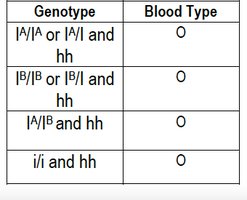
The Bombay phenotype is an example of recessive epistasis in humans. The H gene is required for the attachment of A/B antigens to red blood cells. Individuals with hh genotype lack the attachment protein, so their blood type appears as O regardless of their ABO genotype.
Dominant Epistasis in Squash
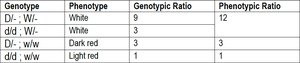
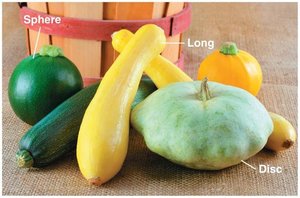
Dominant epistasis occurs in squash color, where the dominant W allele masks the effect of the D allele. Crosses yield a 12:3:1 phenotypic ratio (white:dark red:light red).
Complementation Analysis
Purpose and Method
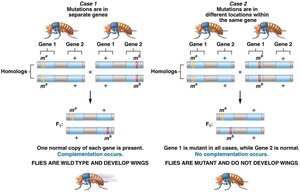
Complementation analysis tests whether mutations causing the same phenotype are in the same gene or different genes. If offspring have a normal phenotype, mutations are in different genes (complementation). If offspring are mutant, mutations are in the same gene (no complementation).
X-Linkage and Sex Determination
X-Linked Genes
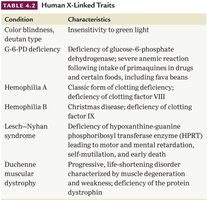
Genes located on the X chromosome exhibit unique inheritance patterns. Males (XY) are hemizygous for X-linked genes, while females (XX) are homozygous or heterozygous.
Y chromosome: Contains few genes, mostly male-specific.
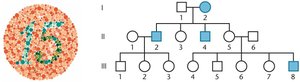
X-Linked Recessive Traits: Red–Green Color Blindness
Red–green color blindness is caused by a mutation on the X chromosome. It is recessive and more common in males. Inheritance patterns depend on parental genotypes.
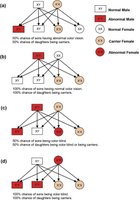
Carrier mother × Normal father: 50% sons affected, 50% daughters carriers.
Affected mother × Normal father: All sons affected, all daughters carriers.
Affected father × Normal mother: No sons affected, all daughters carriers.
Both parents affected: All sons and daughters affected.
Genotype, Environment, and Phenotype
Environmental Effects on Phenotype
Phenotype results from the interaction between genotype and environment. Environmental factors can influence gene expression and trait manifestation.
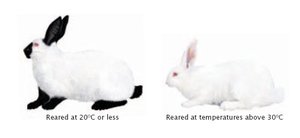
Temperature-sensitive mutations: Some mutations only affect phenotype at certain temperatures.
Nutritional mutations: Some organisms require specific nutrients due to genetic mutations.


Sex-Limited and Sex-Influenced Traits
Definitions and Examples
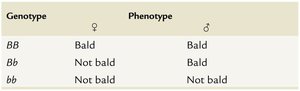
Sex-limited inheritance: Expression of a phenotype is limited to one sex.
Sex-influenced inheritance: Expression of a phenotype is influenced by the sex of the individual.
Example: Male pattern baldness is dominant in males but recessive in females.
Genetic Background and Position Effect
Position Effect
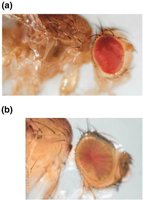
The physical location of a gene within the genome can influence its expression. Chromosomal rearrangements, such as translocations or inversions, can modify gene expression, leading to variegated phenotypes.
Example: Female heterozygote for white-eye in Drosophila may show mottled eyes due to chromosomal rearrangement.
Conditional Mutations
Temperature-Sensitive Mutations
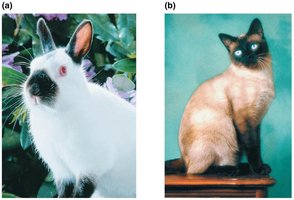
Some mutations cause proteins to function only at certain temperatures. These are useful in research and can be easily induced in viruses and yeast.
Example: Evening primrose flowers are red at 23°C and white at 18°C. Siamese cats and Himalayan rabbits have darker fur on cooler body parts.
Additional info: These notes expand on brief points from the original materials, providing definitions, examples, and tables for clarity. All included images directly reinforce the adjacent explanations.
