 Back
BackExtensions of Mendelian Genetics: Comprehensive Study Guide
Study Guide - Smart Notes
 Tailored notes based on your materials, expanded with key definitions, examples, and context.
Extensions of Mendelian Genetics
Alleles, Dominance, Codominance, and Incomplete Dominance
Genetic traits are determined by alleles, which are alternative forms of a gene. The interaction between alleles can result in various dominance relationships, including complete dominance, codominance, and incomplete (partial) dominance.
Complete Dominance: One allele masks the expression of the other in heterozygotes.
Codominance: Both alleles are fully expressed in the heterozygote, resulting in a phenotype that shows both traits.
Incomplete Dominance: The heterozygote exhibits an intermediate phenotype between the two homozygotes.
Recessive Alleles: Only expressed when both alleles are recessive.
Mutation: The ultimate source of alleles, leading to new phenotypes by altering gene function.
Example: In snapdragons, crossing red and white flowers produces pink flowers in the F1 generation, demonstrating incomplete dominance.
Multiple Alleles and Human ABO Blood Group
Some genes have more than two alleles in a population, though any individual can possess only two alleles for a given gene. The ABO blood group system is a classic example of multiple alleles.
ABO Blood Group: Determined by three alleles: IA, IB, and i.
Phenotypes: A, B, AB, and O, resulting from different combinations of these alleles.
Dominance Relationships: IA and IB are codominant; both are dominant over i.
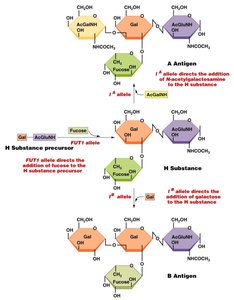
Biochemical Basis: The alleles encode enzymes that modify the H substance on red blood cells, producing A or B antigens.
Lethal Alleles and Essential Genes
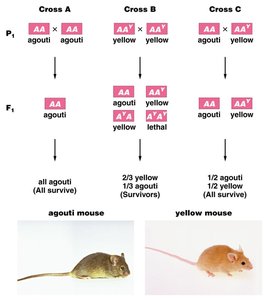
Lethal alleles are mutations in essential genes that can cause death when present in certain genotypes. These alleles often behave as recessive lethals, where homozygous individuals do not survive, but heterozygotes may display a mutant phenotype.
Essential Genes: Required for survival; loss-of-function mutations can be lethal.
Recessive Lethal Alleles: Homozygous recessive individuals die; heterozygotes may show a mutant phenotype.
Dominant Lethal Alleles: Rare, often manifest later in life (e.g., Huntington's disease).
Modification of Mendelian Ratios
Gene interactions and multiple alleles can modify the classic Mendelian ratios (3:1 for monohybrid, 9:3:3:1 for dihybrid crosses). These modifications arise from phenomena such as incomplete dominance, codominance, lethal alleles, and epistasis.
Incomplete Dominance and Codominance: Both yield a 1:2:1 phenotypic ratio.
Lethal Alleles: Can produce a 2:1 ratio if homozygous lethals are not observed.
Epistasis: Interaction between genes can mask or modify phenotypes, resulting in ratios like 9:7, 9:6:1, 12:3:1, 15:1, etc.
Epistasis: Masking, Complementation, and Novel Phenotypes
Epistasis occurs when one gene masks or modifies the expression of another gene. This can lead to novel phenotypes and altered ratios in offspring.
Recessive Epistasis: A recessive genotype at one locus masks expression at another (e.g., mouse coat color, ratio 9:3:4).
Dominant Epistasis: A dominant allele at one locus masks expression at another (e.g., squash color, ratio 12:3:1).
Complementary Gene Interaction: At least one dominant allele at each locus required for phenotype (e.g., pea flower color, ratio 9:7).
Duplicate Dominant Epistasis: Either gene dominant produces phenotype (ratio 15:1).
Polygenic Additive Effects
Polygenic inheritance involves multiple genes contributing additively to a trait, resulting in continuous variation (e.g., skin color, grain color in wheat).
Quantitative Traits: Traits governed by two or more sets of alleles, each with a small additive effect.
Continuous Variation: Produces a bell-shaped curve in populations.
Formula: For F2 population, is the ratio of individuals expressing either extreme phenotype, where n is the number of polygenes involved.
Complementation Analysis and Pleiotropy
Complementation analysis determines whether mutations causing similar phenotypes are alleles of the same gene or different genes. Pleiotropy occurs when a single gene affects multiple phenotypic traits.
Complementation: Crossing mutants to see if offspring are wild type or mutant; helps identify distinct genes.
Pleiotropy: One gene, multiple effects (e.g., Marfan syndrome affects heart, bones, eyes).
Criss-Cross, X-Linkage, Sex-Limited and Sex-Influenced Inheritance
Sex-linked inheritance involves genes located on sex chromosomes, leading to unique patterns such as criss-cross inheritance. Sex-limited and sex-influenced traits are affected by an individual's sex.
X-Linkage: Genes on X chromosome; males are hemizygous, females are homozygous or heterozygous.
Criss-Cross Inheritance: Offspring inherit traits from the parent of the opposite sex.
Sex-Limited Traits: Expressed only in one sex (e.g., cock feathering in chickens).
Sex-Influenced Traits: Expression depends on sex (e.g., pattern baldness in humans).
Environmental Influences, Penetrance, and Expressivity
Phenotypic expression can be influenced by environmental factors and genetic background. Penetrance and expressivity quantify these effects.
Penetrance: Proportion of individuals with a genotype that express the expected phenotype.
Expressivity: Degree to which a phenotype is expressed.
Environmental Effects: Temperature-sensitive mutations, nutritional mutations (e.g., PKU, galactosemia).
Genetic Suppression, Anticipation, and Imprinting
Genetic suppression, anticipation, and imprinting are advanced concepts affecting gene expression and inheritance.
Genetic Suppression: A second mutation relieves the phenotype of a first mutation.
Genetic Anticipation: Symptoms of a genetic disorder appear earlier and more severely in successive generations (e.g., Huntington's disease).
Genetic Imprinting: Phenotypic effect of an allele depends on the parent of origin, often due to epigenetic modifications like DNA methylation.
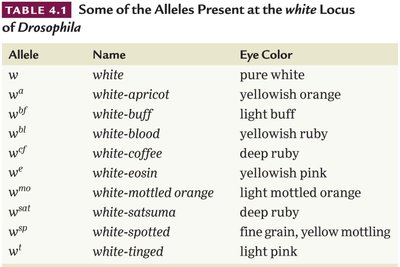
Summary Table: Alleles at the White Locus in Drosophila
The white locus in Drosophila demonstrates the concept of multiple alleles, with a range of eye colors produced by different alleles.
Allele | Name | Eye Color |
|---|---|---|
w | white | pure white |
wa | white-apricot | yellowish orange |
wbf | white-buff | light buff |
wb | white-blood | yellowish ruby |
wcf | white-coffee | deep ruby |
we | white-eosin | yellowish pink |
wmo | white-mottled orange | light mottled orange |
wsat | white-satsuma | deep ruby |
wsp | white-spotted | fine grain, yellow mottling |
wtd | white-tinged | light pink |
Key Takeaways
Genetic traits can be influenced by multiple alleles, gene interactions, environmental factors, and genetic background.
Extensions of Mendelian genetics explain deviations from classic ratios and provide insight into complex inheritance patterns.
Understanding these concepts is essential for interpreting genetic data and predicting phenotypic outcomes.
