 Back
BackExtensions of Mendelian Genetics: Key Concepts and Applications
Study Guide - Smart Notes
 Tailored notes based on your materials, expanded with key definitions, examples, and context.
Chapter 4: Extensions of Mendelian Genetics
Introduction
This chapter explores how inheritance patterns extend beyond simple Mendelian genetics. It covers the molecular and phenotypic consequences of different types of alleles, the use of genetic symbols, and the complexities introduced by multiple alleles, codominance, incomplete dominance, lethal alleles, and gene interactions. These concepts are fundamental for understanding genetic diversity and inheritance in populations.
4.1 Alleles Alter Phenotypes in Different Ways
Alleles and Phenotypic Variation
Alleles are alternative forms of a gene that arise by mutation and are found at the same place on a chromosome.
Mutations can alter the function of the gene product, leading to new phenotypes by:
Eliminating enzyme function
Changing enzyme efficiency
Altering overall enzyme function
Wild-type allele: The allele that occurs most frequently in a population, typically conferring the standard phenotype.
Types of Mutations
Loss-of-function mutations: Reduce or eliminate the function of the gene product, often resulting in a recessive phenotype.
Gain-of-function mutations: Enhance or confer new activity on the gene product, sometimes resulting in a dominant phenotype.
Neutral mutations: Do not affect phenotype or evolutionary fitness.
4.2 Geneticists Use a Variety of Symbols for Alleles
Allele Notation
Dominant alleles: Indicated by italic uppercase letters (e.g., D) or letter combinations.
Recessive alleles: Indicated by italic lowercase letters (e.g., d).
Mutant alleles: Indicated by italic letters, sometimes with superscripts.
Wild-type alleles: Indicated by an italic letter plus a superscript + (e.g., w+).
Example: Drosophila melanogaster Body Color
Wild-type (gray): e+
Ebony mutant: e
No Dominance
If no allele is dominant, uppercase letters with superscripts are used to distinguish alleles.
4.3 Neither Allele Is Dominant in Incomplete, or Partial, Dominance
Incomplete Dominance
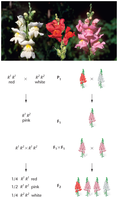
Incomplete dominance occurs when the phenotype of the heterozygote is intermediate between the phenotypes of the two homozygotes. Neither allele is completely dominant.
Each genotype produces a distinct phenotype.
Phenotypic and genotypic ratios in the F2 generation are the same (1:2:1).
Example: Snapdragons
Red flower (R1R1) × White flower (R2R2) → Pink flower (R1R2)
Human Example: Tay–Sachs Disease
Homozygous recessive individuals lack Hexosaminidase A, leading to a fatal lipid-storage disorder.
Heterozygotes have intermediate enzyme activity, but are typically asymptomatic.
Threshold Effect
Normal phenotype is expressed as long as a certain threshold of gene product is present (often 50% or less).
In Tay–Sachs, less than 50% enzyme activity leads to disease.
4.4 In Codominance, the Influence of Both Alleles in a Heterozygote Is Clearly Evident
Codominance
Codominance occurs when both alleles in a heterozygote are fully expressed, resulting in a phenotype that simultaneously displays traits from both alleles.
No dominance or blending occurs.
Both gene products are detectable in the heterozygote.
Example: MN Blood Group in Humans
Individuals can express M, N, or both M and N antigens on red blood cells, depending on their genotype.
4.5 Multiple Alleles of a Gene May Exist in a Population
Multiple Alleles
More than two alleles can exist for a single gene within a population, though any individual can only possess two alleles for each gene.
Multiple alleles result in more complex inheritance patterns.
Example: ABO Blood Groups in Humans
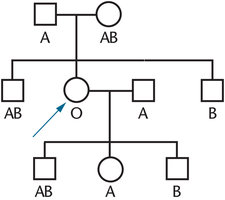
Three alleles: IA, IB, and i
IA and IB are codominant; both are dominant over i.
Phenotypes: Type A, Type B, Type AB, and Type O blood.
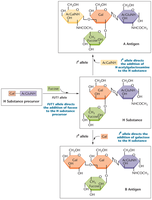
Biochemical Basis: H Substance
A and B antigens are carbohydrate groups attached to lipids on red blood cells.
O blood type only has the H substance, lacking terminal sugars found in A or B types.
Bombay Phenotype
Individuals with the Bombay phenotype appear as type O, even if they have A or B alleles, due to a lack of H substance (resulting from a mutation in the FUT1 gene).
This prevents the formation of A or B antigens.
4.6 Lethal Alleles Represent Essential Genes
Essential, Dominant, and Recessive Lethal Alleles
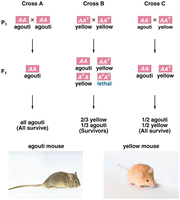
Essential genes are required for survival; mutations can be tolerated if heterozygous, but homozygous recessive individuals do not survive.
Lethal alleles cause death when present in certain genotypes.
Dominant lethal alleles cause death even when only one copy is present (e.g., Huntington disease).
Example: Agouti Gene in Mice
The yellow allele is dominant for coat color but recessive lethal; homozygous yellow mice do not survive.
4.7 Combinations of Two Gene Pairs with Two Modes of Inheritance Modify the 9:3:3:1 Ratio
Gene Interactions and Modified Ratios
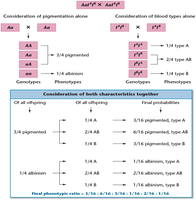
When two gene pairs with different modes of inheritance are considered simultaneously, the classic 9:3:3:1 Mendelian ratio can be modified, resulting in more complex phenotypic ratios.
Example: A cross involving albinism (Mendelian inheritance) and ABO blood type (multiple alleles).
Genotype | Phenotype |
|---|---|
AA or Aa | Pigmented |
aa | Albino |
IAIA or IAi | Type A |
IBIB or IBi | Type B |
IAIB | Type AB |
ii | Type O |
Summary Table: Key Extensions of Mendelian Genetics
Concept | Definition | Example |
|---|---|---|
Incomplete Dominance | Heterozygote shows intermediate phenotype | Pink snapdragons |
Codominance | Both alleles fully expressed in heterozygote | MN blood group |
Multiple Alleles | More than two alleles for a gene in a population | ABO blood groups |
Lethal Alleles | Alleles that cause death in certain genotypes | Yellow coat in mice |
Gene Interaction | Two or more genes affect a single phenotype | Modified 9:3:3:1 ratios |
Additional info: This summary integrates textbook content with expanded academic context for clarity and exam preparation.
