 Back
BackExtensions of Mendelian Genetics: Mechanisms and Phenotypic Outcomes
Study Guide - Smart Notes
 Tailored notes based on your materials, expanded with key definitions, examples, and context.
Extensions of Mendelian Genetics
Introduction
While Mendel’s principles laid the foundation for classical genetics, many traits do not follow simple dominant-recessive inheritance. Extensions of Mendelian genetics explore how alleles interact to produce a variety of phenotypes, including incomplete dominance, codominance, multiple alleles, lethal alleles, epistasis, pleiotropy, and the influence of environmental factors.
Alleles Alter Phenotypes in Different Ways
Function Mutations
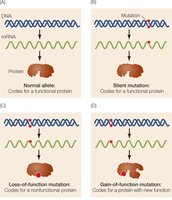
Alleles can alter phenotypes through different types of mutations, each affecting gene function and organismal traits in unique ways.
Loss-of-function mutations: These mutations reduce or eliminate the function of the gene product. Often, the wild-type allele is haplosufficient, so only homozygotes for the mutant allele show the phenotype.
Gain-of-function mutations: These mutations enhance the function of the gene product or confer a new activity. They are often dominant because the altered gene product affects the phenotype even in the presence of a wild-type allele.
Silent mutations: These mutations do not alter the amino acid sequence of the protein and thus have no effect on phenotype or fitness.
Incomplete (Partial) Dominance
Definition and Example
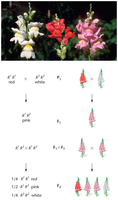
In incomplete dominance, neither allele is completely dominant over the other. The heterozygote displays an intermediate phenotype between the two homozygotes.
Example: In snapdragons (Antirrhinum majus), crossing red-flowered plants (RR) with white-flowered plants (rr) produces pink-flowered offspring (Rr). The F2 generation shows a 1:2:1 ratio of red:pink:white flowers.
Tay-Sachs Disease as Incomplete Dominance
Tay-Sachs disease is a human example of incomplete dominance at the biochemical level. The HEXA gene encodes the enzyme beta-hexosaminidase A, necessary for lipid metabolism in the brain.
Homozygous normal: Full enzyme activity, no disease.
Homozygous mutant: No enzyme activity, fatal lipid-storage disorder.
Heterozygote: Intermediate enzyme activity (about half normal), no disease symptoms but detectable at the biochemical level.
Codominance and Multiple Alleles
Codominance
In codominance, both alleles in a heterozygote are fully expressed, resulting in a phenotype that simultaneously displays traits from both alleles without blending.
Example: The ABO blood group system in humans is a classic example of codominance and multiple alleles.
ABO Blood Group System
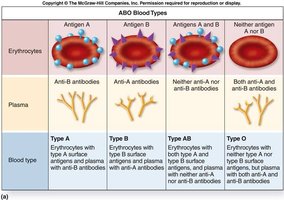
The ABO blood group is determined by three alleles (IA, IB, i) at a single locus. IA and IB are codominant, while i is recessive. The presence of specific antigens on red blood cells determines blood type.
Blood Type | Antigen(s) on RBC | Antibodies in Plasma | Genotype(s) |
|---|---|---|---|
A | A | Anti-B | IAIA, IAi |
B | B | Anti-A | IBIB, IBi |
AB | A and B | None | IAIB |
O | None | Anti-A, Anti-B | ii |
Biochemical Basis of ABO Blood Types
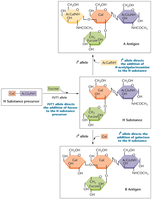
The A and B alleles encode different glycosyltransferase enzymes that modify the H substance on the surface of red blood cells. The O allele does not produce a functional enzyme, leaving the H substance unmodified.
Bombay Phenotype
The Bombay phenotype arises when an individual is homozygous for a rare recessive allele (h) at the FUT1 locus, preventing the synthesis of the H substance. Without the H substance, A and B antigens cannot be formed, resulting in a functional type O blood group regardless of the individual's ABO genotype.
Lethal Alleles
Definition and Types
Lethal alleles are mutations in essential genes that can cause death when present in certain genotypes. They can be recessive or dominant.
Recessive lethal alleles: Only lethal in homozygous state; heterozygotes survive.
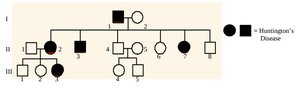
Dominant lethal alleles: Cause death even in heterozygotes, often after reproductive age (e.g., Huntington disease).
Huntington Disease
Huntington disease is caused by a dominant autosomal allele (H). Symptoms, including neurodegeneration and dementia, typically appear in adulthood, allowing the allele to be passed to offspring before lethality occurs.
Epigenesis and Epistasis
Epigenesis
Epigenesis is the concept that an organism develops from a fertilized egg through a series of developmental events, rather than from a preformed miniature organism. This process involves the sequential activation and interaction of genes.

Epistasis
Epistasis occurs when the expression of one gene masks or modifies the effect of another gene at a different locus. This interaction can alter expected Mendelian ratios in genetic crosses.
Recessive epistasis: A homozygous recessive genotype at one locus masks the expression of alleles at a second locus (e.g., coat color in mice).
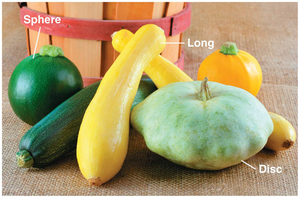
Dominant epistasis: A dominant allele at one locus masks the expression of alleles at a second locus (e.g., fruit color in summer squash).
Complementation Analysis
Principle
Complementation analysis is used to determine whether two mutations that produce a similar phenotype are in the same gene (allelic) or in different genes. If two mutants produce a wild-type phenotype when crossed, the mutations are in different genes (complementation); if not, they are alleles of the same gene.
Pleiotropy
Definition and Example
Pleiotropy occurs when a single gene influences multiple phenotypic traits. For example, the autosomal disorder porphyria variegata causes a buildup of toxic porphyrins, leading to a range of symptoms including abdominal pain, muscle weakness, and vision problems.
X-Linked Inheritance
Patterns and Examples
X-linked inheritance describes genes located on the X chromosome. Males (XY) are hemizygous for X-linked genes, so recessive alleles are always expressed. Examples include red-green color blindness and white eye color in Drosophila.
Sex-Limited and Sex-Influenced Inheritance
Definitions
Sex-limited inheritance: Phenotype is expressed in only one sex, even though both sexes may carry the allele (e.g., milk production in cows).
Sex-influenced inheritance: Phenotype is influenced by the sex of the individual, often due to hormonal differences (e.g., male pattern baldness).
Environmental Effects on Phenotypic Expression
Penetrance and Expressivity
Penetrance: The percentage of individuals with a particular genotype that actually display the expected phenotype.
Expressivity: The degree to which a genotype is expressed in an individual, which can vary due to genetic background or environmental factors.
Environmental Factors
Temperature: Some mutations are temperature-sensitive, expressing different phenotypes at different temperatures (e.g., coat color in Siamese cats).
Nutrition: Nutritional mutations require specific dietary components for normal phenotype expression (e.g., phenylketonuria requires a low-phenylalanine diet).
