 Back
Forward and Reverse Genetics, DNA Technology, and Applications
Study Guide - Smart Notes
 Tailored notes based on your materials, expanded with key definitions, examples, and context.
Forward and Reverse Genetics
Overview of Forward and Reverse Genetics
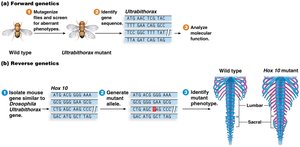
Forward and reverse genetics are two complementary approaches used to study gene function and genetic pathways. Forward genetics starts with a phenotype and seeks to identify the underlying gene, while reverse genetics begins with a gene and investigates the resulting phenotype when it is altered.
Forward Genetics: Mutagenize organisms, screen for phenotypic changes, and identify the mutated gene responsible for the phenotype.
Reverse Genetics: Start with a known gene, create targeted mutations (e.g., knockout, knockdown), and analyze the resulting phenotype.
Applications: Both approaches are fundamental for understanding gene function, disease mechanisms, and genetic pathways.
Example: Forward genetics can identify genes involved in development by screening for mutants with altered body segments; reverse genetics can target a Hox gene and observe skeletal changes.
Mutagens and Mutagenesis
Types of Mutagens Used in Genetic Studies
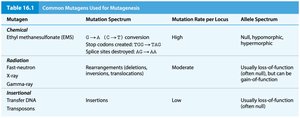
Mutagenesis is the process of inducing mutations in DNA to study gene function. Different mutagens produce distinct mutation spectra and are used in both forward and reverse genetics.
Chemical Mutagens: Ethyl methanesulfonate (EMS) induces point mutations (G→A transitions), often resulting in hypomorphic or null alleles.
Radiation: Fast neutrons, X-rays, and gamma rays cause rearrangements (deletions, inversions, translocations), usually leading to loss-of-function mutations.
Insertional Mutagens: Transposons and transfer DNA (T-DNA) cause insertions, often resulting in gene disruption.
Mutation Rate and Allele Spectrum: Chemical mutagens typically have high mutation rates, radiation moderate, and insertional mutagens low.
Mutagen | Mutation Spectrum | Mutation Rate per Locus | Allele Spectrum |
|---|---|---|---|
Chemical (EMS) | G→A conversion, stop codons | High | Null, hypomorphic, hypermorphic |
Radiation | Rearrangements | Moderate | Loss-of-function, gain-of-function |
Insertional (T-DNA, Transposons) | Insertions | Low | Loss-of-function |
RNA Interference (RNAi) and Gene Knockdown
Mechanism and Application of RNAi
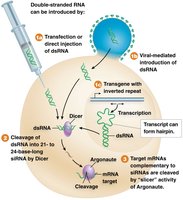
RNA interference (RNAi) is a technique used in reverse genetics to silence specific genes by targeting their mRNA for degradation. Double-stranded RNA (dsRNA) is introduced into cells, processed by Dicer into small interfering RNAs (siRNAs), which guide the Argonaute complex to cleave target mRNAs.
Introduction of dsRNA: Can be achieved by transfection, viral delivery, or transgene expression.
Dicer Processing: dsRNA is cleaved into 21–24 base siRNAs.
Targeting mRNA: siRNAs bind complementary mRNA, leading to its cleavage and gene silencing.
Applications: Used to knockdown gene expression for functional studies and therapeutic purposes.
Gene Expression Analysis: Transcriptional and Translational Fusions
Reporter Gene Fusions for Studying Expression
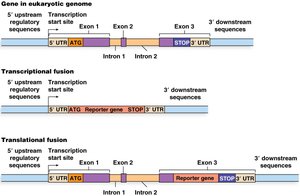
Transcriptional and translational fusions are used to study gene expression patterns and protein localization. Reporter genes (e.g., GFP, lacZ) are fused to regulatory or coding sequences of genes of interest.
Transcriptional Fusion: Reporter gene is placed under the control of a gene's promoter, revealing where and when the gene is transcribed.
Translational Fusion: Reporter gene is fused in-frame with the coding sequence, allowing visualization of protein localization.
Applications: Used to analyze tissue-specific expression, developmental regulation, and protein trafficking.
Visualization of Gene Expression in Model Organisms
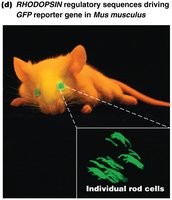
Reporter genes such as GFP (green fluorescent protein) are used to visualize gene expression in living tissues. Regulatory sequences drive expression in specific cell types, enabling detailed analysis of gene function.
Example: RHODOPSIN regulatory sequences drive GFP expression in rod cells of Mus musculus (mouse).
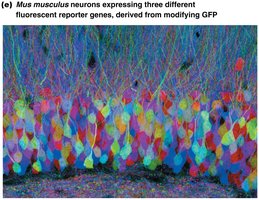
Multiple Reporter Genes: Modified GFP variants allow simultaneous visualization of different cell types.
Recombinant DNA Technology
Restriction Enzymes and DNA Fragmentation
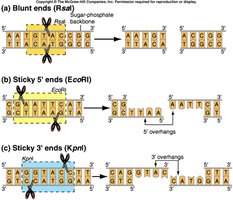
Restriction enzymes are essential tools in recombinant DNA technology, allowing precise cutting of DNA at specific sequences. They generate either blunt or sticky ends, facilitating the creation of recombinant molecules.
Blunt Ends: Produced by enzymes like RsaI, with no overhangs.
Sticky Ends: Produced by enzymes like EcoRI and KpnI, with single-stranded overhangs that facilitate ligation.
Palindromic Sequences: Most restriction sites are palindromes, enabling recognition by the enzyme.
Creation of Recombinant DNA Molecules
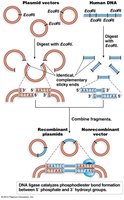
Recombinant DNA is formed by joining DNA fragments from different sources using restriction enzymes and DNA ligase. Plasmid vectors are commonly used to clone and propagate recombinant DNA.
Digestion: Both plasmid and target DNA are cut with the same restriction enzyme to generate compatible ends.
Ligation: DNA ligase joins the fragments, forming recombinant plasmids.
Transformation: Recombinant plasmids are introduced into bacterial cells for amplification.
Delivery and Amplification of Recombinant DNA
Modes of DNA Delivery into Bacterial Cells
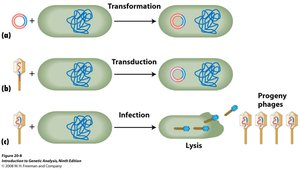
Recombinant DNA can be delivered into bacterial cells by transformation, transduction, or infection. Each method allows for the propagation and selection of recombinant clones.
Transformation: Uptake of plasmid DNA by bacteria.
Transduction: DNA transfer via bacteriophage.
Infection: Introduction of recombinant phage DNA, followed by lysis and release of progeny phages.
Amplification and Selection of Recombinant Clones
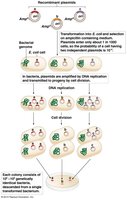
Once inside the host, recombinant DNA is replicated and passed on during cell division. Selection markers (e.g., antibiotic resistance) are used to identify successful transformants.
Replication: Plasmids replicate independently within bacterial cells.
Selection: Only bacteria carrying the plasmid survive in selective media.
Colony Formation: Each colony contains millions of cells with the same recombinant DNA.
Polymerase Chain Reaction (PCR)
PCR Mechanism and Applications
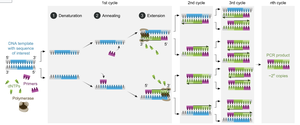
PCR is a powerful technique for amplifying specific DNA sequences from small amounts of template. It involves repeated cycles of denaturation, primer annealing, and extension by a thermostable DNA polymerase.
Denaturation: DNA strands are separated at high temperature (95°C).
Annealing: Primers bind to target sequences at lower temperature.
Extension: DNA polymerase synthesizes new strands.
Applications: Cloning, sequencing, diagnostics, forensic analysis, and genetic screening.
Transgenic Organisms and Genetic Engineering
Creation and Analysis of Transgenic Plants and Animals
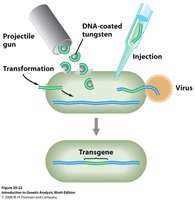
Transgenic organisms are generated by introducing foreign genes (transgenes) into their genomes. The integration and expression of transgenes are essential for studying gene function and developing genetically modified organisms (GMOs).
Transgene Integration: Can occur via transposable elements, homologous recombination, or selectable markers.
Inheritance: For transgenes to be passed to progeny, integration must occur in germ cells.
Applications: Creation of GMOs for agriculture, medicine, and research.
Transformation of Plant Genomes by Agrobacterium
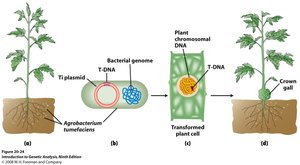
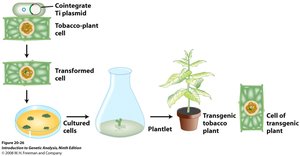
Agrobacterium tumefaciens is used to generate transgenic plants via the Ti plasmid, which naturally transfers T-DNA into plant genomes. The T-DNA region is modified to carry transgenes instead of causing disease.
Ti Plasmid: Contains T-DNA that integrates into plant chromosomal DNA.
Process: Infect plant tissue with Agrobacterium, allow recombination, and propagate transformed cells.
Applications: Widely used for creating genetically modified crops.
Applications and Concerns of Transgenic Plants
Promises and Concerns of Genetically Modified Crops
Transgenic plants offer solutions for food security, improved nutrition, and resistance to environmental stresses. However, concerns exist regarding gene escape, dependency on suppliers, and potential health risks.
Benefits: Increased yield, nutritional enrichment, resistance to pests and environmental stresses.
Concerns: Gene escape via interbreeding, dependency on suppliers, possible allergic reactions.
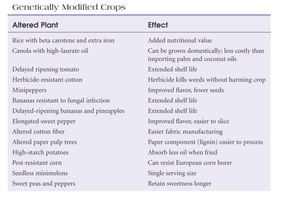
Altered Plant | Effect |
|---|---|
Rice with beta carotene and extra iron | Added nutritional value |
Canola with high-laurate oil | Can be grown domestically, less costly |
Delayed ripening tomato | Extended shelf life |
Herbicide-resistant cotton | Herbicide kills weeds without harming crop |
Minisprayers | Improved drought, fewer |
Bananas resistant to fungal infection | Extended shelf life |
Elongated sweet pepper | Improved flavor, easier to slice |
Seedless watermelons | Single serving size |
Sweet peas and peppers | Retain sweetness longer |
Summary
Key Concepts
Forward and reverse genetics are essential for dissecting gene function and genetic pathways.
Mutagenesis, RNAi, and recombinant DNA technology are foundational tools in modern genetics.
Transgenic organisms and GMOs have broad applications but also raise ethical and environmental concerns.
