 Back
Forward and Reverse Genetics, DNA Technology, and Applications
Study Guide - Smart Notes
 Tailored notes based on your materials, expanded with key definitions, examples, and context.
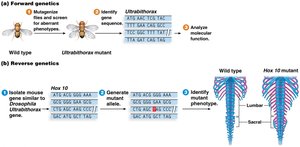
Forward and Reverse Genetics
Overview of Forward and Reverse Genetics
Forward and reverse genetics are two complementary approaches used to study gene function and genetic pathways. Forward genetics starts with a phenotype and seeks to identify the underlying gene, while reverse genetics begins with a gene and investigates the resulting phenotype after its alteration.
Forward Genetics: Mutagenize organisms, screen for phenotypic changes, and identify the mutated gene responsible.
Reverse Genetics: Target a specific gene for mutation or silencing, then analyze the resulting phenotype.
Applications: Both approaches are fundamental for understanding gene function, disease mechanisms, and genetic pathways.
Example: Forward genetics can identify genes involved in development, while reverse genetics can validate the role of a candidate gene in a specific process.
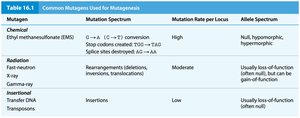
Mutagens Used for Mutagenesis
Mutagenesis is a key step in forward genetics, involving the induction of mutations using various mutagens. These mutagens differ in their mutation spectrum, rate, and the types of alleles they produce.
Chemical Mutagens: Such as EMS, induce point mutations (e.g., G→A transitions).
Radiation: Fast neutrons, X-rays, and gamma rays cause rearrangements and deletions.
Insertional Mutagens: Transposons and T-DNA insertions disrupt gene function.
Allele Spectrum: Mutagens can produce null, hypomorphic, or gain-of-function alleles.
Mutagen | Mutation Spectrum | Mutation Rate per Locus | Allele Spectrum |
|---|---|---|---|
Chemical (EMS) | G→A conversion, stop codons | High | Null, hypomorphic, hypermorphic |
Radiation (Fast neutron, X-ray, Gamma-ray) | Rearrangements, deletions, inversions, translocations | Moderate | Usually loss-of-function |
Insertional (T-DNA, Transposons) | Insertions | Low | Usually loss-of-function |
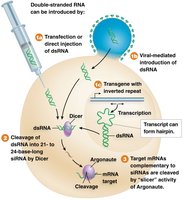
Gene Silencing and RNA Interference (RNAi)
Mechanism of RNAi
RNA interference (RNAi) is a reverse genetics tool used to knock down gene expression by targeting specific mRNA molecules for degradation. Double-stranded RNA (dsRNA) is processed into small interfering RNAs (siRNAs), which guide the silencing complex to complementary mRNAs.
Introduction of dsRNA: Can be achieved by transfection, viral delivery, or transgene expression.
Dicer: Cleaves dsRNA into siRNAs (21–24 bases).
Argonaute: siRNAs guide Argonaute to target mRNA, leading to cleavage and silencing.
Applications: Used to study gene function, model diseases, and develop therapeutics.
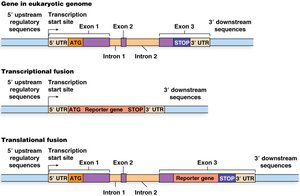
Gene Expression Analysis: Reporter Genes and Fusions
Transcriptional and Translational Fusions
Reporter gene fusions are used to study gene expression patterns and protein localization. Transcriptional fusions link regulatory sequences to a reporter gene, while translational fusions join coding sequences to a reporter.
Transcriptional Fusion: Regulatory sequences drive expression of a reporter gene (e.g., GFP).
Translational Fusion: Coding sequence of gene fused to reporter, allowing visualization of protein localization.
Applications: Used to map expression domains, study promoter activity, and track protein movement.
Visualization of Gene Expression
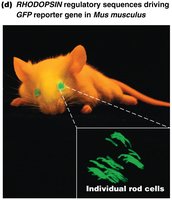
Reporter genes such as GFP (green fluorescent protein) are used to visualize gene expression in living organisms. Regulatory sequences from specific genes can drive expression in targeted cell types.
Example: RHODOPSIN regulatory sequences driving GFP expression in rod cells of Mus musculus.
Application: Allows identification and study of specific cell populations.
Multicolor Reporter Gene Expression
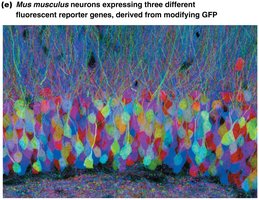
Advanced genetic engineering allows the expression of multiple fluorescent reporter genes, enabling detailed mapping of neuronal circuits and cell populations.
Example: Mus musculus neurons expressing three different fluorescent reporter genes.
Application: Used in neuroscience to study connectivity and function.
Recombinant DNA Technology
Restriction Enzymes and DNA Fragmentation
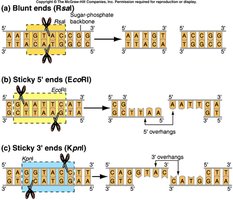
Restriction enzymes are essential tools in recombinant DNA technology, allowing precise cutting of DNA at specific sequences. They generate either blunt or sticky ends, facilitating the creation of recombinant molecules.
Blunt Ends: Produced by enzymes like RsaI; no overhangs.
Sticky Ends: Produced by enzymes like EcoRI and KpnI; overhangs facilitate ligation.
Palindromic Sequences: Recognition sites are often palindromes.
Cloning and Ligation
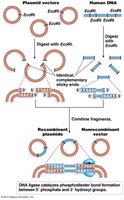
DNA fragments generated by restriction enzymes can be ligated into plasmid vectors, creating recombinant DNA. DNA ligase catalyzes the formation of phosphodiester bonds between fragments.
Complementary Sticky Ends: Facilitate efficient ligation.
Recombinant Plasmids: Used for gene cloning, expression, and analysis.
Delivery and Amplification of Recombinant DNA
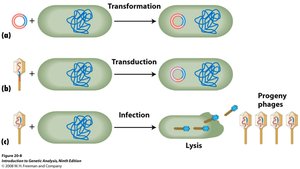
Recombinant DNA can be introduced into bacterial cells by transformation, transduction, or infection. Once inside, the DNA is amplified as the host cells divide.
Transformation: Uptake of plasmid DNA by bacteria.
Transduction: DNA transfer via bacteriophages.
Infection: Introduction of phage DNA, leading to lysis and progeny production.
Selection and Amplification of Recombinant Clones
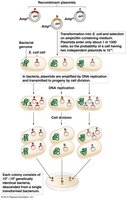
Transformed bacterial cells are selected using antibiotic resistance markers carried by plasmids. Each colony contains many cells with the same recombinant molecule.
Antibiotic Resistance: Allows selection of transformed cells.
Colony Amplification: Each colony originates from a single transformed cell.
Polymerase Chain Reaction (PCR)
PCR Mechanism and Applications
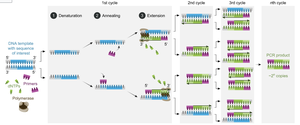
PCR is a powerful technique for amplifying specific DNA sequences from small amounts of template. It involves cycles of denaturation, annealing, and extension.
Denaturation: DNA strands separated at high temperature (95°C).
Annealing: Primers bind to target sequences at lower temperature.
Extension: DNA polymerase synthesizes new strands.
Applications: Cloning, diagnostics, forensic analysis, and research.
Transgenic Organisms and Genetic Engineering
Creation of Transgenic Plants and Animals
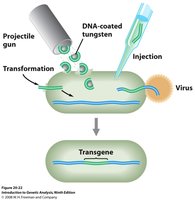
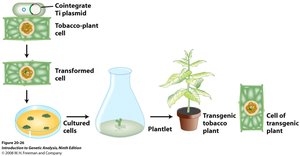
Transgenic organisms are created by introducing recombinant DNA into their genomes. For inheritance, the transgene must integrate into germ cells.
Transgene: Introduced gene from another organism.
Integration: Must occur in germ cells for inheritance.
Regulatory Sequences: Required for expression in host.
Methods of Transgene Introduction
Transgenes can be introduced using transposable elements, homologous recombination, or selectable markers.
Transposable Elements: Carry insert into genome.
Homologous Recombination: Integration at matching genomic sequences.
Selectable Markers: Identify cells carrying the transgene.
Transformation of Plant Genomes by Agrobacterium
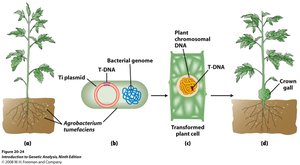
Agrobacterium tumefaciens uses the Ti plasmid to transfer T-DNA into plant genomes, a widely used method for generating transgenic plants.
Ti Plasmid: Contains T-DNA region responsible for integration.
Crown Gall Disease: Caused by T-DNA integration in wild-type strains.
Transgene Integration: T-DNA region modified to carry transgene without causing disease.
Applications and Concerns of Transgenic Plants
Promises and Concerns
Transgenic plants offer benefits such as improved nutrition, resistance to environmental stress, and increased yields. However, concerns include environmental escape of transgenes, dependency on suppliers, and potential health risks.
Benefits: Enhanced nutrition, resistance to pests, drought, and disease.
Concerns: Environmental escape, dependency, and health risks.
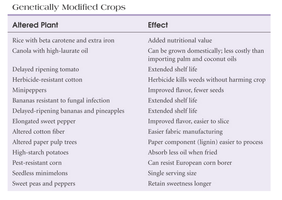
Altered Plant | Effect |
|---|---|
Rice with beta carotene and extra iron | Added nutritional value |
Canola with high-laurate oil | Domestic growth, cost reduction |
Delayed ripening tomato | Extended shelf life |
Herbicide-resistant cotton | Herbicide kills weeds, not crop |
Minisprayers | Improved disease resistance |
Bananas resistant to fungal infection | Extended shelf life |
Elongated sweet pepper | Improved flavor, easier to slice |
Altered cotton fiber | Easier fabric manufacturing |
High-starch potatoes | Absorb less oil when fried |
Seedless watermelons | Single serving size |
Sweet peas and peppers | Retain sweetness longer |
Summary
Forward and reverse genetics, recombinant DNA technology, and the creation of transgenic organisms are central to modern genetics. These tools allow researchers to dissect gene function, engineer organisms for beneficial traits, and address challenges in agriculture and medicine. Ethical and environmental considerations remain important as these technologies advance.
